
Algorithms, Religious Authority, and Digital Da’wah: A Qualitative Study of Social Media in Indonesia
DOI:
https://doi.org/10.58421/misro.v5i1.1322Keywords:
Digital da'wah, Digital literacy, Muslim audiences, Religious authority, Social media algorithmsAbstract
The rapid expansion of social media has reshaped the landscape of Islamic da’wah in Indonesia, with algorithms playing an increasingly important role in the circulation of religious content. This exploratory qualitative study examines how platform algorithms influence the distribution of digital da’wah, how religious authority is renegotiated in online environments, and how Muslim users respond to algorithm-mediated religious messages. The study combines digital ethnography, social media content analysis, and an exploratory questionnaire involving seven active young social media users. The findings show that algorithms significantly shape the visibility of da’wah content and influence everyday encounters with religious messages. The study also identifies an authority paradox: although users continue to value preachers with strong religious education, the content they encounter most frequently is often determined by algorithmic visibility rather than scholarly depth. This situation produces a hybrid form of religious authority in which scholarship, communicative style, and platform performance increasingly intersect. Theoretically, this article contributes to digital religion studies by linking algorithmic mediation with the transformation of religious authority and audience reception. In practice, it highlights the need for credible digital da’wah that integrates scholarly rigor, Islamic communication ethics, and digital literacy in algorithm-driven environments.
Downloads
References
A. A. Malik and M. Masrur, “Qur’anic interpretation of dhikr and the reconfiguration of religious authority in digital media,” Indonesian Journal of Islamic Literature and Muslim Society, vol. 10, no. 2, pp. 167–186, 2025, doi: 10.22515/islimus. v10i2.13194.
Fatimah and F. Pribadi, “The digital da’wah (preachers) and hegemony in digital age: A study of Muslim generations’ political preferences by social media,” Journal of Southern Sociological Studies, vol. 1, no. 2, pp. 206–223, 2025, doi: 10.26740/jsss. v1i2.40520.
M. Basori, “The use of digital media in da’wah: Ethics, theology, and maqashid shariah,” in Proceedings of the International Conference on Da’wa and Communication, vol. 7, no. 1, pp. 53–65, 2025, doi: 10.15642/icondac. v7i1.4272.
Damanhuri, Noffiyanti, and A. E. Putra, “social media, shifting religious authority, and contemporary da’wah in ‘post-secular’ Indonesia,” Kodifikasia: Jurnal Penelitian Islam, vol. 19, no. 1, pp. 149–173, 2025, doi: 10.21154/kodifikasia. v19i1.11142.
F. D. Syakir, “Digital da’wah management strategy through artificial intelligence on social media platforms,” Journal on Islamic Studies, vol. 2, no. 1, pp. 43–55, 2025, doi: 10.35335/ypwvhc08.
M. A. Herman, “The transformation of da’wah on legal hadiths on social media,” Socius: Journal of Social Sciences Research, vol. 3, no. 1, pp. 2021–2026, 2025.
S. E. Zaluchu, “Digital religion, modern society and the construction of digital theology,” Transformation, vol. 41, no. 4, pp. 285–295, 2024, doi: 10.1177/02653788231223929.
R. A. Wibowo and I. Triadi, “Fatwa in the era of digital disruption: A study of religious authority and the influence of social media on the determination of Islamic law,” LexIslamica: A Multidisciplinary Approach to Islamic Law and Its Contemporary Applications, vol. 1, no. 3, pp. 1–16, 2025.
M. S. Amin, “The influence of social media algorithms on Islamic narratives in the digital space,” El-Wasathy: Journal of Islamic Studies, vol. 3, no. 1, pp. 148–158, 2025, doi: 10.61693/elwasathy. vol31.2025.148-158.
S. Sunaryanto, “Ethnographic research methods: Concepts and designs,” El-Hikmah: Journal of Da’wah and Communication, vol. 18, no. 9, pp. 97–121, 2023.
A. Hadiyanto, K. Y. S. Putri, and L. Fazli, “Religious moderation in Instagram: An Islamic interpretation perspective,” Heliyon, vol. 11, no. 4, Art. no. e42816, 2025, doi: 10.1016/j.heliyon. 2025.e42816.
A. I. Jumhadi, A. S. Geun, M. Muhibuddin, F. K. Nisa, and N. A. Hijjiriyah, “Digital media-based da’wah strategy in increasing religious understanding of Generation Z in Indonesia,” Spektra: Jurnal Ilmu-Ilmu Sosial, vol. 6, no. 3, pp. 343–350, 2024, doi: 10.34005/spektra. v6i3.5255.
M. Hasbi, S. Sucitra, and A. Fadillah, “The role of social media in da’wah: Challenges and opportunities in the digital era,” Journal of Innovative and Creativity (Joecy), vol. 4, no. 2, pp. 17–23, 2024, doi: 10.31004/joecy. v4i2.135.
A. Astor, G. Khir-Allah, and R. Martinez-Cuadros, “Anonymity and digital Islamic authority,” Religions, vol. 15, no. 12, pp. 1–12, 2024, doi: 10.3390/rel15121507.
L. Hakim and Z. Mukhlis, “Religious authority in cyberspace: Fragmentation and contestation,” Journal of Communication Sciences, vol. 13, no. 2, 2023.
M. F. Subakti, “Digital literacy: The basic foundation of da’wah in social media,” Journal of Da’wah, vol. 23, no. 1, pp. 1–16, 2022, doi: 10.14421/jd.23.1.22.4.
M. Andok, “The impact of online media on religious authority,” Religions, vol. 15, no. 9, 2024, doi: 10.3390/rel15091103.
A. Fikri, A. Abdullah, and S. Sunarwoto, “Religious authority in social media: The influence of Ali Jum’ah’s online fatwa and Yusuf al-Qaradawi,” Al-Tahrir: Jurnal Pemikiran Islam, vol. 24, no. 1, pp. 147–162, 2024, doi: 10.21154/altahrir. v24i1.9773.
M. Achmad, R. Jannah, and Azizah, “social media as a new strategy in Islamic da’wah: An analytical study on the ‘Belajariah’ platform,” Dakwatuna: Journal of Islamic Da’wah and Communication, vol. 9, no. 1, pp. 1–15, 2023, doi: 10.54471/dakwatuna. v9i1.2109.
D. A. Rizal, R. Maula, and N. Idamatussilmi, “Social media transformation in religious digitalization; da’wah media and religious tourism,” Mukaddimah: Journal of Islamic Studies, vol. 9, no. 2, pp. 206–230, 2024, doi: 10.14421/mjsi. v9i2.3909.
G. Larsson and E. Willander, “Muslims and social media: A scoping review,” Information, Communication & Society, vol. 28, no. 11, pp. 1908–1922, 2025, doi: 10.1080/1369118X.2024.2379835.
M. ’Ulyan, “Digital da’wah and religious authority: A narrative review of Islamic preaching in the social media era,” Sinergi International Journal of Islamic Studies, vol. 1, no. 3, pp. 100–113, 2023, doi: 10.61194/ijis. v1i3.591.
N. Naamy, “Da’wah on new media and religious authorities in Indonesia,” Jurnal Ilmu Dakwah, vol. 43, no. 1, pp. 268–280, 2023, doi: 10.21580/jid. v43.1.18307.
T. Sukayat, “Da’wah communication in the contemporary era: Implementing da’wah ethics on social media,” Jurnal Ilmu Dakwah, vol. 43, no. 2, pp. 375–390, 2023, doi: 10.21580/jid. v43.2.18465.
A. Rachman, T. Saumantri, and T. Hidayatulloh, “Transformation of religious authority in the digital era: A post-normal times analysis by Ziauddin Sardar on the phenomenon of social media da’wah,” Jurnal Ilmu Dakwah, vol. 45, no. 1, 2025, doi: 10.21580/jid. v45.1.25644.
Downloads
Additional Files
Published
How to Cite
Issue
Section
License
Copyright (c) 2026 Journal of Mathematics Instruction, Social Research and Opinion

This work is licensed under a Creative Commons Attribution-ShareAlike 4.0 International License.
SideBar
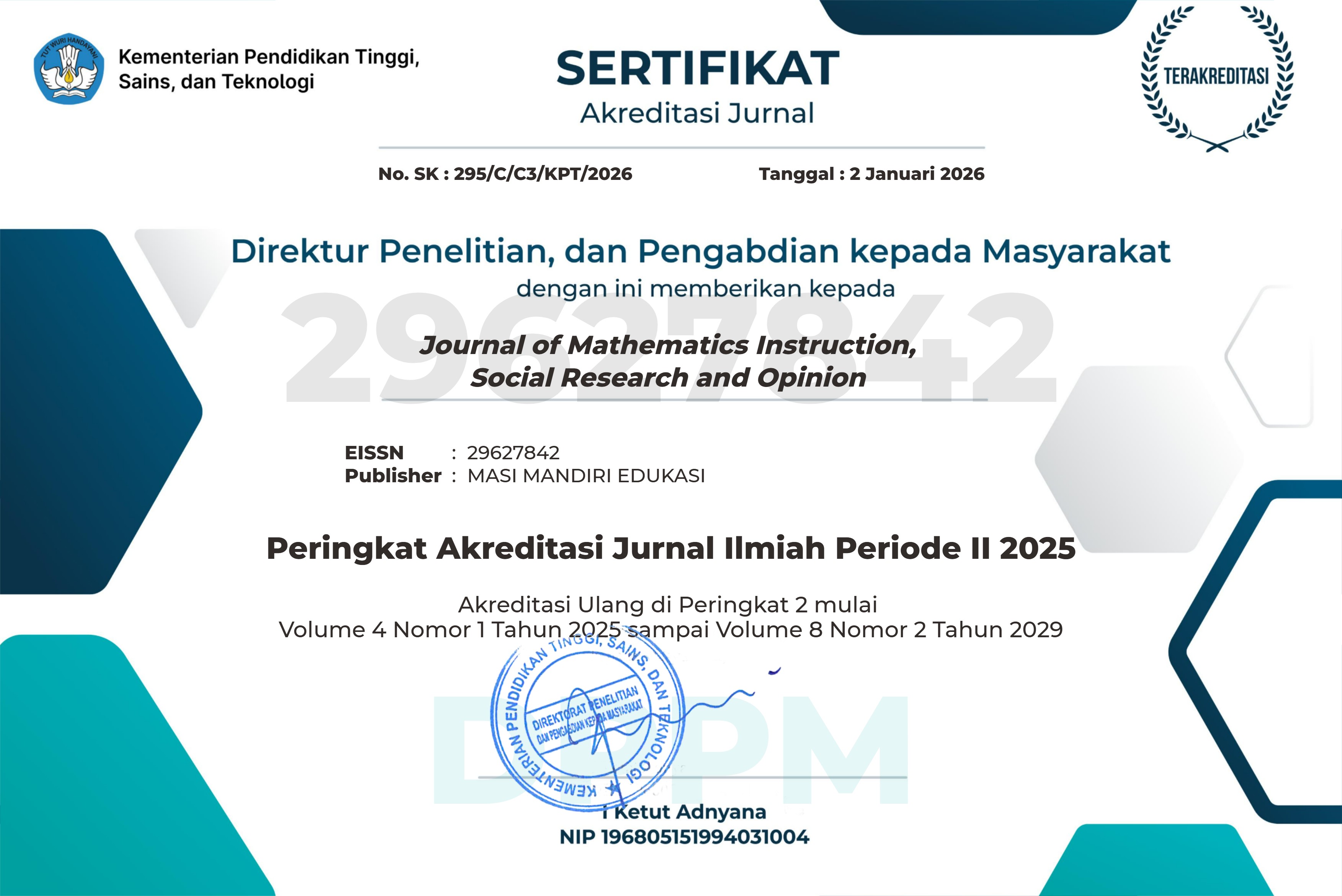
| Accreditation Certificate |
  |
| Indexing |






Contact Us

visitor
| Information |
>> For Authors
>> For Readers
>> For Librarians
| Visitor Statistics |
| Member of |


| Announcement |

| Keywords |
Mathematics Learning Difficulty Dyscalculia Teacher perceptions personality ICT Learning Computer teaching Academic Fisherfolks Economic Behavior Probit Models matrix mathematical model Concepts Guided Note Taking Golden Ratio Philosophy Integrated Learning van Hiele geometry Assessment Learning Outcomes method skills Problem Solving Experiment
| License |

MISRO is licensed under a Creative Commons Attribution-ShareAlike 4.0 International License.
| Publisher |

Address:
Jl. Gagak N0.105, Bandung,
Indonesia 40133
E-mail:
journalmisro@gmail.com
| in collaboration with |
| Recommended Tools |


| ISSN Barcode |

