
Transforming Post-Divorce Alimony in Indonesian Religious Courts: A Maqashid al-Sharia Analysis
DOI:
https://doi.org/10.58421/misro.v5i1.1320Keywords:
Gender justice, Maqashid al-sharia, Post-divorce alimony, Religious courts, Women's financial rightsAbstract
Post-divorce alimony remains a significant issue in Indonesian religious courts because formal legal recognition does not always ensure substantive protection for divorced women. This article examines how post-divorce alimony is determined in Indonesian religious courts and evaluates whether recent judicial reasoning remains consistent with maqashid al-sharia. The study focuses on Decision No. 291/Pdt.G/2021/MS.Str and compares it with two other religious court decisions. Using a normative juridical method, it combines statutory, case, and conceptual approaches. The analysis applies maqashid al-sharia, particularly hifzh al-nafs, hifzh al-mal, and hifzh al-nasl, as the main evaluative framework. The findings show that the principal decision relied heavily on mediation outcomes and awarded iddah maintenance of IDR 3,000,000 without an independent proportionality assessment. It also failed to explicitly award mut’ah despite a 39-year marriage and the existence of ten children. These findings indicate a shift from a normative-textual approach toward a pragmatic-mediative model. The article contributes theoretically by demonstrating the application of maqashid al-sharia in evaluating judicial reasoning. It highlights the policy need for stronger gender-sensitive adjudication, closer scrutiny of mediated settlements, and adaptive guidelines for post-divorce alimony in Indonesian religious courts.
Downloads
References
Republic of Indonesia, Law No. 16 of 2019 concerning Amendments to Law No. 1 of 1974 on Marriage, 2019.
Republic of Indonesia, Presidential Instruction No. 1 of 1991 concerning the Dissemination of the Compilation of Islamic Law, 1991.
Wiranto, "Nafkah in the Perspective of Qawa'id Fiqhiyyah," vol. 2, no. 1, pp. 35-52, 2025.
A. A. Falah, "Child Custody After Divorce Due to Apostasy Mothers from the Perspective of Maqāṣid Ash-Syarī'ah (Study of the Decision of the Tolitoli Religious Court Number 97/Pdt.G/2022/PA.Tli)," 2024.
M. Akram, M. Idris, and F. A. Pratama, "The Impact of Out-of-Court Divorce on Children from the Perspective of Hifz al-Nasl (A Study in Kendari City)," vol. 2, no. 2, pp. 121-137, 2022.
N. Hakim, "Mediation Institutions as a Means of Fulfilling Women's Rights After Divorce in Divorce Cases in the Perspective of Maslahah Izzuddin Bin Abd Assalam," 2024.
A. Fauzan, "A Holistic Approach in Post-Divorce Child Custody: A Perspective of Maqāṣid Syarī'ah Al-Tahir Ibn Ashur," pp. 111-126, 2024.
D. Nissa, K. Putri, and A. Izzuddin, "Considerations of the Judges of the Singaraja Religious Court in Determining 'Iddah Maintenance and Mut'ah and Their Execution in Verstek Divorce Decisions," vol. 6, no. 4, 2022.
Republic of Indonesia, Law No. 50 of 2009 concerning the Second Amendment to Law No. 7 of 1989 on Religious Courts, 2009.
H. Harianti et al., "Judges' Sensitivity to the Protection of Wife's Rights in Contested Divorce Cases," vol. 4, no. 1, pp. 47-67, 2021.
A. Romadhona, "The Phenomenon of Post-Divorce Alimony with Symbolic Nominality: A Case Analysis of Rp100 in Tasya Farasya's Divorce," vol. 3, pp. 1298-1303, 2025.
Supreme Court of the Republic of Indonesia, Regulation No. 3 of 2017 concerning Guidelines for Adjudicating Women's Cases Facing the Law, 2017.
Z. Zakyyah and M. Ridwansyah, "The Disparity of Iddah Maintenance Norms in the Compilation of Islamic Law: A Mashlahah Mursalah Perspective for Post-Divorce Legal Certainty," Jurnal Mediasas: Media Ilmu Syari'ah dan Ahwal Al-Syakhsiyyah, vol. 7, no. 2, pp. 718-737, 2024, doi: 10.58824/mediasas.v7i2.231.
A. Sugitanata, "Transformation of the Concept of Hadhanah in Indonesia: An Analysis of the Benefits in the Supreme Court Circular Letter Number 1 of 2017," 2023.
Decision No. 1812/Pdt.G/2018/PA.Kab.Mlg, Religious Court of Malang Regency, 2018.
I. Rahmani and R. Alwi, "Maqasid Sharia as the Basis for Reform of Divorce and Child Custody Laws in the Modern Context," vol. 1, no. 2, pp. 102-111, 2025.
L. Shofa, "Maqasid Syariah in the Judge's Decision on the Divorce Case at the Amuntai Religious Court," pp. 127-137, 2025.
Decision No. 1439/Pdt.G/2019/PA.Ckr, Religious Court of Cikarang, 2019.
N. Rosita, "Divorce Trends Due to Wives' Financial Independence: An Analysis of Sharia Maqasid and Gender Justice Theory," vol. 15, no. 1, pp. 118-128, 2026.
F. Arrasyid, Pagar, and D. Tanjung, "Islamic Family Law Reform in Indonesia Through Supreme Court Circulars: A Maqasid Sharia Perspective," Ulul Albab: Jurnal Studi dan Penelitian Hukum Islam, vol. 6, no. 2, pp. 208-225, 2023, doi: 10.30659/jua.v6i2.29236.
S. Mulyati, "Reconstruction of Idah and Mut'ah Maintenance: A Study of Sharia Economics on Religious Court Decisions and Widow Welfare," vol. 1, no. 1, pp. 54-68, 2025.
A. Fidaus, "The Controversy Between the MUI Fatwa and the Marriage Law in Indonesia on Out-of-Court Talak Reviewed from Maqhasid Sharia," vol. 11, pp. 230-243, 2024.
S. Ibnu, "The Transformation of the Compilation of Islamic Law into Law: A Philosophical, Theoretical, and Dogmatic Study," vol. 14, no. 3, pp. 421-435, 2025.
A. R. Pratama, "Maqashid Al-Sharia's Analysis of the High Divorce Rate in Indonesia," vol. 3, no. 3, pp. 317-330, 2025.
N. A. Wahda, M. Sabir, and M. F. Anas, "The Fulfillment of Post-Divorce Rights for Former Wives and Children in Bantaeng Regency: A Maqāṣid al-Sharī'ah Analysis," Parewa Saraq: Journal of Islamic Law and Fatwa Review, vol. 4, no. 1, pp. 47-55, 2025, doi: 10.64016/parewasaraq.v4i1.25.
"The Dynamics of the Talak Divorce Decision at the Banyuwangi Religious Court (A Critical Study of the Judge's Consideration)," vol. 6, pp. 11-29, 2025.
A. Suhaili, "The Integration of Maqāṣid Al-Syarī'ah in the Practice of Religious Justice in Indonesia: An Alternative Study of Family Dispute Resolution," vol. 6, 2025.
N. U. Usthyawati, M. Muhaimin, and B. B. Satriya, "Fulfillment of Wife's Rights after Divorce in the Perspective of Legal Justice Theory and Maqashid Shari'ah Cum-Mubadalah," Sakina: Journal of Family Studies, vol. 9, no. 3, pp. 293-305, 2025, doi: 10.18860/jfs.v9i3.15981.
S. Daulay et al., "The Transformation of Islamic Family Law Through Religious Court Decisions," vol. 2, no. 1, pp. 577-586, 2025.
N. Fadhilah et al., "Regulating Arbitrary Divorce in Islamic Family Law: A Maqāṣid al-Sharī'ah-Based Comparative Analysis of Muslim-Majority Legal Systems," vol. 15, no. 2, 2025.
Decision No. 291/Pdt.G/2021/MS.Str, Syar'iyah Court of Simpang Tiga Redelong, 2021.
Downloads
Additional Files
Published
How to Cite
Issue
Section
License
Copyright (c) 2026 Journal of Mathematics Instruction, Social Research and Opinion

This work is licensed under a Creative Commons Attribution-ShareAlike 4.0 International License.
SideBar
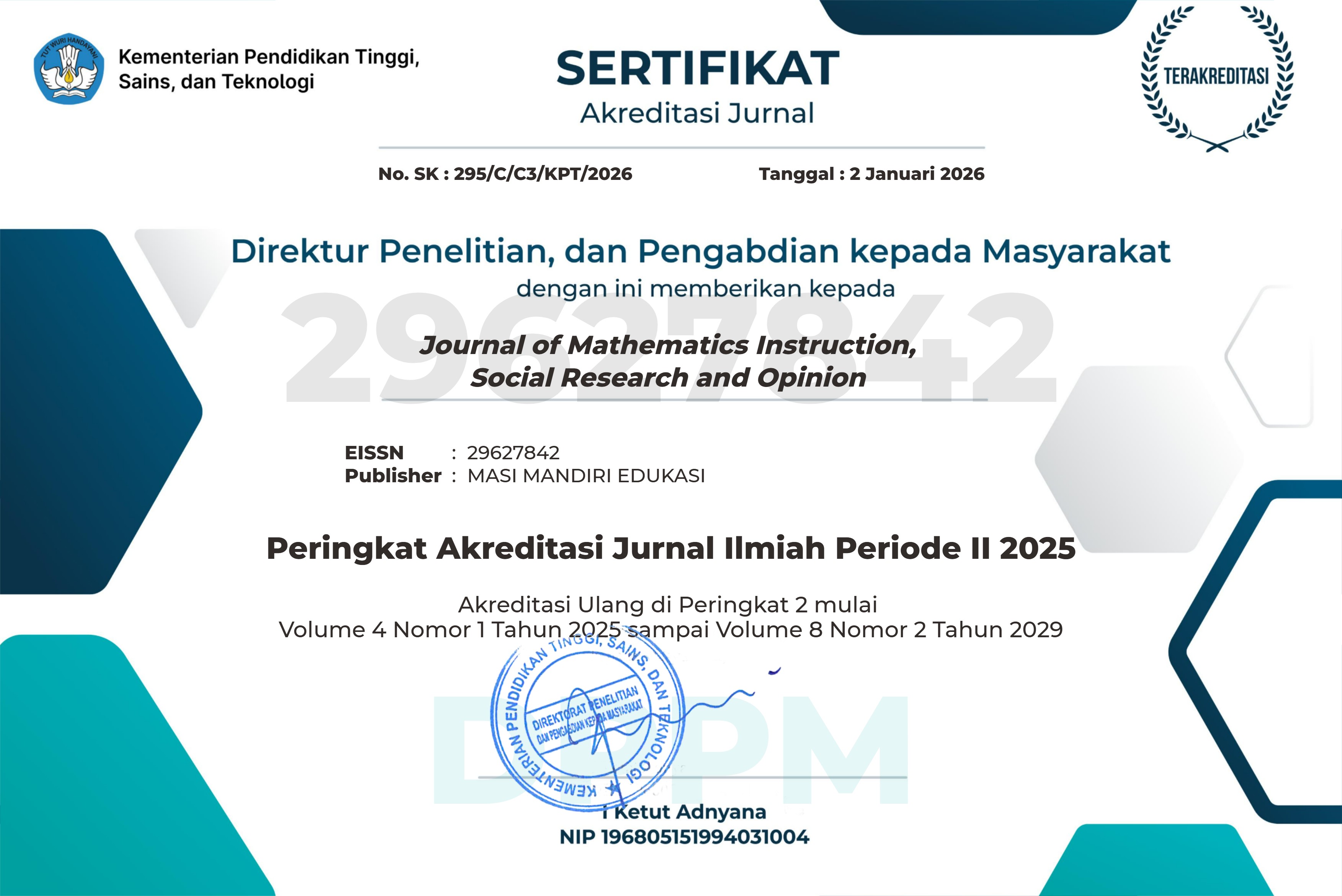
| Accreditation Certificate |
  |
| Indexing |






Contact Us

visitor
| Information |
>> For Authors
>> For Readers
>> For Librarians
| Visitor Statistics |
| Member of |


| Announcement |

| Keywords |
Mathematics Learning Difficulty Dyscalculia Teacher perceptions personality ICT Learning Computer teaching Academic Fisherfolks Economic Behavior Probit Models matrix mathematical model Concepts Guided Note Taking Golden Ratio Philosophy Integrated Learning van Hiele geometry Assessment Learning Outcomes method skills Problem Solving Experiment
| License |

MISRO is licensed under a Creative Commons Attribution-ShareAlike 4.0 International License.
| Publisher |

Address:
Jl. Gagak N0.105, Bandung,
Indonesia 40133
E-mail:
journalmisro@gmail.com
| in collaboration with |

| Recommended Tools |


| ISSN Barcode |

