
Strengthening Ecotheological Education in Enhancing Environmental Piety (Research at SMP Daarut Tauhiid Boarding School)
DOI:
https://doi.org/10.58421/misro.v5i1.1313Keywords:
Educational Strengthening, Ecotheology, Environmental PietyAbstract
Ecotheological education is designed to foster environmental piety by integrating religious values with ecological responsibility. However, its implementation in practice has not been fully effective, indicating the need for more targeted educational strategies and optimal supervision to achieve comprehensive environmental piety. This study aims to describe and analyse the strengthening of ecotheological education in improving environmental piety at SMP Daarut Tauhiid Boarding School. This research employs a descriptive qualitative approach, focusing on the process of strengthening ecotheological education. Data were collected through observation, in-depth interviews, and documentation studies involving the school principal, teachers, and students. The findings reveal that strengthening ecotheological education enhances students’ environmental awareness and positive attitudes, as well as their ability to identify and provide appropriate solutions to environmental problems. This study highlights the importance of strengthening ecotheological education as an effective strategy for fostering environmental piety and offers a model for implementing it that can be sustainably applied within the school environment.
Downloads
References
Team & Hourcade, Synthesis Report of The Ipcc Sixth Assessment Report (AR6). Switzerland., 2023.
Naomi Klein, This Changes Everything: Capitalism vs. the Climate. New York : Mc Graw – Hill., 2014.
WHO., Air Pollution Data Portal.” Diakses 10 Juni 2025. https://www.who.int/data/gho/data/themes/air-pollution. 2024.
Latour, Facing Gaia: Eight Lectures on the New Climatic Regime. John Wiley & Sons., 2017.
Bauman, Consuming Life. Polity Press., 2007.
GESAMP., WG 40: Plastics and micro-plastics in the ocean http://www.gesamp.org/work/groups/40. 2019.
Nash, Loving Nature: Ecological Integrity and Christian Responsibility. Nashville: Abingdon Press., 1991.
Rasmussen, Earth Community, Earth Ethics. Maryknoll, N.Y: Orbis Books., 1996.
Hessel & Ruether, Christianity and Ecology: Seeking the Well-Being of Earth and Humans (Religions of the World and Ecology). CSWR., 2000.
McFague, A New Climate for Theology: God, the World, and Global Warming. Fortress Press., 2008.
David, Ecological literacy : education and the transition to a postmodern world. Albany: State University of New York Press., 1992.
Aritonang, Teologi-Teologi Kontemporer. Jakarta: BPK Gunung Mulia., 2018.
Sendana, “Lingkungan Sebagai ‘Sang Liyan’: Upaya Pelestarian Lingkungan Ditinjau Dari Konsep ‘Sang Liyan’ Dari Gagasan Pemikiran Emmanuel Levinas.,” SOPHIA J. Teol. Dan Pendidik. Kristen, vol. 2, no. 2, pp. 62-79., 2021, doi: https://doi.org/10.34307/sophia.v2i2.52.
Firdawati, Islam dan Teologi Pembebasan. Yogyakarta: Pustaka Pelajar., 2004.
A. K. Fata, “Teologi Lingkungan Hidup Dalam Islam,” J. Ulul Albab, vol. 15, no. 2, 2014.
Abdillah, Agama Ramah Lingkungan Perspektif Al-Qur’an. Jakarta: Paramadina., 2001.
Abdullah, Islam sebagai Ilmu: Epistemologi, Metodologi, dan Etika. Yogyakarta: Pustaka Pelajar., 2006.
O. Arifudin, “The Role of Strategic Management in Improving the Competence of Islamic Religious Education Teachers,” JIRAN J. Southeast Asia Stud., vol. 7, no. 2, pp. 23–35, 2026.
E. Erfiyana, “Learning Management in order to Improve the Quality of Madrasah Aliyah Graduates,” J. Gen. Educ. Humanit., vol. 5, no. 1, pp. 1981–1992, 2026.
U. Supriatna, “Technology-Based Learning Management In Improving Learning Outcomes In Junior High Schools,” Int. J. Sci. Educ. Technol. Manag., vol. 4, no. 2, 2025.
U. Supriatna, “The Role Of Teachers In Improving The Quality Of Learning In Madrasah Tsanawiyah,” Int. J. Sci. Educ. Technol. Manag., vol. 5, no. 1, pp. 45–56, 2026.
S. Nurazizah, “The Role Of Teachers In Instilling Disciplined Character In Early Childhood 5-6 Years Old At Darussalam Early Childhood Education Center,” Int. J. Sci. Educ. Technol. Manag., vol. 5, no. 1, pp. 1–13, 2026.
E. Erfiyana, “Islamic School Financial Management: A Case Study of Islamic Junior High Schools in Rural Areas,” Int. J. Sci. Educ. Technol. Manag., vol. 4, no. 2, pp. 33–44, 2025.
A. Mayasari, “Optimizing Student Management to Improve Educational Service Quality: A Qualitative Case Study in Integrated Islamic Elementary Schools,” EDUKASIA J. Pendidik. dan Pembelajaran, vol. 5, no. 2, pp. 799–808, 2024.
O. Arifudin, “Why digital learning is the key to the future of education,” Int. J. Educ. Digit. Learn., vol. 3, no. 4, pp. 201–210, 2025.
O. Arifudin, “Research Trends Education Management In Indonesia,” J. Educ. Glob., vol. 1, no. 2, pp. 165–173, 2024.
J. Sudrajat, “Enhancing the Quality of Learning through an E-Learning-Based Academic Management Information System at Madrasah Aliyah Negeri,” EDUKASIA J. Pendidik. dan Pembelajaran, vol. 5, no. 2, pp. 621–632, 2024, doi: https://doi.org/10.62775/edukasia.v5i2.1724.
I. Zaelani, “The Role And Implementation Of Zakat In The Development Of The Real Sector,” Int. J. Sci. Educ. Technol. Manag., vol. 4, no. 1, pp. 15–22, 2025.
A. Abduloh, “Effect of Organizational Commitment toward Economical, Environment, Social Performance and Sustainability Performance of Indonesian Private Universities,” PalArch’s J. Archaeol. Egypt/Egyptology, vol. 17, no. 7, pp. 6951–6973, 2020.
I. Iskandar, “Improving Village Entrepreneurship Through The Role Of The Mudharabah Agreement,” Int. J. Sci. Educ. Technol. Manag., vol. 4, no. 1, pp. 23–39, 2025.
A. Delvina, “Governance and legal perspectives: Problems in the management of Zakat funds are used as collateral,” J. Adv. Res. Dyn. Control Syst., vol. 12, no. 6, pp. 209–217, 2020, doi: 10.5373/JARDCS/V12I6/S20201023.
L. Judijanto, “Ethics And Security In Artificial Intelligence And Machine Learning: Current Perspectives In Computing,” Int. J. Soc. Rev., vol. 3, no. 2, pp. 374–380, 2025.
N. Nasril, “Evolution And Contribution Of Artificial Intelligencess In Indonesian Education,” J. Int. Multidiscip. Res., vol. 3, no. 3, pp. 19–26, 2025.
Huang et al, “Motivations of Parental Involvement in Children’s Learning: Voices From Urban African American Families of Preschoolers.,” Multicultu, vol. 1, no. 1, pp. 20–27., 2008.
I. R. Paturochman, “Pluralism And Multiculturalizm Education.,” Int. J. Soc. Rev., vol. 2, no. 3, pp. 564–573, 2024.
Deslandes et al, “Understanding complex relationships between teachers and parents.,” Int. J. about Parents Educ., vol. 9, no. 1, pp. 131–144., 2015.
A. Noviana, “Effect of accountability, transparency of management amil zakat institutions and poverty alleviation of Muzakki trust,” J. Adv. Res. Dyn. Control Syst., vol. 12, no. 6, pp. 199–208, 2020, doi: 10.5373/JARDCS/V12I6/S20201022.
O. Arifudin, “Teacher Personality Competence In Building The Character Of Students,” Int. J. Educ. Digit. Learn., vol. 1, no. 1, pp. 5–12, 2022, doi: https://doi.org/10.47353/ijedl.v1i1.3.
R. B. Rohimah, “Madrasah’s Contribution To The Empowerment Of The Village Community In Indonesia.,” Int. J. Teach. Learn., vol. 2, no. 4, pp. 1088–1101, 2024.
A. Mayasari, “Technology-Based Learning Innovation To Improve The Quality Of Education In The Digital Era,” Int. J. Soc. Sci. Educ. Econ. Agric. Res. Technol., vol. 5, no. 3, pp. 1646–1654, 2026.
M. Safar, “The Effectiveness of Multimodal Gamified Learning Platforms in Enhancing Student Engagement and Computational Thinking Skills in K-12 Classrooms: A Randomized Controlled Trial,” Int. J. Educ. Res. Excell., vol. 5, no. 1, pp. 972–981., 2026, doi: https://doi.org/10.55299/ijere.v5i1.1811.
Halim et al, “Ecotheology in Promoting Environmental Sustainability: Conserving the Eco-Friendly Islamic Doctrine in Jambi Province.,” J. Ilm. Ilmu Ushuluddin, vol. 22, no. 1, pp. 171–178., 2023, doi: https://doi.org/10.18592/jiiu.v22i2.10069.
Altmeyer, “Religious education for ecological sustainability: an initial reality check using the example of everyday decision-making.,” J. Relig. Educ., vol. 69, no. 1, pp. 57–74., 2021, doi: https://doi.org/10.1007/s40839-020-00131-5.
Anwar & Rosyad., “Praktik Teologi Lingkungan di Pesantren,” J. Pendidik. dan Sos. Keagamaan, vol. 9, no. 1, pp. 70–85., 2021.
Downloads
Additional Files
Published
How to Cite
Issue
Section
License
Copyright (c) 2026 Journal of Mathematics Instruction, Social Research and Opinion

This work is licensed under a Creative Commons Attribution-ShareAlike 4.0 International License.
SideBar
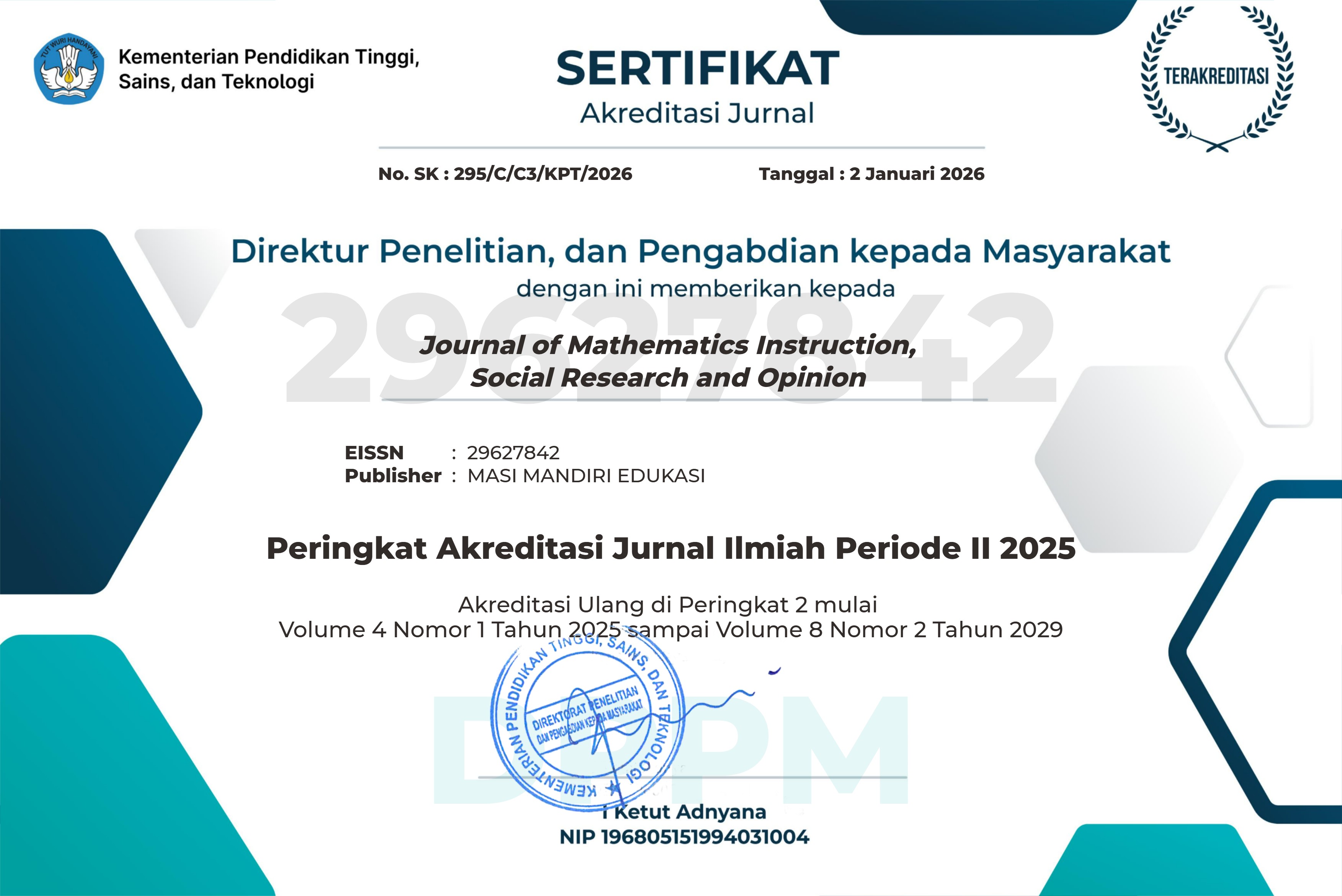
| Accreditation Certificate |
  |
| Indexing |






Contact Us

visitor
| Information |
>> For Authors
>> For Readers
>> For Librarians
| Visitor Statistics |
| Member of |


| Announcement |

| Keywords |
Mathematics Learning Difficulty Dyscalculia Teacher perceptions personality ICT Learning Computer teaching Academic Fisherfolks Economic Behavior Probit Models matrix mathematical model Concepts Guided Note Taking Golden Ratio Philosophy Integrated Learning van Hiele geometry Assessment Learning Outcomes method skills Problem Solving Experiment
| License |

MISRO is licensed under a Creative Commons Attribution-ShareAlike 4.0 International License.
| Publisher |

Address:
Jl. Gagak N0.105, Bandung,
Indonesia 40133
E-mail:
journalmisro@gmail.com
| in collaboration with |

| Recommended Tools |


| ISSN Barcode |

