
The impact of district administration leadership characteristics on community resilience: Evidence from Kampong Thom provincial administration in Cambodia
DOI:
https://doi.org/10.58421/misro.v5i1.1303Keywords:
Cambodia, Community resilience , District administration, Leadership characteristics , Leadership styles , Provincial administrationAbstract
Even though community resilience (CORE) has been studied extensively, scholars have offered different definitions of CORE. The majority of current measures and tools are unable to view CORE in its entirety. The relationship between district administration (DIA) and CORE has not been thoroughly examined in empirical research on CORE assessment methods. Understanding the relationship between several DIA features, including leadership tenure, staff retention, leadership competencies, leadership styles, and CORE measurement, is crucial given DIA’s impact on CORE indicators. This study explored the relationship between district administration leadership (DIAL) attributes and CORE levels. The survey was completed by 111 samples. District governors, deputy district governors, and head and deputy heads of office were included in the survey sample. SPSS was used to analyze the collected data using both descriptive and inferential statistics. Distributed leadership was positively correlated with CORE levels but negatively correlated with knowledge scores on the CARL. There was no statistically significant relationship between CORE levels and leadership tenure or declared disaster experience, although there was a weak-to-moderate negative association between CARL self-awareness ratings and CORE levels. When interpreting a holistic CORE assessment, DIAL and staff characteristics should be considered as custodians of community resources and resilience. Research on this subject should pay more attention to the relationship between distributed leadership and CORE.
Downloads
References
G. Barzilai, “Communities and law: Politics and cultures of legal identities.” University of Michigan Press.
Y. Fan, and X. Lyu, “Exploring two decades of research in community resilience: A content analysis across the international literature.” Psychology Research and Behavior Management, 14, 1643– 1654.2021. https://doi.org/10.2147/PRBM.S329829
C. Barbera, M. Jones, S. Korac, I. Saliterer, I. and Steccolini, “Local government strategies in the face of shocks and crises: The role of anticipatory capacities and financial vulnerability.” International Review of Administrative Sciences, 87(1), 154–170, 2021.
A. Boin, L. Comfort, and C. Demchack, “The rise of resilience.” In L. Comfort, A. Boin, & C. Demchack (Eds.), Designing resilience (pp. 1–13). Pittsburg University Press, 2010.
M. Linnenleucke, “Resilience in business and management research: A review of influential publications and a research agenda.” International Journal of Management Reviews, 19(1), 4–30, 2017.
S. Somers, “Measuring resilience potential: An adaptive strategy for organizational crisis planning.” Journal of Contingencies and Crisis Management, 17(1), 12–23, 2009.
W. Boh, P. Constantinides, B. Padmanabhan, and S. Viswanathan, “Building digital resilience against major shocks.” MIS Quarterly, 47(1), 343–359, 2023.
S. Larkin, C. Fox-Lent, D. Eisenberg, B. Trump, S. Wallace, C. Chadderton, and I. Linkov, “Benchmarking agency and organizational practices in resilience decision making.” Environment Systems and Decision, 35, 185–195, 2015. https://doi.org/10.1007/s10669-015- 9554-5
K. Lindberg and T. Swearingen, “A reflective thrive-oriented community resilience scale.” American Journal of Community Psychology, 65(3–4), 467–478, 2020. http://dx.doi.org/10.1002/ajcp.12416
B. MacArthur, C. Dorobantu, and H. Margetts, “Resilient government requires data science reform.” Nature Human Behavior, 6, 1035–1037, 2022.
O. Agbakoba and H. Ogbonna, “Local Government Administration and Development in Nigeria: A Capacity Building Manual.” Lagos, Nigeria: Hurilaws, 2004.
M. Parsons, S. Glavac, P. Hastings, G. Marshall, J. McGregor, J. McNeill, P. Morley, I. Reeve, and R. Stayner, “Top-down assessment of disaster resilience: A conceptual framework using coping and adaptive capacities.” International Journal of Disaster Risk Reduction, 19, 1–11, 2016. http://dx.doi.org/10.1016/j.ijdrr.2016.07.005
P. Pasca, E. De Simone, E. Ciavolino, A. Rochira, and T. Mannarini, “A higher-order model of community resilience potential: Development and assessment through confirmatory composite analysis based on partial least squares.” Quality & Quantity: International Journal of Methodology, 57(2), 1033–1054, 2023. https://doi.org/10.1007/s11135- 022-01400-1
M. Schoch-Spana, K. Gill, D. Hosangadi, C. Slemp, R. Burhans, J. Zeis, E. Carbone, and J. Links, “Top-down and bottom-up measurement to enhance community resilience to disasters.” American Journal of Public Health, 109(S4), S265–S267, 2019. https://doi.org/10.2105/AJPH.2019.305151
S. Tan, “Measuring community resilience: A critical analysis of a policy-oriented indicator tool.” Environmental and Sustainability Indicators, 12, 1–16, 2021.
https://doi.org/10.1016/j.indic.2021.100142
J. Loerzel and M. Dillard, “An analysis of an inventory of community resilience frameworks.” Journal of Research of the National Institute of Standards and Technology, 126, 1–13, 2021.
https://doi.org/10.6028/jres.126.031
W. Adger, “Social and ecological resilience: Are they related?” Progress in Human Geography, 24(3), 347–364, 2000. https://doi.org/10.1191/030913200701540465
A. Bec, C. Moyle, and B. Moyle, “Community resilience to change: Development of an index.” Social Indicators Research, 142, 1103–1128, 2019. https://doi.org/10.1007/s11205-018- 1960-x
C. Holling and L. Gunderson, “Resilience and adaptive cycles.” In L. H. Gunderson & C. S. Holling (Eds.), Panarchy: Understanding transformations in human natural systems (pp. 25–62). Island Press, 2002.
A. Masten, “Ordinary magic: Resilience processes in development.” American Psychologist, 56(3), 227– 238, 2001.
M. Bravo, M. Rubio-Stipec, G. Canino, M. Woodbury, and J. Ribera, “The psychological sequelae of disaster stress prospectively and retrospectively evaluated.” American Journal of Community Psychology, 18(5), 661–680, 1990. https://doi.org/10.1007/BF00931236
J. M. Kendra, and T. Wachtendorf, “Elements of resilience after the World Trade Center disaster: Reconstituting New York City’s Emergency Operations Centre.” Disasters, 27(1), 97–103, 2003. https://doi.org/10.1111/1467-7717.00218
D. Paton, M. Millar, and D. Johnston, “Community resilience to volcanic hazard consequences.” Natural Hazards, 24, 157–169, 2001. https://doi.org/10.1023/A:1011882106373
S. McManus, “Organizational resilience in New Zealand.” [Doctoral dissertation, University of Canterbury], 2008. http://dx.doi.org/10.26021/1351
S. Park, M. Graham, and E. Foster, “Improving local government resilience: Highlighting 98 the role of internal resources in crisis management.” Sustainability, 14, 1–13, 2022. https://doi.org/10.3390/su14063214
V. Cvetković, J. Tanasić, A. Ocal, Z. Kešetović, N. Nikolić, and A. Dragašević, “Capacity development of local self-governments for disaster risk management.” International Journal of Environmental Research and Public Health, 18(19), 1–33, 2021. https://doi.org/10.3390/ijerph181910406
United Nations International Strategy for Disaster Reduction, “Hyogo framework for action 2005– 2015.” UNISDR, 2005.
G. Bonanno, S. Romero, and S. Klein, “The temporal elements of psychological resilience: An integrative framework for the study of individuals, families, and communities.” Psychological Inquiry, 26(2), 139–169, 2015. https://doi.org/10.1080/1047840X.2015.992677
R. Davis, D. Cook, and L. Cohen, “A community resilience approach to reducing ethnic and racial disparities in health.” American Journal of Public Health, 95(12), 2168–2173, 2005. https://doi.org/10.2105/AJPH.2004.050146
J. Mochizuki, A. Keating, W. Liu, S. Hochrainer-Stigler, and R. Mechler, “An overdue alignment of risk and resilience: A conceptual contribution to community resilience.” Disasters, 42(2), 361–391, 2018. https://doi.org/10.1111/disa.12239
C. Bene, R. Wood, A. Newsham, and M. Davies, “Resilience: New utopia or new tyranny?” (IDS Working Paper 405). Institute of Development Studies, 2012. https://hdl.handle.net/20.500.12413/2291
M. Pelling, “Adaptation to climate change: From resilience to transformation.” Routledge, 2010.
J. Twiggs, “Characteristics of a disaster-resilient community: A guidance note (Version 2).” DFID Disaster Risk Reduction NGO Interagency Group, 2009. https://discovery.ucl.ac.uk/id/eprint/1346086/
Royal Government of Cambodia (RGC), “Pentagonal strategy-phase I for growth, employment, equity and efficiency: Building the foundation toward realizing the Cambodia vision 2050.” [Online], 2023. Available: http://cdc-crdb.gov.kh/en/strategy/documents/Pentagonal-Strategy-Phase-I__English__24.08.2023.pdf (accessed: January 30, 2026).
Cambodia Development Resource Institute (CDRI), “Cambodia: Enhancing governance for sustainable development.” (Working Paper 14, 2000).
Human Rights Watch, “They killed us from the inside: An investigation into the August 4 Beirut blast.” https://www.hrw.org/report/2021/08/03/they-killed-us- inside/investigation-august-4-beirut-blast, (2021, August 3).
K. Chhum, “The influences of good governance on trust in government: Case of Cambodia.” Public Policy and Administration Research, vol. 10, no. 11, 2020.
R. Pin, “Good governance key to a developed Cambodia.” [Online], 2004. Available: https://cambodianess.com/article/good-governance-key-to-a-developed-cambodia (accessed: January 30, 2026).
J. Bryson, B. Crosby, and L. Bloomberg, “Public value governance: Moving beyond traditional public administration and the new public management.” Public Administration Review, 74(4), 445–456, 2014.
J. Denhardt, and R. Denhardt, “The new public service: Serving, not steering (4th ed.).” Routledge, 2015.
K. Liou, “Public administration challenges in disaster responses: Issues.” Public Administration Quarterly, 46(4), 296–308, 2022. https://doi.org/10.37808/paq.46.4.1
B. Peters, and J. Pierre, Governance without government? Rethinking public administration.” Journal of Public Administration Research and Theory, 8(2), 223–243, 1998.
C. Ansell, A. Boin, and A. Keller, “Managing transboundary crises: Identifying the building blocks of an effective response system.” Journal of Contingencies and Crisis Management, 18(4), 195–207, 2010.
O. Bodin, and D. Nohrstedt, “Formation and performance of collaborative disaster management networks: Evidence from a Swedish wildfire response.” Global Environmental Change, 41, 183– 194, 2016.
F. Bynander, and D. Nohrstedt, “Collaborative crisis management: Inter- organizational approaches to extreme events.” Routledge, 2020.
L. K. Comfort, “Crisis management in hindsight: Cognition, communication, coordination, and control.” Public Administration Review, 67(1), 189–197, 2007.
M. McGuire, J. Brudney, and B. Gazley, “The “new emergency management': Applying the lessons from collaborative governance to twenty-first century emergency planning.” In R. O’Leary, D. Van Slyke, & S. Kim (Eds.), The future of public administration around the world (pp. 117–128). Georgetown University Press, 2010.
D. Nohrstedt, “Explaining mobilization and performance of collaborations in routine emergency management.” Administration and Society, 48(2), 135–162, 2016.
D. Nohrstedt, F. Bynander, C. Parker, and P. ‘t Hart, “Managing crises collaboratively: Prospects and problems—a systematic literature review.” Perspectives on Public Management and Governance, 4(4), 257–271, 2018.
C. F. Parker and B. Sundelius, “Avoiding the failures of collaborative crisis management: Lessons from research and practice.” In F. Bynander & D.Nohrstedt (Eds.), Collaborative crisis management (pp. 119–131). Routledge, 2020.
G. Simo, and A. L. Bies, “The role of nonprofits in disaster response: An expanded model of cross- sector collaboration.” Public Administration Review, 67(s1), 125–142, 2007.
J. Wilson and A. Oyola-Yemaiel, “The evolution of emergency management and the advancement towards a profession in the United States and Florida.” Safety Science, 39(1–2), 117–131, 2010. https://doi.org/10.1016/S0925-7535(01)00031-5
H. Rodríguez, E. Quarantelli, and R. Dynes, “Handbook of disaster research.” Springer, 2006.
L. Faulkner, K. Brown, and T. Quinn, “Analyzing community resilience as an emergent property of dynamic social-ecological systems.” Ecology and Society, 23(1), 1–10, 2018.
https://doi.org/10.5751/ES-09784-230124
F. Berkes, and H. Ross, “Community resilience: Toward an integrated approach.” Society & Natural Resources, 26(1), 5–20, 2012. https://doi.org/10.1080/08941920.2012.736605
S. Carpenter, K. Arrow, S. Barrett, R. Biggs, W. Brock, A. Crépin, G. Engström, C. Folke, T. Hughes, N. Kautsky, C. Li, G. McCarney, K. Meng, K. Mäler, S. Polasky, M. Scheffer, J. Shogren, T. Sterner, J. R. Vincent, and A. De Zeeuw, “General resilience to cope with extreme events.” Sustainability, 4, 3248–3259, 2012. https://doi.org/10.3390/su4123248
C. Folke, S. Carpenter, B. Walker, M. Scheffer, and J. Rockström, “Resilience thinking: Integrating resilience, adaptability and transformability.” Ecology and Society, 15(4), 2010.
https://doi.org/10.5751/ES-03610-150420
K. Muff, A. Liechti, and T. Dyllick, “How to apply responsible leadership theory in practice: A competency tool to collaborate on sustainable development goals.” Corporate Social Responsibility and Environmental Management, 27, 2254–2274, 2020. https://doi.org/10.1002/csr.1962
A. Liechti, “Collaboratories als wirksame Methode zur Ausbildung von veranwortungsvollen Führungskräften?” [Collaboration as an effective method for training responsible leaders] [Master’s thesis, University of St. Gallen], 2014. http://www.nachhaltigkeit.unisg.ch/~/media/internet/content/dateien/instituteundcenters/n h/masterarbeit_anna%20liechti_08606733.pdf?fl=de
K. Muff, C. Delacoste, and T. Dyllick, “Responsible leadership competencies in leaders around the world: Assessing stakeholder engagement, ethics and values, systems thinking 95 and innovation competencies in leaders around the world.” Corporate Social Responsibility and Environmental Management, 29, 273–292, 2022. https://doi.org/10.1002/csr.2216
D. G. Bonett and T. A. Wright, “Sample size requirements for estimating Pearson, Kendall and Spearman correlations.” Psychometrics, 65, 23–28, 2000. http://dx.doi.org/10.1007/BF02294183
L. Wang, M. Cheng, and S. Wang, “Carrot or stick? The role of in-group/out-group on the multilevel relationship between authoritarian and differential leadership and employee turnover intention.” Journal of Business Ethics, 152, 1069–1084, 2018. http://link.springer.com/10.1007/s10551-016- 3299-z
M. Pasquier, and J. Villeneuve, “Organizational barriers to transparency: A typology and analysis of organizational behavior tending to prevent or restrict access to information.” International Review of Administrative Sciences, vol. 73, pp. 147–162, 2007. doi: 10.1177/0020852307075701.
A. Profiroiu, and C. Nastacă, “What strengthens resilience in public administration institutions?” Eastern Journal of European Studies, 12, 100–125, 2021. https://doi.org/10.47743/ejes-2021-SI05
F. Norris, S. Stevens, B. Pfefferaum, K. Wyce, and R. Pfefferbaum, “Community resilience as a metaphor, theory, set of capacities, and strategy for disaster readiness.” American Journal of Community Psychology, 41(1–2), 124–150, 2008.
J. Kulig, D. Edge, I. Townshend, N. Lightfoot, and W. Reimer, “Community resilience: 89 Emerging theoretical insights.” Journal of Community Psychology, 41(6), 758–775, 2013.https://doi.org/10.1002/jcop.21569
C. Lindsay, “Leadership in public sector organizations.” In J. Bratton (Ed.), Organizational leadership (pp. 339–358). Sage Publications, 2020.
J. Hartley, E. Sorensen, and J. Torfing, “Collaborative innovation: A viable alternative to market competition and organizational entrepreneurship.” Public Administration Review, 73(6), 821–830, 2013.
D. Orazi, A. Turrini, and G. Valotti, “Public sector leadership: New perspectives for research and practice.” International Review of Administrative Sciences, 79(3), 486–504, 2013.
S. Datar, D. Garvin, and P. Cullen, “Rethinking the MBA: Business education at the crossroads.” Harvard Business Press, 2010.
D. Euler, and A. Hahn, “Wirtschaftsdudaktik (2nd ed.).” Haupt, 2007.
R. S. Oktari, K. Munadi, R. Idroes, H. Sofyan, and B. Latuamury, “Knowledge creation elements for enhancing community resilience towards disaster: A Delphi study.” Jàmbá: Journal of Disaster Risk Studies, 13(1), 1137,2021. https://doi.org/10.4102/jamba.v13i1.1137
E. Asianab, “Influence of leadership styles on staff retention: A review of literature.” International Journal of Multidisciplinary Studies and Innovative Research, 11(2), 26–34, 2023. https://scholarindexing.com/uploads/files/iwlduom0xrvqsz3.pdf
G. Hauer, T. Quan, and Y. Liang, “Leadership as an influencing factor in employee retention—a case study analysis in East Asia multinational corporations in the digital age.” Romanian Journal of Information Technology and Automatic Control, 31(1), 89–100, 2021.
B. Wakabi, “Leadership style and staff retention in organizations.” International Journal of Science and Research, 5(1), 412–416, 2016.
Rare, “Five reasons why local leaders hold the key to community resilience,” (2025, April 21). https://rare.org/stories-articles/five-reasons-why-mayors-hold-the-key-to-community- resilience/
A. Wedell, “Local government leaders share 13 proven ways to build community resilience.” ICMA. https://icma.org/articles/article/local-government-leaders-share-13- proven-ways-build-community- resilience, (2025, April 9).
M. Voss, and K. Wagner, “Learning from (small) disasters.” Natural Hazards, 55, 657–669, 2010. https://doi.org/10.1007/s11069-010-9498-5
C. Haque, M. Choudhury, and M. Sikder, “Events and failures are our only means for making policy changes: Learning in disaster and emergency management policies in Manitoba, Canada.” Natural Hazard, 98, 137–162, 2019.
T. Robertson, P. Docherty, F. Millar, A. Ruck, and S. Engstrom, “Theory and practice of building community resilience to extreme events.” International Journal of Disaster Risk Reduction, 59, 1–34, 2021. https://doi.org/10.1016/j.ijdrr.2021.102253
H. Frederickson, “The repositioning of American public administration.” PS: Political Science and Politics, 32, 701–711, 1999.
E. Gerber, and C. Loh, “Spatial dynamics of vertical and horizontal intergovernmental collaboration.” Journal of Urban Affairs, 37(3), 270–288, 2014.
https://doi.org/10.1111/juaf.12139
J. A. Mancini, and G. L. Bowen, Community resilience: A social organization theory of action and change. In J. A. Mancini & K. A. Roberto (Eds.), Pathways of human development: Explorations of change (pp. 245–246). Lexington Books, 2009.
Downloads
Additional Files
Published
How to Cite
Issue
Section
License
Copyright (c) 2026 Journal of Mathematics Instruction, Social Research and Opinion

This work is licensed under a Creative Commons Attribution-ShareAlike 4.0 International License.
SideBar
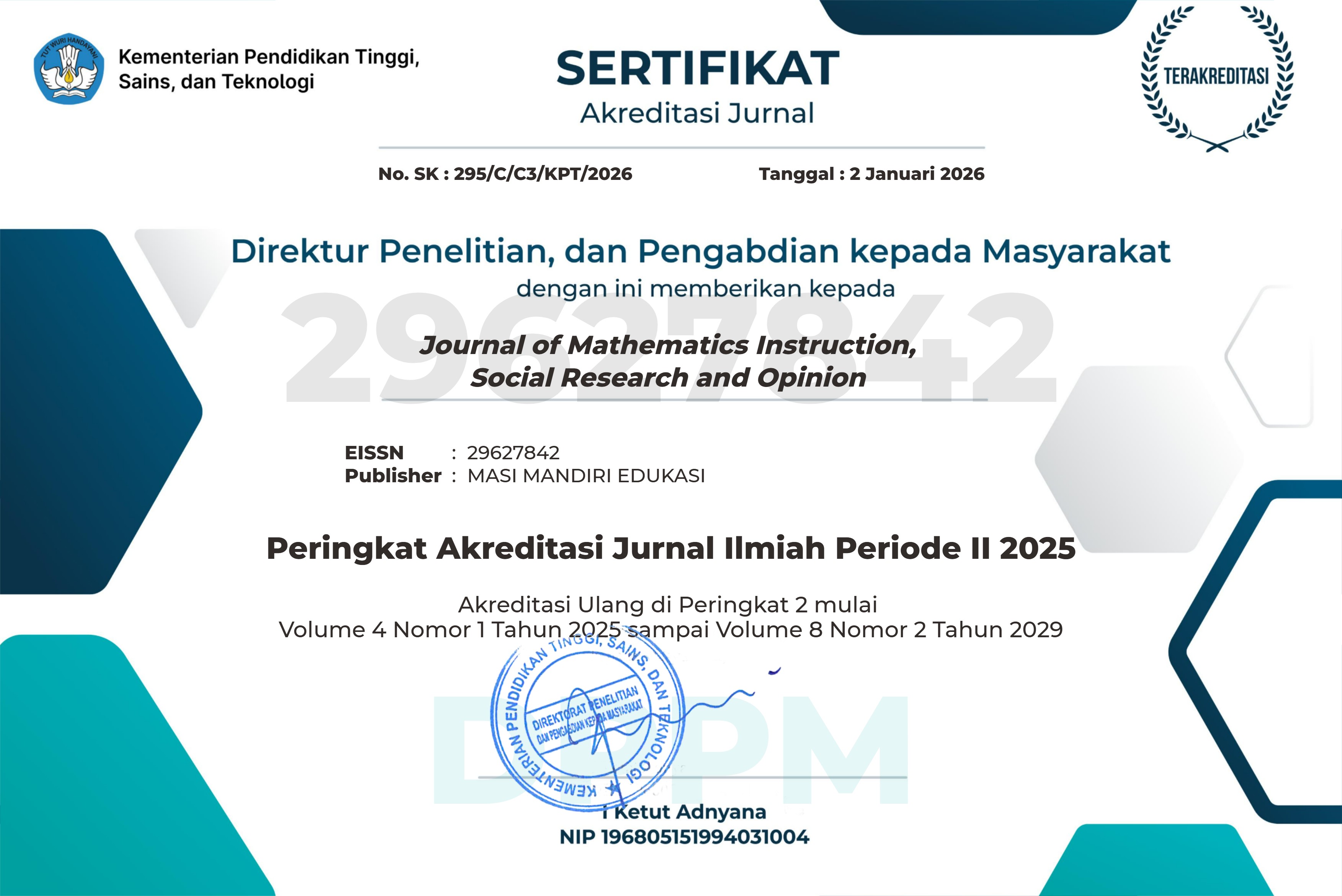
| Accreditation Certificate |
  |
| Indexing |






Contact Us

visitor
| Information |
>> For Authors
>> For Readers
>> For Librarians
| Visitor Statistics |
| Member of |


| Announcement |

| Keywords |
Mathematics Learning Difficulty Dyscalculia Teacher perceptions personality ICT Learning Computer teaching Academic Fisherfolks Economic Behavior Probit Models matrix mathematical model Concepts Guided Note Taking Golden Ratio Philosophy Integrated Learning van Hiele geometry Assessment Learning Outcomes method skills Problem Solving Experiment
| License |

MISRO is licensed under a Creative Commons Attribution-ShareAlike 4.0 International License.
| Publisher |

Address:
Jl. Gagak N0.105, Bandung,
Indonesia 40133
E-mail:
journalmisro@gmail.com
| in collaboration with |

| Recommended Tools |


| ISSN Barcode |

