
The Effect of Fiscal Policy and Macroeconomic Factors on Poverty in Districts/Cities of East Nusa Tenggara Province
DOI:
https://doi.org/10.58421/misro.v5i1.1297Keywords:
Poverty Persistence;, Government Expenditure;, Dynamic Panel;, System Gmm;, Regional Development;, East Nusa TenggaraAbstract
Poverty remains a persistent development challenge in East Nusa Tenggara, Indonesia, where structural constraints continue to hinder inclusive economic growth. This study investigates the impact of government expenditure (education, health, and infrastructure) and macroeconomic factors (labor absorption and economic growth) on poverty levels across 22 districts and cities in the province. Utilizing dynamic panel data covering the period 2014–2023, the analysis employs the System Generalized Method of Moments (System GMM) estimator to address endogeneity and capture poverty persistence. The empirical findings reveal strong evidence of poverty persistence, indicating a poverty trap in the region. Government expenditure in health and infrastructure significantly reduces poverty, demonstrating that targeted fiscal allocations effectively enhance productivity and lower transaction costs. In contrast, education expenditure shows a positive short-term relationship with poverty, implying a time lag before educational investments translate into tangible income improvements. Furthermore, while labor absorption significantly contributes to poverty reduction, regional economic growth has an insignificant impact, reflecting that the economic expansion in the province has not been fully inclusive. Overall, the results highlight the critical need for sustained, targeted fiscal interventions and inclusive macroeconomic policies to break the structural poverty cycle in East Nusa Tenggara.
Downloads
References
S. Smith and M. P. Todaro, Economic Development, 12th Edition (The Pearson Series In Economics). 2003.
Irawan and Suparmoko, Ekonomika Pembangunan. Yogyakarta: BPFE, 2002.
A. Widodo, W. Waridin, and J. M. Kodoatie, “Analisis Pengaruh Pengeluaran Pemerintah di Sektor Pendidikan dan Kesehatan Terhadap Pengentasan Kemiskinan Melalui Peningkatan Pembangunan Manusia di Provinsi Jawa Tengah,” JURNAL DINAMIKA EKONOMI PEMBANGUNAN, vol. 1, no. 1, p. 25, Feb. 2012, doi: 10.14710/jdep.1.1.25-42.
M. Arellano and O. Bover, “Another look at the instrumental variable estimation of error-components models,” J. Econom., vol. 68, no. 1, pp. 29–51, Jul. 1995, doi: 10.1016/0304-4076(94)01642-D.
R. Blundell and S. Bond, “Initial conditions and moment restrictions in dynamic panel data models,” J. Econom., vol. 87, no. 1, pp. 115–143, Nov. 1998, doi: 10.1016/S0304-4076(98)00009-8.
E. Setyowati, “Efektivitas Belanja Fungsi Kesehatan dan Infrastruktur dalam Pengentasan Kemiskinan di Wilayah Kepulauan,” Jurnal Ekonomi dan Kebijakan Publik, vol. 13, no. 1, pp. 45–58, 2022.
C. Arndt, S. Jones, and F. Tarp, “Assessing Foreign Aid’s Long-Run Contribution to Growth and Development,” World Dev., vol. 69, pp. 6–18, May 2015, doi: 10.1016/j.worlddev.2013.12.016.
G. Psacharopoulos, “Returns to investment in education: A global update,” World Dev., vol. 22, no. 9, pp. 1325–1343, Sep. 1994, doi: 10.1016/0305-750X(94)90007-8.
M. Ravallion, On the Welfarist Rationale for Relative Poverty Lines. Oxford: Oxford University Press, 2011.
Downloads
Additional Files
Published
How to Cite
Issue
Section
License
Copyright (c) 2026 Journal of Mathematics Instruction, Social Research and Opinion

This work is licensed under a Creative Commons Attribution-ShareAlike 4.0 International License.
SideBar
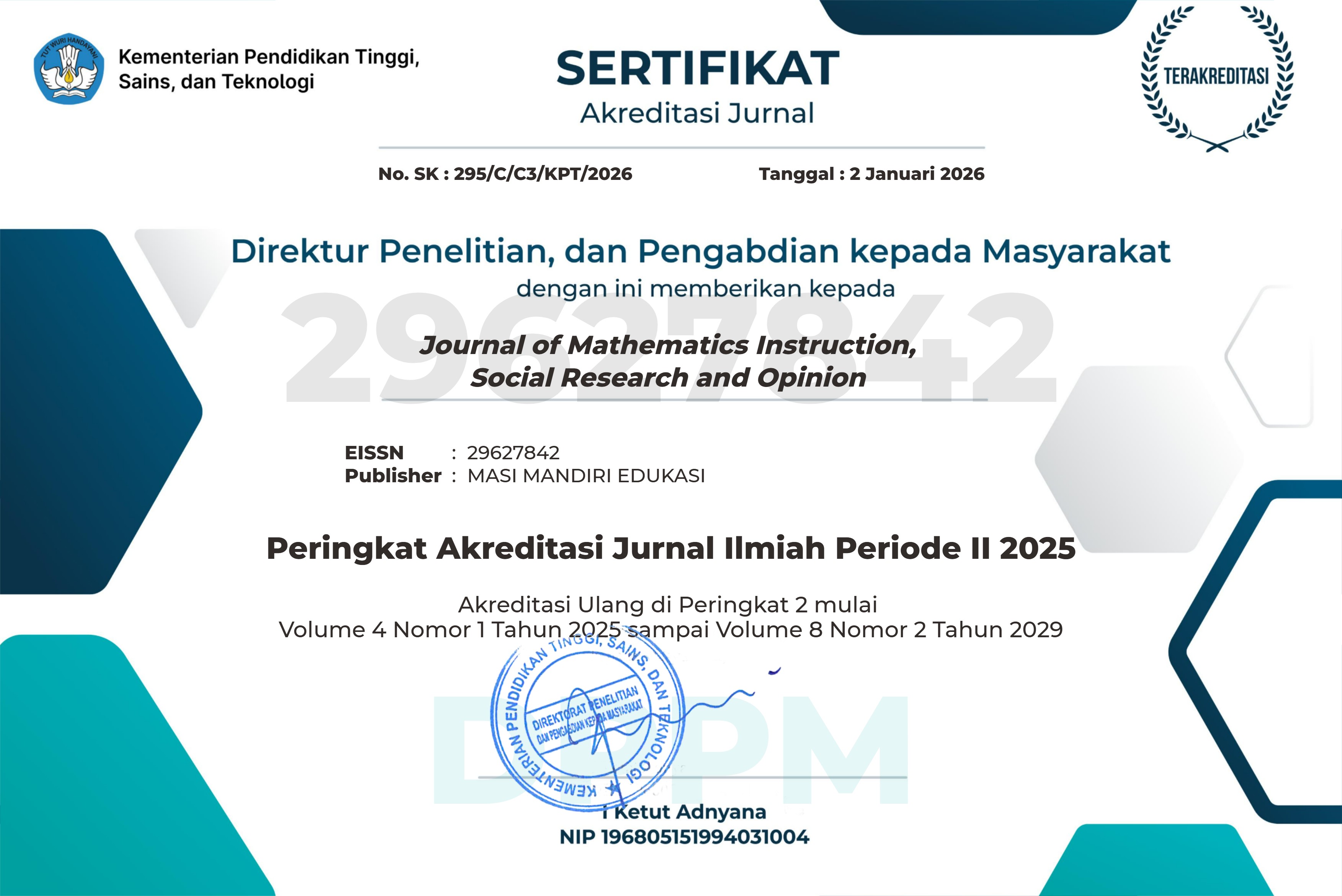
| Accreditation Certificate |
  |
| Indexing |






Contact Us

visitor
| Information |
>> For Authors
>> For Readers
>> For Librarians
| Visitor Statistics |
| Member of |


| Announcement |

| Keywords |
Mathematics Learning Difficulty Dyscalculia Teacher perceptions personality ICT Learning Computer teaching Academic Fisherfolks Economic Behavior Probit Models matrix mathematical model Concepts Guided Note Taking Golden Ratio Philosophy Integrated Learning van Hiele geometry Assessment Learning Outcomes method skills Problem Solving Experiment
| License |

MISRO is licensed under a Creative Commons Attribution-ShareAlike 4.0 International License.
| Publisher |

Address:
Jl. Gagak N0.105, Bandung,
Indonesia 40133
E-mail:
journalmisro@gmail.com
| in collaboration with |

| Recommended Tools |


| ISSN Barcode |

