
From Environmental Beliefs to Ecotourism Intention: The Mediating Role of Ecodestination Image in Sustainable Tourism Behavior
DOI:
https://doi.org/10.58421/misro.v5i1.1292Keywords:
Ecotourism intention, Environmental beliefs, Eco-destination image, Perceived value, Sustainable tourismAbstract
Ecotourism has become a key approach to promoting sustainable tourism and environmental conservation, yet the psychological mechanisms driving tourists’ participation remain insufficiently understood. This study addresses this gap by examining how environmental beliefs influence ecotourism intention through the mediating roles of ecodestination image and perceived value among tourists in West Java. A quantitative research design was employed using survey data collected from 280 tourists who had previously visited natural destinations in the region. Data were gathered from an online questionnaire using a bipolar 1–10 scale and analyzed using Structural Equation Modeling (SEM) with the Partial Least Squares (PLS) approach via SmartPLS 3.0. The findings reveal that environmental beliefs significantly influence ecotourism intention both directly and indirectly through ecodestination image. Ecodestination image emerges as a key mediating mechanism, linking internal environmental values to behavioral intention and significantly enhancing perceived value. In contrast, perceived value does not significantly predict ecotourism intention, indicating that environmentally driven psychological factors and destination-related perceptions are more influential than utilitarian evaluations in shaping sustainable travel behavior. These results highlight the critical role of destination-specific perceptions, integrating environmental belief perspectives with tourism marketing constructs. In practice, the study suggests that destination managers should prioritize strengthening the environmental image through sustainability communication and environmental education initiatives. Such strategies can enhance tourists’ pro-environmental attitudes, encourage responsible travel behavior, and support the long-term development of sustainable tourism.
Downloads
References
C. Lorenzo‐Romero, M. Alarcón‐del‐Amo, and J.-A. Crespo-Jareño, “Cross-Cultural Analysis of the Ecological Behavior of Chilean and Spanish Ecotourists: A Structural Model,” Ecol. Soc., vol. 24, no. 4, 2019, doi: 10.5751/es-11343-240438.
C. Lorenzo‐Romero, M. Alarcón‐del‐Amo, and J. A. Crespo-Jareño, “An Explanatory Model of the Ecotourists Behaviour: Management Strategies for Tourism Sector,” E+m Ekon. a Manag., vol. 24, no. 3, pp. 224–238, 2021, doi: 10.15240/tul/001/2021-3-013.
J. Y. Choe, J. J. Kim, and J. Hwang, “The Environmentally Friendly Role of Edible Insect Restaurants in the Tourism Industry: Applying an Extended Theory of Planned Behavior,” Int. J. Contemp. Hosp. Manag., vol. 32, no. 11, pp. 3581–3600, 2020, doi: 10.1108/ijchm-04-2020-0352.
M. Jin, Y. Choi, C. Lee, and M. S. Ahmad, “Effects of Place Attachment and Image on Revisit Intention in an Ecotourism Destination: Using an Extended Model of Goal-Directed Behavior,” Sustainability, vol. 12, no. 18, p. 7831, 2020, doi: 10.3390/su12187831.
J. M. Vegara-Ferri, J. M. L. Gullón, I. Valantinė, A. D. Suárez, and S. A. Sánchez, “Factors Influencing the Tourist’s Future Intentions in Small-Scale Sports Events,” Sustainability, vol. 12, no. 19, p. 8103, 2020, doi: 10.3390/su12198103.
Y. Zhu, N. Zaidin, and Y. Pu, “Local Residents Becoming Local Tourists: Value Co-Creation in Chinese Wetland Parks During the COVID-19 Pandemic,” Sustainability, vol. 14, no. 19, p. 12577, 2022, doi: 10.3390/su141912577.
N. Zulvianti, H. Aimon, and A. Abror, “Perceived Environmental Value, Destination Image, and Tourist Loyalty: The Role of Tourist Satisfaction and Religiosity,” sustainability, vol. 15, no. 10, p. 8038, 2023, doi: 10.3390/su15108038.
S. Yang, S. M. Isa, and T. Ramayah, “How Are Destination Image and Travel Intention Influenced by Misleading Media Coverage? Consequences of COVID-19 Outbreak in China,” Vision, vol. 26, no. 1, pp. 80–89, 2022, doi: 10.1177/0972262921993245.
C. E. Susanti, Y. B. Hermanto, and B. Suwito, “The Effect of Tourist Destination Image (TDI) on Intention to Visit through Tourism Risk Perception (TRP) of COVID-19 in the Tourism Industry in the New Normal Era in Indonesia: Case Study in East Java,” J. Risk Financ. Manag., vol. 16, no. 2, 2023, doi: 10.3390/jrfm16020076.
N. T. Khanh and L. T. Phong, “Impact of Environmental Belief and Nature-Based Destination Image on Ecotourism Attitude,” J. Hosp. Tour. Insights, vol. 3, no. 4, pp. 489–505, 2020, doi: 10.1108/jhti-03-2020-0027.
N. T. H. Dương, N. T. Khanh, H. t. Nguyễn, N. T. K. Nguyen, C. P. Nguyen, and T.-T.-U. Nguyen, “WTPP for Ecotourism: The Impact of Intention, Perceived Value, and Materialism,” J. Hosp. Tour. Insights, vol. 5, no. 5, pp. 1034–1045, 2021, doi: 10.1108/jhti-01-2021-0005.
J. Nadeau, N. O’Reilly, and L. A. Heslop, “China’s Olympic Destination: Tourist Evaluations of China and the Games,” Int. J. Cult. Tour. Hosp. Res., vol. 5, no. 3, pp. 235–246, 2011, doi: 10.1108/17506181111156934.
E. Sthapit, P. Yang, C. Ji, P. Björk, and M. J. Stone, “Remembrance of travels past: creating memorable halal food experiences among non-muslim Chinese tourists,” J. Foodserv. Bus. Res., vol. 00, no. 00, pp. 1–28, 2024, doi: 10.1080/15378020.2024.2321415.
D. Skandali, A. Magoutas, and G. Tsourvakas, “Consumer Behaviour Analysis for AI Services in the Tourism Industry,” Malaysian J. Consum. Fam. Econ., vol. 32, pp. 332–362, 2024, doi: 10.60016/majcafe.v32.13.
C. Gao and J. Iqbal, “An Empirical Study of Thailand Cities’ Color Landscapes,” Heliyon, vol. 9, no. 6, p. e17558, 2023, doi: 10.1016/j.heliyon.2023.e17558.
G. A. Abbasi, J. Kumaravelu, Y. N. Goh, and K. S. Dara Singh, “Understanding the intention to revisit a destination by expanding the theory of planned behaviour (TPB),” Spanish J. Mark. - ESIC, vol. 25, no. 2, pp. 282–311, 2021, doi: 10.1108/SJME-12-2019-0109.
H. S. T. Pham and N. T. Khanh, “Ecotourism Intention: The Roles of Environmental Concern, Time Perspective and Destination Image,” Tour. Rev., vol. 76, no. 5, pp. 1141–1153, 2020, doi: 10.1108/tr-09-2019-0363.
M. S. Rahman, A. M. Osman-Gani, and M. Raman, “Destination Selection for Education Tourism,” J. Islam. Mark., vol. 8, no. 3, pp. 373–392, 2017, doi: 10.1108/jima-10-2015-0080.
C. C. López, M. Carvache‐Franco, and W. Carvache‐Franco, “Perceived Value and Its Predictive Relationship With Satisfaction and Loyalty in Ecotourism: A Study in the Posets-Maladeta Natural Park in Spain,” Sustainability, vol. 13, no. 14, p. 7860, 2021, doi: 10.3390/su13147860.
M. Nowacki, J. Kowalczyk‐Anioł, and Y. Chawla, “Gen Z’s Attitude Towards Green Image Destinations, Green Tourism and Behavioural Intention Regarding Green Holiday Destination Choice: A Study in Poland and India,” Sustainability, vol. 15, no. 10, p. 7860, 2023, doi: 10.3390/su15107860.
N. T. Khanh and H. S. T. Pham, “The Moderating Role of Eco-Destination Image in the Travel Motivations and Ecotourism Intention Nexus,” J. Tour. Futur., vol. 10, no. 2, pp. 317–333, 2022, doi: 10.1108/jtf-01-2022-0014.
J. Ren, K. Su, Y. Zhou, Y. Hou, and Y. Wen, “Why Return? Birdwatching Tourists’ Revisit Intentions Based on Structural Equation Modelling,” sustainability, vol. 14, no. 21, p. 14632, 2022, doi: 10.3390/su142114632.
S. F. Persada et al., “How Tourists Reacted to Ecotourism During COVID-19: Insights on Its Sustainability From a Multivariate Analysis Based on the Case of Banyuwangi,” sustainability, vol. 15, no. 2, p. 1440, 2023, doi: 10.3390/su15021440.
M. Carvache‐Franco, C. C. López, and W. Carvache‐Franco, “The Perceived Value and Future Behavioral Intentions in Ecotourism: A Study in the Mediterranean Natural Parks From Spain,” Land, vol. 10, no. 11, p. 1133, 2021, doi: 10.3390/land10111133.
U. Jamrozy and K. Lawonk, “The Multiple Dimensions of Consumption Values in Ecotourism,” Int. J. Cult. Tour. Hosp. Res., vol. 11, no. 1, pp. 18–34, 2017, doi: 10.1108/ijcthr-09-2015-0114.
J. Ban, H. J. Kim, B. Sheehan, and B. Prideaux, “How Service Quality and Perceived Value Affect Behavioral Intentions of Ecolodge Guests: The Moderating Effect of Prior Visit,” J. Vacat. Mark., vol. 28, no. 2, pp. 244–257, 2021, doi: 10.1177/13567667211042641.
D. Ö. Özbey et al., “How Does Environmental Education Moderate Local People’s Commitment to the Environment and Intention to Support Tourism Development?,” Sustainability, vol. 16, no. 13, p. 5646, 2024, doi: 10.3390/su16135646.
Downloads
Additional Files
Published
How to Cite
Issue
Section
License
Copyright (c) 2026 Journal of Mathematics Instruction, Social Research and Opinion

This work is licensed under a Creative Commons Attribution-ShareAlike 4.0 International License.
SideBar
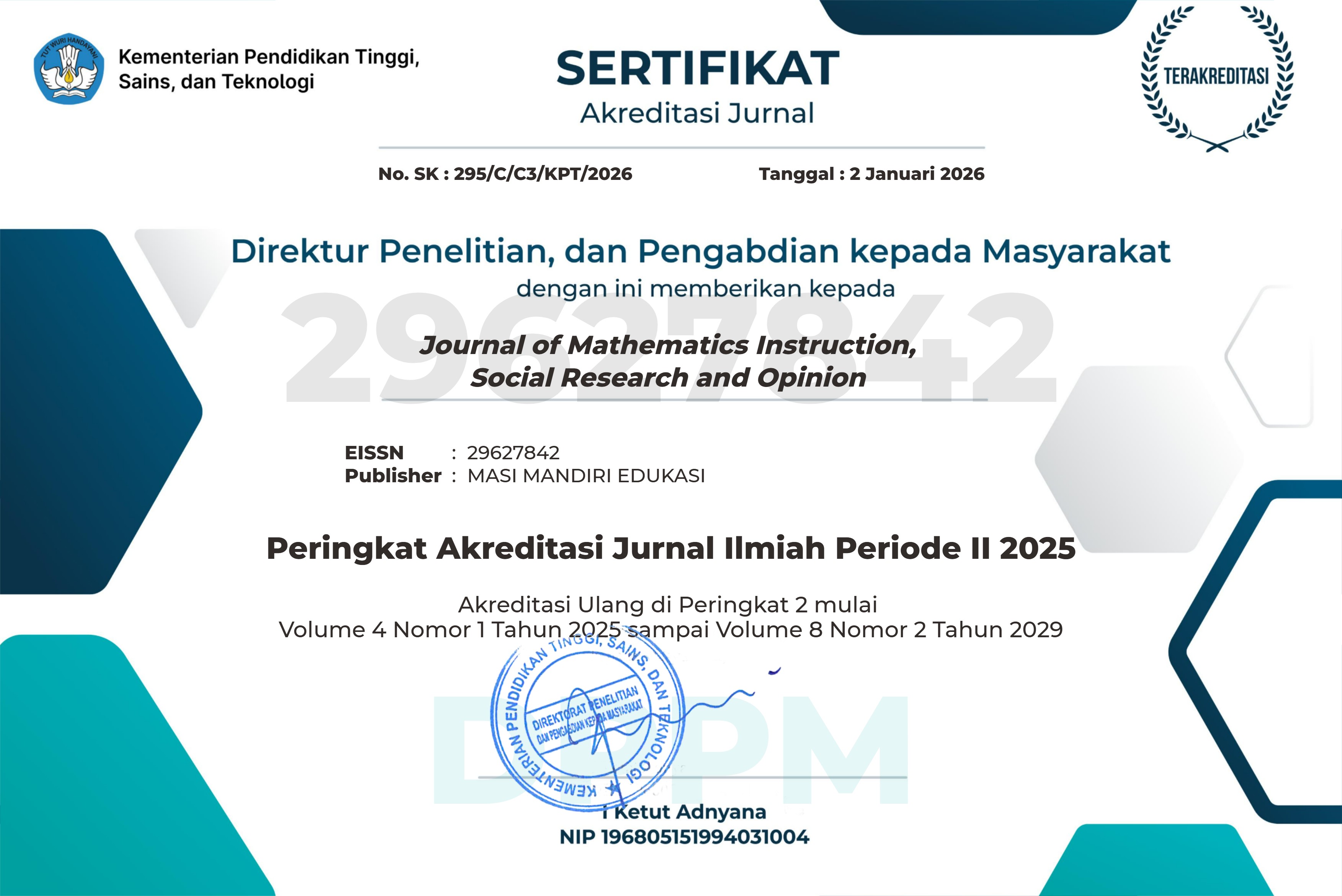
| Accreditation Certificate |
  |
| Indexing |






Contact Us

visitor
| Information |
>> For Authors
>> For Readers
>> For Librarians
| Visitor Statistics |
| Member of |


| Announcement |

| Keywords |
Mathematics Learning Difficulty Dyscalculia Teacher perceptions personality ICT Learning Computer teaching Academic Fisherfolks Economic Behavior Probit Models matrix mathematical model Concepts Guided Note Taking Golden Ratio Philosophy Integrated Learning van Hiele geometry Assessment Learning Outcomes method skills Problem Solving Experiment
| License |

MISRO is licensed under a Creative Commons Attribution-ShareAlike 4.0 International License.
| Publisher |

Address:
Jl. Gagak N0.105, Bandung,
Indonesia 40133
E-mail:
journalmisro@gmail.com
| in collaboration with |

| Recommended Tools |


| ISSN Barcode |

