
Integrating Artificial Intelligence into Informatics Education: Effects on Students’ Analytical Reasoning and Creativity
DOI:
https://doi.org/10.58421/misro.v5i1.1253Keywords:
analytical reasoning, artificial intelligence, informatics learning, PLS-SEM, student creativityAbstract
The integration of artificial intelligence (AI) in education is rapidly increasing; however, empirical evidence regarding its impact on students’ higher-order thinking skills in junior secondary informatics education remains limited, particularly within the Indonesian madrasah context. This study aims to examine the effect of AI integration in informatics learning on students’ analytical reasoning and creativity at MTs Negeri 9 Indramayu. A quantitative research design was employed using Partial Least Squares–Structural Equation Modeling (PLS-SEM). The study involved 174 students who had experience using AI-based tools in informatics classes. Data were collected through a four-point Likert-scale questionnaire consisting of 14 items that met established validity and reliability criteria. The results show that AI integration has a positive and significant influence on both analytical reasoning and creativity, with a stronger effect observed on analytical reasoning. The structural model demonstrates moderate explanatory power and satisfactory predictive relevance. These findings contribute to educational technology research by providing empirical evidence that AI can function as a cognitive support system in informatics learning to foster higher-order thinking skills in the madrasah educational environment.
Downloads
References
W. Holmes, M. Bialik, dan C. Fadel, Artificial Intelligence in Education. Promise and Implications for Teaching and Learning. 2021.
M. Cukurova, S. Hennessy, L. Major, M. Mavrikis, dan S. Price, “Artificial intelligence in education: Challenges and opportunities. British Journal of Educational Technology.,” Br. J. Educ. Technol., vol. 52, no. 1, hal. 5–7, 2021, doi: https://doi.org/10.1111/bjet.13064.
F. Xaveria dan D. Kristianingsih, “Artificial intelligence in adaptive education : a systematic review of techniques for personalized learning,” 2025.
W. Holmes, M. Bialik, dan C. Fadel, Artificial intelligence in education promises and implications for teaching and learning. Center for Curriculum Redesign, 2019.
Z. Liu, Z. Gearty, E. Richard, C. H. Orrill, dan S. Kayumova, “Bringing computational thinking into classrooms : a systematic review on supporting teachers in integrating computational thinking into K ‑ 12 classrooms,” no. 2024, 2025.
P. Andreucci-Annunziata, A. Riedemann, S. Cortés, A. Mellado, M. T. del Río, dan A. Vega-Muñoz, “Conceptualizations and instructional strategies on critical thinking in higher education: A systematic review of systematic reviews,” Front. Educ., vol. Volume 8-2023, 2023, doi: 10.3389/feduc.2023.1141686.
J. Nilimaa, “New Examination Approach for Real-World Creativity and Problem-Solving Skills in Mathematics,” Trends High. Educ., vol. 2, no. 3, hal. 477–495, 2023, doi: 10.3390/higheredu2030028.
X. Chen, “Enhancing Higher Education through AI-Driven Personalized Adaptive Learning : Evidence from a ChatGPT-Based Strategy,” vol. 19, no. 1, hal. 579–594, 2026.
R. Melisa et al., “Critical Thinking in the Age of AI: A Systematic Review of AI’s Effects on Higher Education.,” Educ. Process Int. J., vol. 14, hal. e2025031, 2025.
J. Peng dan Y. Li, “Frontiers of artificial intelligence for personalized learning in higher education: A systematic review of leading articles,” Appl. Sci., vol. 15, no. 18, hal. 10096, 2025.
N. Selwyn, Should Robots Replace Teachers? AI and the Future of Education, 1st ed. Cambridge, UK: Polity Press, 2021.
E. Hendarwati et al., “Collaborative Problem Based Learning Integrated with Online Learning,” vol. 16, no. 13, hal. 29–39, 2021.
Sugiyono, Metode Penelitian Pendidikan: Pendekatan Kuantitatif, Kualitatif, Kombinasi, R&D, dan Penelitian Pendidikan. Bandung, Indonesia: Alfabeta, 2021.
Q. Tian dan X. Zheng, “The impact of artificial intelligence on students’ 4C skills: A meta-analysis,” Educ. Res. Rev., hal. 100728, 2025.
I. Celik, E. Gedrimiene, S. Siklander, dan H. Muukkonen, “The affordances of artificial intelligence-based tools for supporting 21st-century skills: A systematic review of empirical research in higher education,” Australas. J. Educ. Technol., vol. 40, no. 3, hal. 19–38, 2024.
S. Rifky, “Dampak penggunaan artificial intelligence bagi pendidikan tinggi,” Indones. J. Multidiscip. Soc. Technol., vol. 2, no. 1, hal. 37–42, 2024.
A. Henukh et al., Transformasi Pembelajaran di Era Artificial Intelligence. Sigufi Artha Nusantara, 2025.
O. Zawacki-richter, V. I. Marín, dan M. Bond, “Systematic review of research on artificial intelligence applications in higher education – where are the educators ?,” 2020.
L. Chen dan P. Chen, “Artificial Intelligence in Education : A Review,” vol. 8, 2020, doi: 10.1109/ACCESS.2020.2988510.
Z. Razilu, Inovasi pembelajaran integrasi artificial intelligence dalam teknologi pendidikan. Penerbit Widina, 2025.
L. Kohnke, B. L. Moorhouse, dan D. Zou, “ChatGPT for Language Teaching and Learning,” RELC J., vol. 54, no. 2, hal. 537–550, 2023, doi: 10.1177/00336882231162868.
E. Kasneci et al., “ChatGPT for good? On opportunities and challenges of large language models for education,” Learn. Individ. Differ., vol. 103, hal. 102274, 2023, doi: https://doi.org/10.1016/j.lindif.2023.102274.
D. Cotton, P. Cotton, dan R. Shipway, “Chatting and Cheating. Ensuring academic integrity in the era of ChatGPT,” 2023. doi: 10.35542/osf.io/mrz8h.
Z. Mengmeng, M. Izzuan, M. Ishar, M. S. Saud, dan L. Bohong, “Generative AI and Higher-Order Thinking in Vocational Education : A Study of Human-Machine Collaboration,” vol. 14, no. 4, hal. 1667–1679, 2025.
M. Saritepeci dan H. Y. Durak, “Effectiveness of artificial intelligence integration in design-based learning on design thinking mindset, creative and reflective thinking skills: An experimental study,” Educ. Inf. Technol., vol. 29, hal. 25175–25209, 2024, doi: 10.1007/s10639-024-12829-2.
G. Riva, “The Architecture of Cognitive Amplification: Enhanced Cognitive Scaffolding as a Resolution to the Comfort-Growth Paradox in HumanAI Cognitive Integration,” 2025.
Downloads
Additional Files
Published
How to Cite
Issue
Section
License
Copyright (c) 2026 Journal of Mathematics Instruction, Social Research and Opinion

This work is licensed under a Creative Commons Attribution-ShareAlike 4.0 International License.
SideBar
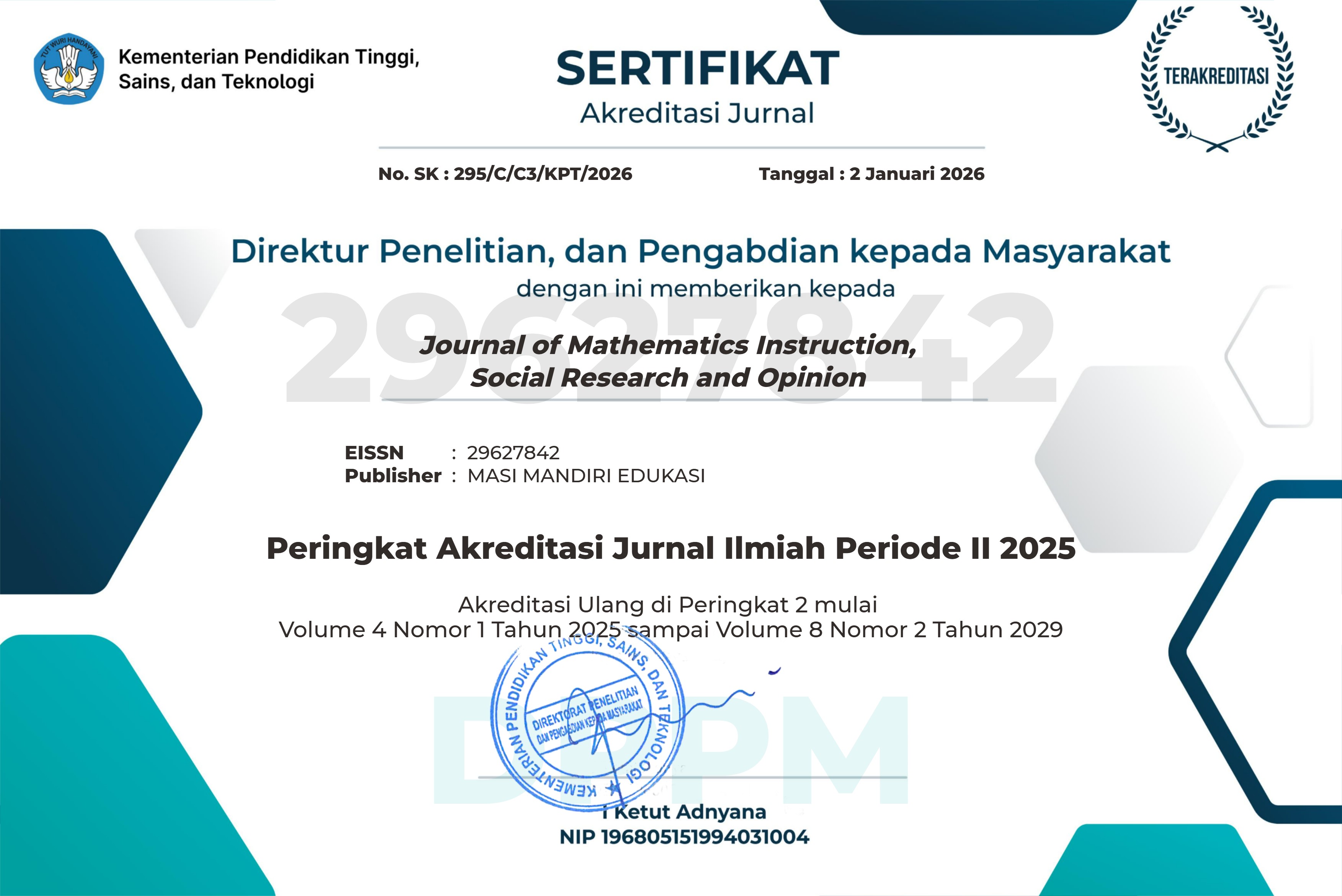
| Accreditation Certificate |
  |
| Indexing |






Contact Us

visitor
| Information |
>> For Authors
>> For Readers
>> For Librarians
| Visitor Statistics |
| Member of |

| Announcement |

| Keywords |
Mathematics Learning Difficulty Dyscalculia Teacher perceptions personality ICT Learning Computer teaching Academic Fisherfolks Economic Behavior Probit Models matrix mathematical model Concepts Guided Note Taking Golden Ratio Philosophy Integrated Learning van Hiele geometry Assessment Learning Outcomes method skills Problem Solving Experiment
| License |

MISRO is licensed under a Creative Commons Attribution-ShareAlike 4.0 International License.
| Publisher |

Address:
Jl. Gagak N0.105, Bandung,
Indonesia 40133
E-mail:
journalmisro@gmail.com
| in collaboration with |

| Recommended Tools |


| ISSN Barcode |

