
Worked Example-Based Instruction to Reduce Cognitive Load and Academic Boredom in Mathematics Learning
DOI:
https://doi.org/10.58421/misro.v5i1.1233Keywords:
Worked example, Cognitive load, Academic boredom, Mathematic learning, PLS-SEMAbstract
This study investigates how cognitive load influences learning outcomes by considering the role of academic boredom, while also examining the effectiveness of worked example-based instruction in reducing both cognitive load and academic boredom in mathematics learning. The research employed a quasi-experimental design involving experimental and control groups with a total of 120 participants (n = 120). Data were collected using questionnaires measuring cognitive load and academic boredom, along with tests assessing learning outcomes. The relationships among variables, both direct and indirect, were examined using Partial Least Squares Structural Equation Modelling (PLS-SEM). The results show that an increase in cognitive load tends to be associated with higher levels of academic boredom and a decline in learning outcomes. Academic boredom negatively predicts learning outcomes and acts as a mediating variable between cognitive load and achievement. Worked example-based instruction demonstrates a stronger ability to regulate cognitive and emotional processes compared with traditional instructional approaches. These results underscore the need to maintain an appropriate balance between cognitive demands and students’ emotional engagement in mathematics learning. The study offers a contribution by combining cognitive and affective aspects within a unified analytical perspective and presents practical recommendations for developing instructional strategies that foster cognitive-emotional balance.
Downloads
References
L. Wesenberg, F. Krieglstein, S. Jansen, G. Daniel, and S. Schneider, “Teaching with worked examples – Why the selection of problems for exemplification is critical,” Contemp. Educ. Psychol., vol. 80, no. 1, p. 102328, 2025, doi: 10.1016/j.cedpsych.2024.102328.
E. Rexigel, J. Kuhn, S. Becker, and S. Malone, The more the better? A systematic review and meta‑analysis of the benefits of more than two external representations in stem education, vol. 36, no. 4. Springer US, 2024. doi: 10.1007/s10648-024-09958-y.
T. Vessonen et al., Task characteristics associated with mathematical word problem‑solving performance among elementary school‑aged children: A systematic review and meta‑analysis, vol. 36, no. 4. Springer US, 2024. doi: 10.1007/s10648-024-09954-2.
K. Schuessler, J. Koenen, E. Sumfleth, and M. Rost, “Variations in repeated measures of cognitive load and interest during complex learning tasks,” Educ. Psychol. Pract., vol. 38, no. 7, pp. 1–48, 2026, [Online]. doi: 10.1007/s10648-025-10105-4
O. Chen, E. Retnowati, B. Kai, Y. Chan, and S. Kalyuga, “The effect of worked examples on learning solution steps and knowledge transfer,” Educ. Psychol., vol. 43, no. 8, pp. 914–928, 2023, doi: 10.1080/01443410.2023.2273762.
C. Chen, “Effects of worked examples with explanation types and learner motivation on cognitive load and programming problem-solving performance,” ACM Trans. Comput. Educ., vol. 25, no. 2, pp. 1–19, 2025, doi: 10.1145/3732791.
E. Papageorgiou, J. Wong, Q. Liu, M. Khalil, and A. J. Cabo, A systematic review on student engagement in undergraduate mathematics: Conceptualization, measurement, and learning outcomes, vol. 37, no. 3. Springer US, 2025. doi: 10.1007/s10648-025-10046-y.
A. Veloo, S. K. S. Shanmugam, and S. Revindran, “A comparative study of cognitive processing in oral mathematics tests among Malaysian orang asli pupils,” Malaysian J. Learn. Instr., vol. 22, no. 2, pp. 73–93, 2025, [Online]. Available: https://doi.org/10.32890/mjli2025.22.2.4
C. I. Bekker, S. Rothmann, and M. M. Kloppers, “The happy learner: Effects of academic boredom, burnout, and engagement,” Front. Psychol., vol. 13, no. 1, pp. 1–14, 2023, doi: 10.3389/fpsyg.2022.974486.
C. A. Barbieri, D. Miller‑Cotto, S. N. Clerjuste, and K. Chawla, “A meta‑analysis of the worked examples effect on mathematics performance,” Educ. Psychol. Rev., vol. 35, no. 11, pp. 1–33, 2023, doi: 10.1007/s10648-023-09745-1.
I. Zeitlhofer, J. Zumbach, and J. Schweppe, “Complexity affects performance, cognitive load, and awareness,” Learn. Instr., vol. 94, no. 2, p. 102001, 2024, doi: 10.1016/j.learninstruc.2024.102001.
S. Ludwig, A. Rausch, and M. Taub, “Effects of instructional design, instructional preferences, and cognitive load on problem solving and knowledge acquisition in a computer-based office simulation,” Learn. Instr., vol. 101, no. 2, p. 102255, 2026, doi: 10.1016/j.learninstruc.2025.102255.
A. Hamed, D. Moralejo, and A. Durante, “Challenges and considerations in naming true and quasi-experimental research designs: A methodological discussion,” Creat. Nurs., vol. 3, no. 1, pp. 1–9, 2025, doi: 10.1177/10784535241307932.
M. L. Maciejewski, “Quasi-experimental design,” Biostat. Epidemiol., vol. 1, no. 1, pp. 1–10, 2018, doi: 10.1080/24709360.2018.1477468.
J. Leppink, F. Paas, C. P. M. Van der Vleuten, T. Van Gog, and J. J. G. Van Merriënboer, “Development of an instrument for measuring different types of cognitive load,” Behav Res, vol. 45, no. 1, pp. 1058–1072, 2013, doi: 10.3758/s13428-013-0334-1.
C.-C. Wang, P. K.-H. Cheng, and T.-H. Wang, “Measurement of extraneous and germane cognitive load in the mathematics addition task: An event-related potential study,” Study. Brain Sci, vol. 12, no. 1, p. 1036, 2022, doi: 10.3390/brainsci12081036
T. W. Acee et al., “Academic boredom in under- and over-challenging situations,” Contemp. Educ. Psychol., vol. 35, no. 1, pp. 17–27, 2010, doi: 10.1016/j.cedpsych.2009.08.002.
J. F. Hair, J. J. Risher, M. Sarstedt, and C. M. Ringle, “When to use and how to report the results of pls-sem,” Eur. Bus. Rev., vol. 31, no. 1, pp. 2–24, 2019, doi: 10.1108/EBR-11-2018-0203.
J. Henseler, C. M. Ringle, and M. Sarstedt, “A new criterion for assessing discriminant validity in variance-based structural equation modeling,” J. Acad. Mark. Sci., vol. 43, no. 1, pp. 115–135, 2015, doi: 10.1007/s11747-014-0403-8.
J. F. Hair, G. T. M. Hult, C. M. Ringle, M. Sarstedt, N. P. Danks, and S. Ray, Partial least squares structural equation modeling (PLS-SEM) using R. Switzerland: Springer Nature Switzerland AG, 2021. doi: 10.1007/978-3-030-80519-7.
J. F. Hair, G. T. Hult, C. Ringle, and M. Sarstedt, A primer on partial least squares structural equation modeling (PLS-SEM), 2nd ed. SAGE Publications, 2017. [Online]. Available: http://study.sagepub.com/hairprimer2e.
J. F. Hair, C. M. Ringle, and M. Sarstedt, “PLS-SEM: Indeed a silver bullet,” J. Mark. Theory Pract., vol. 19, no. 2, pp. 139–152, 2011, doi: 10.2753/MTP1069-6679190202.
A. S. Alrajhi, “The salient antecedents of boredom in formal English language learning,” Cogent Educ., vol. 11, no. 1, pp. 1–17, 2024, doi: 10.1080/2331186X.2024.2342672.
Baiduri, I. Holisin, S. Inganah, and W. S. Hidayati, “The impact of cognitive load on learning achievement and semester level in mathematics education students,” J. Hunan Univ., vol. 51, no. 8, pp. 19–35, 2024, doi: 10.55463/issn.1674-2974.51.8.2
D. Cairns, “Balancing teacher-led and student-led learning in science: The importance of cognitive load,” Cairns Large-scale Assessments Educ., vol. 13, no. 27, pp. 1–22, 2025, doi :10.1186/s40536-025-00263-w
M. Zhou and X. Wang, “The influence of enjoyment, boredom, and burnout on EFL achievement: Based on latent moderated structural equation modeling,” PLoS One, vol. 19, no. 9, pp. 1–20, 2024, doi: 10.1371/journal.pone.0310281.
G. Sozio, S. Agostinho, S. Tindall-ford, and F. Paas, “Enhancing teaching strategies through cognitive load theory: process vs. product worked examples,” Educ. Sci., vol. 14, no. 1, p. 813, 2024, doi: 10.3390/educsci14080813
R. A. Lubis and S. W. Lubis, “Development of mathematics student worksheets based on mathematical understanding with a worked example approach,” EduMatika J. MIPA, vol. 2, no. 3, pp. 69–74, 2022, doi: 10.30596/jcositte.v1i1.xxxx.
M. S. Abdellatif, “Modeling the relationships between academic boredom, self-compassion, and quality of academic life among university students,” Public Educ. Democr. - Orig. Res. model., vol. 12, no. 4, pp. 1–14, 2022, doi: 10.1177/21582440221141703.
S. M. Adeniji and P. Baker, “Effects of worked example on students’ learning outcomes in complex algebraic problems,” Int. J. Instr., vol. 16, no. 2, pp. 229–246, 2023, doi: 10.29333/iji.2023.16214a
H. M. Lee and P. Ayres, “The worked-example effect and a mastery approach goal orientation,” Educ. Sci., vol. 14, no. 1, p. 597, 2024, doi :10.3390/educsci14060597
I. M. Tegeh, I. M. Suarjana, and G. W. Rukmana, “Mindful learning-based cognitive load management model in elementary school mathematics learning,” Indones. J. Instr., vol. 6, no. 1, pp. 214–221, 2025, [Online]. Available: https://doi.org/10.23887/iji.v6i1.96672
C. Baah, I. Govender, and P. R. Subramaniam, “Enhancing learning engagement: a study on gamification’s influence on motivation and cognitive load,” Educ. S, vol. 14, no. 1, pp. 1–18, 2024, doi: 10.3390/educsci14101115
X. Ke and K. J. Newton, “English learners learn from worked example comparison in algebra,” Instr. Sci., vol. 52, no. 5, pp. 831–858, 2024, doi: 10.1007/s11251-024-09668-6.
Downloads
Additional Files
Published
How to Cite
Issue
Section
License
Copyright (c) 2026 Journal of Mathematics Instruction, Social Research and Opinion

This work is licensed under a Creative Commons Attribution-ShareAlike 4.0 International License.
SideBar
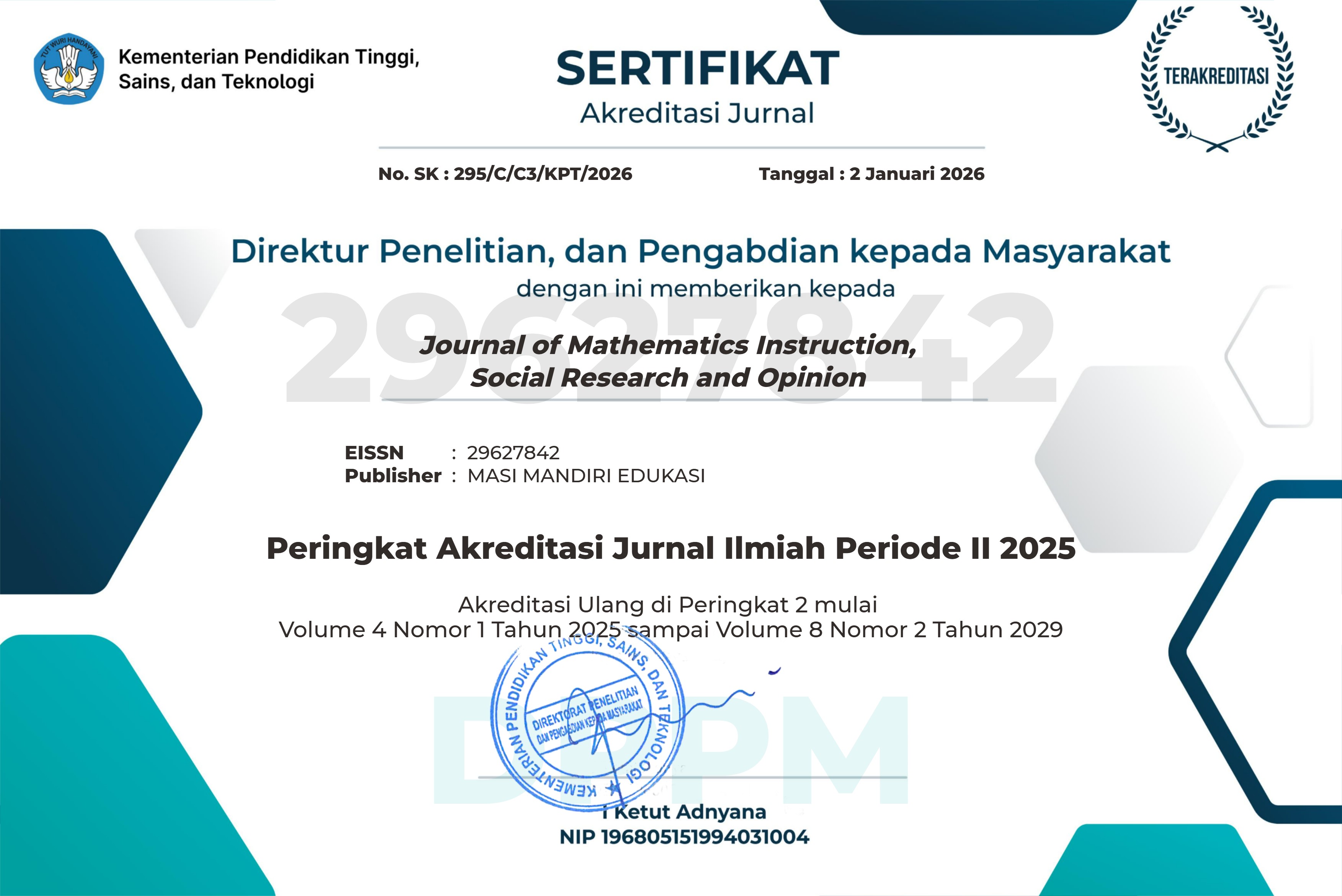
| Accreditation Certificate |
  |
| Indexing |






Contact Us

visitor
| Information |
>> For Authors
>> For Readers
>> For Librarians
| Visitor Statistics |
| Member of |


| Announcement |

| Keywords |
Mathematics Learning Difficulty Dyscalculia Teacher perceptions personality ICT Learning Computer teaching Academic Fisherfolks Economic Behavior Probit Models matrix mathematical model Concepts Guided Note Taking Golden Ratio Philosophy Integrated Learning van Hiele geometry Assessment Learning Outcomes method skills Problem Solving Experiment
| License |

MISRO is licensed under a Creative Commons Attribution-ShareAlike 4.0 International License.
| Publisher |

Address:
Jl. Gagak N0.105, Bandung,
Indonesia 40133
E-mail:
journalmisro@gmail.com
| in collaboration with |

| Recommended Tools |


| ISSN Barcode |

