
Theoretical Model of Intelligence Integration to Improve Self-Directed Learning in Mathematics in the 21st Century
DOI:
https://doi.org/10.58421/misro.v5i1.1232Keywords:
21st-century learning, Intelligence integration model, Mathematics education, Self-directed learning, Self-regulationAbstract
This study examines the effectiveness of the Theoretical Model of Intelligence Integration in improving students’ self-directed learning in 21st-century mathematics education. The research addresses the problem that many students remain dependent on teacher guidance and have limited ability to regulate their own learning processes. Therefore, this study aims to evaluate whether integrating intellectual, emotional, and spiritual intelligence can strengthen students’ self-directed learning in mathematics. A quantitative approach using a true experimental posttest-only control group design was applied, involving 120 eighth-grade students divided equally into experimental and control groups through cluster random sampling. The experimental group received instruction based on the integration of multiple intelligences through stages of contextual problem orientation, self-awareness reflection, strategic problem solving, collaborative discussion, and reflective evaluation, while the control group received conventional instruction. Data were collected using a validated self-directed learning questionnaire measuring awareness, learning strategies, learning activities, evaluation, and interpersonal skills. Hypothesis testing used descriptive statistics, regression, and correlation analysis. The results show a substantial difference between groups and a strong regression effect (R² = 0.823), indicating that the model significantly improves students’ learning autonomy and provides a holistic framework for strengthening self-regulation in mathematics learning.
Downloads
References
K. Karatas and I. Arpaci, “The role of self-directed learning, metacognition , and 21st century skills predicting the readiness for online learning,” Contemp. Educ. Technol., vol. 13, no. 3, pp. 1–13, 2021, doi: 10.30935/cedtech/10786.
M. Hendriani, I. M. Arnawa, and M. Zainil, “Global research trends in mathematical problem-solving skills: A biibliometric review of 2020–2024 publications,” Semin. Med. Writ. Educ., vol. 3, no. 453, pp. 1–17, 2025, doi: 10.56294/mw2025453.
S. Li, X. Jia, Y. Zhao, Y. Ni, L. Xu, and Y. Li, “The mediating role of self-directed learning ability in the impact of educational environment , learning motivation , and emotional intelligence on metacognitive awareness in nursing students,” BMC Nurs., vol. 23, no. 789, pp. 1–20, 2024, doi: 10.1186/s12912-024-02457-z.
S. Lit, M. Kool, and P. Drijvers, “Teacher knowledge and skills for mathematical problem solving: A systematic literature review,” J. Math. Teach. Educ., no. January, pp. 1–28, 2026, doi: 10.1007/s10857-025-09737-8.
I. Anggraini and N. Faiziyah, “Unveiling the connection: Emotional intelligence reflective thinking in students ’ PISA problem-solving,” Desimal J. Mat., vol. 7, no. 2, pp. 407–416, 2024, doi: 10.24042/djm.v7i2.23631.
M. Ç. Gürbüz, “The relationship between peer learning and self-directed learning: The mediating role of collaborative leadership among pre-service mathematics teachers,” Front. Psychol., vol. 16, no. 1724725, pp. 1–13, 2026, doi: 10.3389/fpsyg.2025.1724725.
D. D. D. Fahrni, G. Iten, D. Prasse, and T. Hascher, “Teachers ’ practices in the use of digital technology to promote students ’ self-regulated learning and metacognition: A systematic review,” Teach. Teach. Educ., vol. 165, no. 105150, pp. 1–13, 2025, doi: 10.1016/j.tate.2025.105150.
U. Munawar, A. Irshad, P. Mubasher, and P. Mateen Iqbal, “Multiple intelligences and academic achievement: Investigating multidimensional relationships and predictive among undergraduate students in STEAM disciplines in Punjab, Pakistan,” J. Soc. Sci. Res. Policy Mult., vol. 3, no. 4, pp. 148–164, 2025, doi: 10.71327/jssrp.34.148.164.
R. Suson et al., “Emotional intelligence as predictor of learning performance in higher education: A SEM approach,” Front. Educ., vol. 10, no. 1685826, pp. 1–10, 2025, doi: 10.3389/feduc.2025.1685826.
Y. M. Eid, “Self-directed learning and emotional intelligence: Differences between students with high and low academic performance,” Psychol. Sci. Educ., vol. 29, no. 4, pp. 94–103, 2024, doi: 10.17759/pse.2024290408.
S. Bordbar, S. H. Mogadammorki, O. Atashbahar, J. Bahmaei, M. Vejdani, and Ali Reza Yusefi, “The effect of emotional intelligence on academic performance with the mediating role of academic self-regulation: Evidence from college students,” Discov. Educ., vol. 4, no. 506, pp. 1–17, 2025, doi: 10.1007/s44217-025-00952-2.
N. R. A. Suhaimee, M. I. Zakaria, N. Ismail, M. F. A. Hanid, and N. H. Hanafi, “Self-directed learning in mathematics education: A bibliometric analysis,” Int. J. Educ. Math. Sci. Technol., vol. 13, no. 3, pp. 568–583, 2025, doi: 10.46328/ijemst.4770.
J. W. Creswell and J. D. Creswell, Research design: qualitative, quantitative, and mixed methods approaches, 5 Edition. Thousand Oaks: SAGE Publications, 2018.
L. B. Kumanireng and A. K. Lagamakin, “Analisis kemampuan pemahaman relasional peserta didik ditinjau dari self directed learning,” ASIMTOT J. Kependidikan Mat., vol. 5, no. 1, pp. 73–82, 2023, doi: 10.30822/asimtot.v5i01.2828.
J. J. F. Hair, W. C. Black, B. J. Babin, and R. E. Anderson, Multivariate data analysis, 8 Edition. Andover: Cengage Learning, 2019.
C.R. Kothari, Research methodology method and techniques, 2 Edition. Jaipur: New Age International Publishers, 2009.
O. Aksela, J. Lämsä, and S. Järvelä, “Secondary school students ’ enacted self-regulated learning strategies in a computer‑based writingt task–insights from digital trace data and interviews,” Technol. Knowl. Learn., vol. 30, no. October, pp. 1727–1756, 2025.
D. D. Hidayat and A. Mahmudi, “Impact of multiple intelligences and problem-based learning on mathematical literacy and self-efficacy in junior high school students,” Al-Ishlah J. Pendidik., vol. 17, no. 1, pp. 512–523, 2025, doi: 10.35445/alishlah.v17i1.5463.
S. F. Rahmawati and E. Irawan, “Pengaruh learning anxiety dan self-directed learning terhadap prestasi belajar matematika siswa sekolah dasar,” J. Math. Educ. Res., vol. 6, no. 2, pp. 143–156, 2025, doi: 10.17509/j-mer.v6i2.84171.
D. Cairns, “Balancing teacher-led and student-led learning in scienc: the importance of cognitive load,” Cairns Large-scale Assessments Educ., vol. 13, no. 27, pp. 1–22, 2025, doi: 10.1186/s40536-025-00263-w.
D. Yulianto and E. A. Juniawan, “Fostering mathematical creativity and autonomy through a STEM-based digital learning space,” J. Math. Educ., vol. 16, no. 3, pp. 1093–1118, 2025, doi: 10.22342/jme.v16i3.pp1093-1118.
Y. L.Man, I. Hidayah, and N. R. D. N. Adhi, “The influence of self-directed learning assisted by modules on mathematical literacy in terms of students’ learning independence,” Al Khawarizmi J. Pendidik. dan Pembelajaran Mat., vol. 7, no. 2, pp. 108–120, 2023, doi: 10.22373/jppm.v7i2.21079.
J. C. Mercado, “Self-directed learning in STEM teaching and learnin : A systematic review of empirical evidence,” Sci. J. Sci. Technol., vol. 3, no. 1, pp. 53–84, 2024, doi: 10.55849/Scientechno.v3i1.739.
A. Rulyansah, “Integrasi realistic mathematics education dan multiple intelligences pada siswa sekolah dasar,” ELSE (Elementary Sch. Educ. Journal), vol. 5, no. 1, pp. 45–54, 2021, doi: 10.30651/else.v5i1.7336.
A. Suryani, R. Warastuti, and I. Permana, “Integrating multiple intelligences in teaching materials to enhance students’ critical thinking: A literature review,” J. Innov. Sci. Educ., vol. 14, no. 2, pp. 171–181, 2025, doi: 10.15294/jise.v14i2.24163.
K. Prananto, S. Cahyadi, F. Y. Lubis, and Z. R. Hinduan, “Perceived teacher support and student engagement among higher education students – a systematic literature review,” BMC Psychol., vol. 13, no. 112, pp. 1–22, 2025, doi: 10.1186/s40359-025-02412-w.
Özge Karakuş Özdemirci, “A systematic review of research articles on the effects of multiple intelligences-based instruction in Türkiye,” Kastamonu Educ. J., vol. 33, no. 2, pp. 304–321, 2025, doi: 10.24106/kefdergi.1683457.
Puren Akçay, “The mediating role of academic self-efficacy in the relationship between university students’ heutagogical competencies and lifelong learning tendencies,” Front. Educ., vol. 10, no. 1719199, pp. 1–9, 2025, doi: 10.3389/feduc.2025.1719199.
H. Aydin, “The effect of multiple intelligence (s) on academic success : A systematic review and meta-analysis,” Eurasia J. Math. Sci. Technol. Educ., vol. 15, no. 12, pp. 1–20, 2019, doi: 10.29333/ejmste/109008.
Ismah, H. Rosiyanti, Zaitun, Nursalam, and M. A. Lamanda, “Performance analysis of mathematics learning outcomes based on logical-mathematical and linguistic intelligence,” Int. J. Res. Innov. Soc. Sci., vol. IX, no. III, pp. 2028–2035, 2025, doi: 10.47772/IJRISS.2025.90300159.
Downloads
Additional Files
Published
How to Cite
Issue
Section
License
Copyright (c) 2026 Journal of Mathematics Instruction, Social Research and Opinion

This work is licensed under a Creative Commons Attribution-ShareAlike 4.0 International License.
SideBar
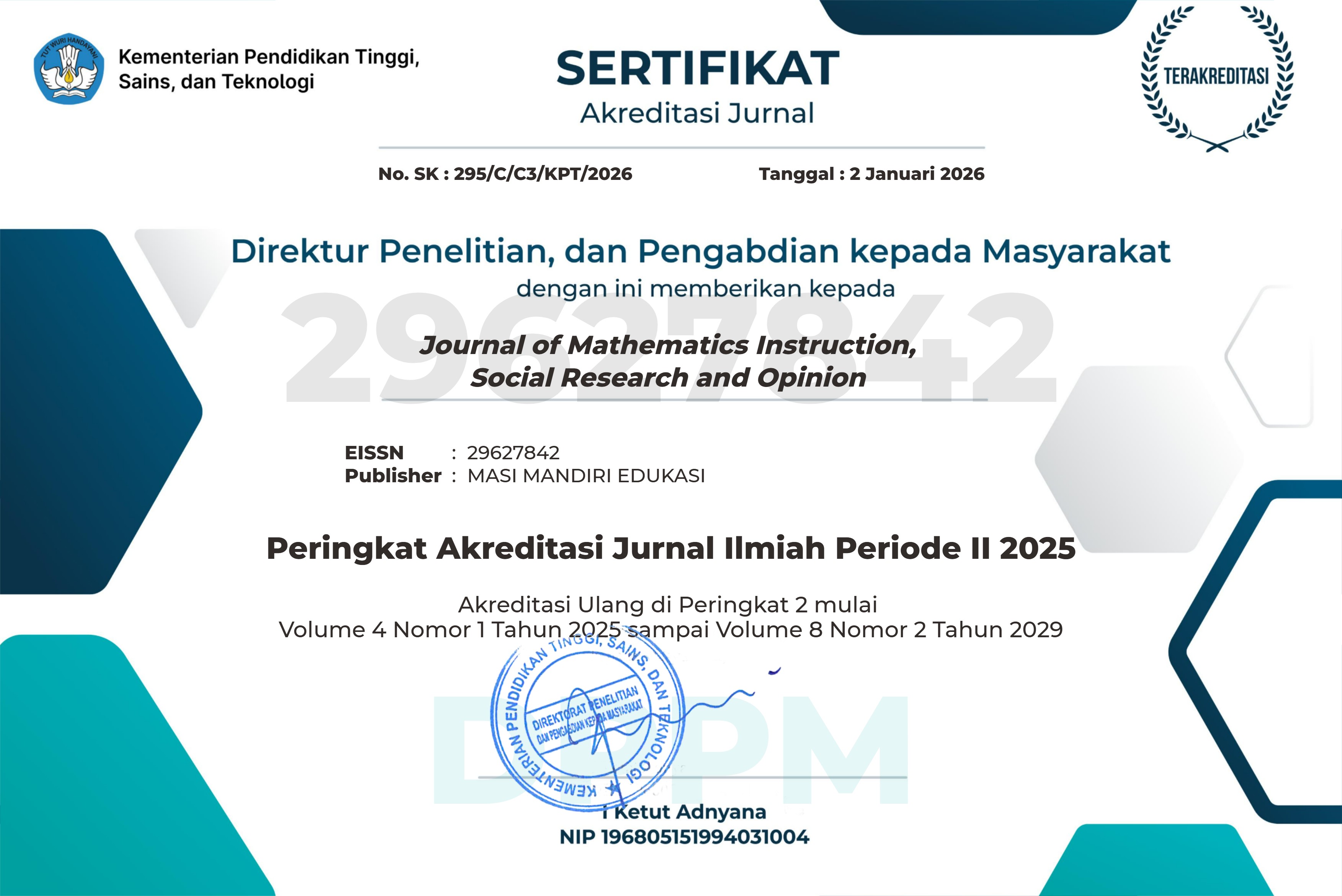
| Accreditation Certificate |
  |
| Indexing |






Contact Us

visitor
| Information |
>> For Authors
>> For Readers
>> For Librarians
| Visitor Statistics |
| Member of |


| Announcement |

| Keywords |
Mathematics Learning Difficulty Dyscalculia Teacher perceptions personality ICT Learning Computer teaching Academic Fisherfolks Economic Behavior Probit Models matrix mathematical model Concepts Guided Note Taking Golden Ratio Philosophy Integrated Learning van Hiele geometry Assessment Learning Outcomes method skills Problem Solving Experiment
| License |

MISRO is licensed under a Creative Commons Attribution-ShareAlike 4.0 International License.
| Publisher |

Address:
Jl. Gagak N0.105, Bandung,
Indonesia 40133
E-mail:
journalmisro@gmail.com
| in collaboration with |

| Recommended Tools |


| ISSN Barcode |

