
Teachers’ Roles in Designing and Implementing Numeracy-Oriented Instruction in Junior High School Mathematics: A Multiple Case Study
DOI:
https://doi.org/10.58421/misro.v5i1.1204Keywords:
Numeracy literacy, Mathematics teachers’ roles, Instructional design, Mathematical reasoning, Minimum Competency Assessment (AKM)Abstract
This study investigates the role of mathematics teachers in junior high schools in promoting students' numeracy through the design and delivery of classroom instruction. The qualitative multiple-case study design was used to gather information on ten mathematics teachers, selected through purposive sampling based on teaching experience and willingness to participate, in the form of lesson plans, observations in classrooms, semi-structured interviews, and analysis of students’ work, which were analyzed using a numeracy framework consisting of representation, conceptual understanding, procedural fluency, and reasoning, guiding thematic content analysis and cross-case comparison. The results show that educators have progressively incorporated real-life contexts and diagnostic tests in their instructional planning. Nevertheless, the combination of the various representations and the systematic development of mathematical reasoning is underdeveloped. These trends indicate that the primary problem with numeracy learning is not the accessibility of numeracy-related tasks, but rather the representation, reasoning, and coherence of instructional design. Based on this, the research indicates the need for professional development initiatives that specifically assist teachers in crafting exploratory, discourse-based numeracy assignments that are consonant with Minimum Competency Assessment (AKM) requirements and classroom contexts.
Downloads
References
H. Purnomo, C. Sa’dijah, E. Hidayanto, S. Sisworo, H. Permadi, and L. Anwar, “Development of Instrument Numeracy Skills Test of Minimum Competency Assessment (MCA) in Indonesia,” International Journal of Instruction, vol. 15, no. 3, pp. 635–648, Jul. 2022, doi: 10.29333/iji.2022.15335a.
R. Rosnelli and P. A. Ristiana, “Independent Curriculum Learning Management to Improve Students’ Literacy and Numerical Competence in Schools,” International Journal of Education in Mathematics, Science and Technology, vol. 11, no. 4, pp. 946–963, Jun. 2023, doi: 10.46328/ijemst.3513.
A. N. Rohmah, S. Sutama, Y. M. Hidayati, E. Fauziati, and L. E. Rahmawati, “Planning for Cultivation Numerical Literacy in Mathematics Learning for Minimum Competency Assessment (AKM) in Elementary Schools,” Mimbar Sekolah Dasar, vol. 9, no. 3, pp. 503–516, Dec. 2022, doi: 10.53400/mimbar-sd.v9i3.51774.
R. Barwell, “What Is Numeracy?,” For the Learning of Mathematics, vol. 24, no. 1, pp. 20–22, 2004, [Online]. Available: http://www.jstor.org/stable/40248441
A. P. Maulidina, “Profil Kemampuan Numerasi Siswa Sekolah Dasar Berkemampuan Tinggi Dalam Memecahkan Masalah Matematika,” Jurnal Bidang Pendidikan Dasar, vol. 3, no. 2, pp. 61–66, Jul. 2019, doi: 10.21067/jbpd.v3i2.3408.
S. L. Handayani, K. Khairil, and K. Kusmajid, “Peningkatan Pembelajaran di Sekolah Dasar Melalui Pengabdian Masyarakat Berbasis Literasi Pada Era Pandemi Covid-19,” International Journal of Public Devotion, vol. 4, no. 1, p. 1, Jul. 2021, doi: 10.26737/ijpd.v4i1.2238.
A. Ayu, N. Fauziyah, and R. R. Wantika, “Pengaruh penerapan pendekatan realistic mathematics education (RME) terhadap kemampuan numerasi matematis siswa,” vol. 10, no. 2, pp. 145–153, 2025.
A. C. Nisa, “Meningkatkan Kemampuan Numerasi Siswa Melalui Model Problem Based Learning Berbantu Quizizz,” Jurnal Educatio FKIP UNMA, vol. 9, no. 1, pp. 310–317, Mar. 2023, doi: 10.31949/educatio.v9i1.4459.
S. Rahmah, A. A. Dalila, W. Liliawati, and A. Setiawan, “Pendekatan Pembelajaran Diferensiasi dalam Model Inkuiri terhadap Kemampuan Numerasi Siswa,” Jurnal Imiah Pendidikan dan Pembelajaran, vol. 6, no. 2, pp. 393–401, Jul. 2022, doi: 10.23887/jipp.v6i2.50838.
S. P. Shahira, S. Sumaji, and H. Ulya, “Efektivitas Model Pembelajaran Creative Problem Solving Berbantuan Media Permath Apps terhadap Kemampuan Numerasi Matematis,” Kognitif: Jurnal Riset HOTS Pendidikan Matematika, vol. 4, no. 3, Sep. 2024, doi: 10.51574/kognitif.v4i3.1720.
Z. A. Chaniago and S. A. Awalludin, “Analisis Kemampuan Berpikir Kritis Matematis Ditinjau dari Tipe Kepribadian dalam Menyelesaikan Soal Literasi dan Numerasi,” SJME (Supremum Journal of Mathematics Education), vol. 8, no. 2, pp. 215–233, Jul. 2024, doi: 10.35706/sjme.v8i2.11306.
Hamda, Waliyullah Akbar, and Nasrullah, “Analisis kemampuan penalaran matematis siswa SMP dalam menyelesaikan masalah literasi numerasi ditinjau dari gaya belajar,” VENN: Journal of Sustainable Innovation on Education, Mathematics and Natural Sciences, vol. 4, no. 3, pp. 183–195, 2025, doi: 10.53696/venn.v4i3.295.
A. F. Putri and R. Setianingsih, “Kemampuan komunikasi matematis siswa dalam menyelesaikan soal numerasi ditinjau dari self-efficacy [Students’ mathematical communication skills in solving numeracy problems viewed from self-efficacy],” MATHEdunesa , vol. 13, pp. 836–845, 2024, doi: https://doi.org/10.26740/mathedunesa.v13n3.p836-845.
A. R. Putri and P. Wijayanti, “Numerasi Peserta Didik SMP Ditinjau Dari Kecerdasan Majemuk Dalam Menyelesaikan Soal AKM,” Journal of the Indonesian Mathematics Education Society, vol. 2, no. 2, pp. 41–63, 2024, doi: https://doi.org/10.26740/jimes.v2n2.p41-63.
S. Rosidah, E. Hidayat, and H. Patmawati, “Analisis kemampuan number sense peserta didik dalam menyelesaikan soal numerasi akm ditinjau dari kecerdasan logis matematis,” Kognitif: Jurnal Riset HOTS Pendidikan Matematika, vol. 4, no. 4, pp. 1673–1686, 2024, doi: 10.51574/kognitif.v4i4.2431.
L. V. Putra, Sukestiyarno, Masrukan, and J. Widodo, “Numeration Problems in Elementary School Mathematics Learning in Semarang from the Teacher’s Perspective,” Pegem journal of Education and Instruction, vol. 13, no. 4, 2023, doi: 10.47750/pegegog.13.04.08.
A. N. Rohmah, S. Sutama, Y. M. Hidayati, E. Fauziati, and L. E. Rahmawati, “Planning for Cultivation Numerical Literacy in Mathematics Learning for Minimum Competency Assessment (AKM) in Elementary Schools,” Mimbar Sekolah Dasar, vol. 9, no. 3, pp. 503–516, Dec. 2022, doi: 10.53400/mimbar-sd.v9i3.51774.
I. R. Hidayah, C. Sa’dijah, L. Anwar, Y. Yerizon, and I. M. Arnawa, “Empowering students’ numeracy skills: Mathematics teachers’ perceptions regarding the effectiveness and challenges of Indonesian national curriculum and the programs – A mixed method study,” Infinity Journal, vol. 14, no. 1, pp. 163–188, Nov. 2024, doi: 10.22460/infinity.v14i1.p163-188.
N. D. S. Lestari, D. S. Pambudi, D. Kurniati, A. P. Maulana, W. Murtafiah, and S. Suwarno, “Kesiapan Guru Matematika Sekolah Menengah Dalam Mengajarkan Literasi Dan Numerasi Melalui Kurikulum Merdeka,” AKSIOMA: Jurnal Program Studi Pendidikan Matematika, vol. 12, no. 2, p. 1650, Jun. 2023, doi: 10.24127/ajpm.v12i2.6674.
L. V. Putra, Sukestiyarno, Masrukan, and J. Widodo, “Numeration Problems in Elementary School Mathematics Learning in Semarang from the Teacher’s Perspective,” Pegem journal of Education and Instruction, vol. 13, no. 4, Aug. 2023, doi: 10.47750/pegegog.13.04.08.
R. K. . Yin and D. T. . Campbell, Case study research and applications : design and methods. SAGE Publications, Inc., 2018.
S. Arikunto, Prosedur Penelitian Pendidikan Suatu Pendekatan Praktik. Jakarta: Rineka Cipta, 2010.
E. Ampadu, M. Narh-Kert, and R. Yeboah, “Teachers’, Researchers’, and Educators’ Partnerships: The Effect of Co-Creation on Pupils’ Problem-Solving Performance in Mathematics,” Educ. Sci. (Basel)., vol. 14, no. 12, p. 1328, Dec. 2024, doi: 10.3390/educsci14121328.
L. Goertzen, T. Schils, and S. Heeneman, “Co-designing formative assessment practices: A collaboration between elementary school teachers and researchers to conceptualize and implement formative assessment as a unified practice,” Teach. Teach. Educ., vol. 134, p. 104306, Nov. 2023, doi: 10.1016/j.tate.2023.104306.
A.-C. Weber, L. Bogler, and S. Vollmer, “Formal vs. informal mathematics: Assessing numeracy with school and market items in a large sample of school-aged children in North-West Nigeria,” Econ. Educ. Rev., vol. 102, p. 102564, Oct. 2024, doi: 10.1016/j.econedurev.2024.102564.
H. Sigus and K. Mädamürk, “Context matters: the importance of extra-mathematical knowledge in solving mathematical problems,” Front. Educ. (Lausanne)., vol. 9, Apr. 2024, doi: 10.3389/feduc.2024.1334034.
T. Fan, J. Song, and Z. Guan, “Integrating diagnostic assessment into curriculum: a theoretical framework and teaching practices,” Language Testing in Asia, vol. 11, no. 1, p. 2, Jan. 2021, doi: 10.1186/s40468-020-00117-y.
OECD, “PISA 2022 Mathematics Framework Draft,” 2022, Accessed: Jan. 16, 2026. [Online]. Available: https://pisa2022-maths.oecd.org/#What-is-Mathematical-Literacy
Kemendikbudristek, Kajian Akademik Penyusunan Rancangan Permendikbud – Standar Proses Pembelajaran; Badan Standar, Kurikulum, dan Asesmen Pendidikan. 2021.
J. R. Star, “Reconceptualizing procedural knowledge,” J. Res. Math. Educ., vol. 36, no. 5, pp. 404–411, 2005, doi: 10.2307/30034943.
National Council of Teacher Mathematics, Principles and standards for school mathematics. Reston, Virginia: NCTM, 2000.
L. Patterson and Y. Xu, “Enhancing Teachers’ Competence in Building Students’ Numeracy in Grades K-3,” Front. Educ. (Lausanne)., vol. 5, Apr. 2020, doi: 10.3389/feduc.2020.00031.
M. Walshaw and G. Anthony, “The Teacher’s Role in Classroom Discourse: A Review of Recent Research Into Mathematics Classrooms,” Rev. Educ. Res., vol. 78, no. 3, pp. 516–551, Sep. 2008, doi: 10.3102/0034654308320292.
Y. F. Zakariya and N. A. Adegoke, “Teacher instructional practices: untangling their complex relations with self-efficacy, job satisfaction, stress, and cooperation among mathematics teachers,” Front. Educ. (Lausanne)., vol. 9, Jul. 2024, doi: 10.3389/feduc.2024.1367076.
D. A. G. Berg, N. Ingram, M. Asil, J. Ward, and J. K. Smith, “Self-efficacy in teaching mathematics and the use of effective pedagogical practices in New Zealand primary schools,” Journal of Mathematics Teacher Education, vol. 28, no. 1, pp. 129–149, Feb. 2025, doi: 10.1007/s10857-024-09623-9.
R. Suryani and N. Pratiwi, “Exploring Strategies and Challenges Faced by Novice Teachers in Preparing Students for the Minimum Competency Assessment: a Case Study in Indonesia,” Southeast Asian Mathematics Education Journal, vol. 14, no. 1, pp. 31–46, Jul. 2024, doi: 10.46517/seamej.v14i1.271.
M. Tamur, “Evaluation of the Results of Professional Development of Mathematics Teachers in East Nusa Tenggara Province,” Plusminus: Jurnal Pendidikan Matematika, vol. 5, no. 1, pp. 81–90, Mar. 2025, doi: 10.31980/plusminus.v5i1.2378.
D. Pranata and A. Supramono, “The Student’s Difficulties in Completing Numeracy Item of Minimum Competency Assessment,” 2024. [Online]. Available: www.istes.orghttps://orcid.org/0000-0002-7207-5365https://orcid.org/0000-0002-0580-5671https://orcid.org/0000-0002-9226-8500www.istes.org
R. Prince and V. Frith, “An investigation of the relationship between academic numeracy of university students in South Africa and their mathematical and language ability,” ZDM, vol. 52, no. 3, pp. 433–445, Jun. 2020, doi: 10.1007/s11858-019-01063-7.
S. Setiyani, S. B. Waluya, Y. L. Sukestiyarno, and A. N. Cahyono, “Mathematical Reflective Thinking Process of Prospective Elementary Teachers Review from the Disposition in Numerical Literacy Problems,” Int. J. Educ. Method., vol. 8, no. 3, pp. 405–420, Aug. 2022, doi: 10.12973/ijem.8.3.405.
Downloads
Additional Files
Published
How to Cite
Issue
Section
License
Copyright (c) 2026 Journal of Mathematics Instruction, Social Research and Opinion

This work is licensed under a Creative Commons Attribution-ShareAlike 4.0 International License.
SideBar
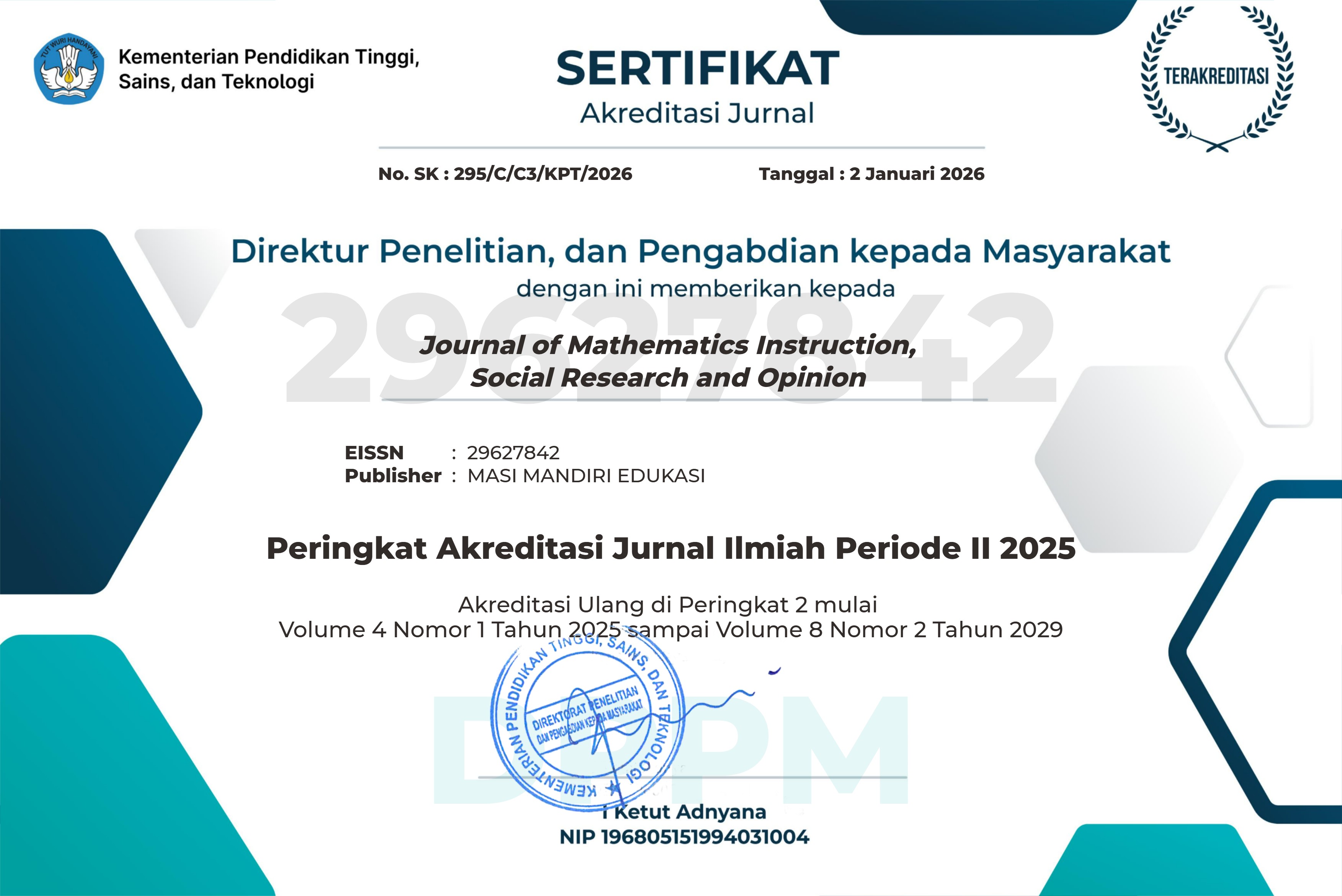
| Accreditation Certificate |
  |
| Indexing |






Contact Us

visitor
| Information |
>> For Authors
>> For Readers
>> For Librarians
| Visitor Statistics |
| Member of |


| Announcement |

| Keywords |
Mathematics Learning Difficulty Dyscalculia Teacher perceptions personality ICT Learning Computer teaching Academic Fisherfolks Economic Behavior Probit Models matrix mathematical model Concepts Guided Note Taking Golden Ratio Philosophy Integrated Learning van Hiele geometry Assessment Learning Outcomes method skills Problem Solving Experiment
| License |

MISRO is licensed under a Creative Commons Attribution-ShareAlike 4.0 International License.
| Publisher |

Address:
Jl. Gagak N0.105, Bandung,
Indonesia 40133
E-mail:
journalmisro@gmail.com
| in collaboration with |

| Recommended Tools |


| ISSN Barcode |

