
Determinants of the Success of Zakat Utilization in Alleviating Poverty
DOI:
https://doi.org/10.58421/misro.v5i1.1185Keywords:
Zakat, Structural Equation Modeling, Mustahik empowerment, Poverty alleviationAbstract
Zakat has increasingly been recognized as a strategic Islamic economic instrument for poverty alleviation and social welfare development. However, the effectiveness of zakat in improving the economic conditions of mustahik remains inconsistent due to complex interactions among institutional, psychological, and economic factors. Despite extensive studies on zakat distribution and poverty reduction, few have examined the structural relationships among these factors using a comprehensive quantitative approach. Therefore, this study aims to analyze the determinants of successful zakat utilization in alleviating poverty. This study employs a quantitative approach using Structural Equation Modeling (SEM) to examine the relationships among key variables influencing zakat program effectiveness. The sample consists of 258 mustahik who participated in productive zakat programs in West Java, Indonesia. Data were collected via structured questionnaires using a five-point Likert scale and analyzed with AMOS. The results indicate that the proposed model demonstrates an acceptable level of goodness-of-fit, with values of CMIN/DF = 2.551, CFI = 0.902, TLI = 0.887, and RMSEA = 0.078. The findings reveal that organizational support significantly influences education, motivation, entrepreneurship, and economic empowerment, while education and motivation significantly contribute to economic empowerment. Furthermore, economic empowerment directly contributes to poverty alleviation, suggesting that productive zakat programs can generate sustainable welfare improvements when supported by robust institutional mechanisms. These findings suggest that zakat institutions should strengthen capacity-building programs, entrepreneurial mentoring, and integrated empowerment strategies to enhance the long-term effectiveness of zakat in alleviating poverty.
Downloads
References
K. A. Meerangani, “The Effectiveness of Zakat in Developing Muslims in Malaysia,” Insa. J. Islam Humanit., vol. 3, no. 2, pp. 127–138, May 2019, doi: 10.15408/insaniyat.v3i2.11315
B. Ahmad Malik, “Philanthropy in Practice: Role of Zakat in the Realization of Justice and Economic Growth,” Int. J. Zakat, vol. 1, no. 1, pp. 64–77, Nov. 2016, doi: 10.37706/ijaz.v1i1.7.
S. Herianingrum et al., “Zakat as an instrument of poverty reduction in Indonesia,” J. Islam. Account. Bus. Res., vol. 15, no. 4, pp. 643–660, Mar. 2024, doi: 10.1108/JIABR-11-2021-0307.
N. A. Wahab and A. Rahim Abdul Rahman, “A framework to analyse the efficiency and governance of zakat institutions,” J. Islam. Account. Bus. Res., vol. 2, no. 1, pp. 43–62, Apr. 2011, doi: 10.1108/17590811111129508.
N. S. Shirazi, “Integrating Zakat and Waqf into the Poverty Reduction Strategy of the IDB Member Countries,” Islam. Econ. Stud., vol. 22, no. 1, pp. 79–108, 2014, doi: 10.12816/0004131.
I. D’Attoma and M. Matteucci, “Multidimensional poverty: an analysis of definitions, measurement tools, applications and their evolution over time through a systematic review of the literature up to 2019,” Qual. Quant., vol. 58, no. 4, pp. 3171–3213, Aug. 2024, doi: 10.1007/s11135-023-01792-8.
C. Li and X. Zhang, “A Moderated Mediation Model of the Relationship Between Multidimensional Poverty and Psychological Consequences of Left-Behind Children,” Int. J. Ment. Health Addict., vol. 23, no. 1, pp. 368–388, Feb. 2025, doi: 10.1007/s11469-023-01117-8.
P. Martínez Valera et al., “Poverty associated with anxiety, personality and depression disorders in adults at the ‘Sarita Colonia’ Community Mental Health Center in Callao 2017–2022,” Cogent Soc. Sci., vol. 11, no. 1, Dec. 2025, doi: 10.1080/23311886.2025.2449597.
E. Muda, Syafrinaldi, and A. Thalib, “Innovative Approaches to Managing Zakat within the Context of Sustainable Development and Societal Well-Being in Indonesia,” Eur. J. Stud. Manag. Bus., vol. 29, pp. 74–89, Jan. 2024, doi: 10.32038/mbrq.2024.29.05.
I. Piliyanti, “Implementing Maqāṣid Syarīʿah on Social Innovation For Sustainable Zakat Management Organization in Indonesia,” KARSA J. Soc. Islam. Cult., vol. 31, no. 1, pp. 109–130, Jun. 2023, doi: 10.19105/karsa.v31i1.12554.
Y. Aziz, F. Mansor, S. Waqar, and L. Haji Abdullah, “The nexus between zakat and poverty reduction, is the effective utilization of zakat necessary for achieving SDGs: A multidimensional poverty index approach,” Asian Soc. Work Policy Rev., vol. 14, no. 3, pp. 235–247, Oct. 2020, doi: 10.1111/aswp.12212.
A. Fachri and C. Etika, “Optimization of Zakat Fundraising Realisation Based on the Measurement of the Zakat Literacy Index in Rural and Urban Communities,” Islam. Econ. J., vol. 10, no. 2, pp. 163–183, Dec. 2024, doi: 10.21111/iej.v10i2.12975.
M. I. H. Kamaruddin and M. M. Hanefah, “Bridging Zakat Impacts Toward Maqasid Shariah and Sustainable Development Goals (SDGs), Influence of Corporatization and Experiences on COVID-19,” in Islamic Wealth and the SDGs, Cham: Springer International Publishing, 2021, pp. 393–420. doi: 10.1007/978-3-030-65313-2_20.
S. A. Bin-Nashwan, H. Abdul-Jabbar, and S. A. Aziz, “Does trust in zakat institution enhance entrepreneurs’ zakat compliance?,” J. Islam. Account. Bus. Res., vol. 12, no. 5, pp. 768–790, Aug. 2021, doi: 10.1108/JIABR-09-2020-0282.
Y. Busa, L. Witteveen, E. Elihami, N. Nurdin, M. Masnur, and D. Anugrah, “Determinants of Zakat Management Policy Implementation in Enrekang Regency,” J. Local Gov. Issues, vol. 8, no. 1, pp. 107–124, Mar. 2025, doi: 10.22219/logos.v8i1.28018.
Syadiyah Abdul Shukor, “Determinants of Zakat Compliance among Muslim Individuals: A Systematic Literature Review,” J. Islam. Financ., vol. 10, no. 2, pp. 90–100, Dec. 2021, doi: 10.31436/jif.v10i2.599.
R. A. J. Saad and A. U. Farouk, “A comprehensive review of barriers to a functional Zakat system in Nigeria,” Int. J. Ethics Syst., vol. 35, no. 1, pp. 24–42, Jan. 2019, doi: 10.1108/IJOES-06-2018-0090.
A. N. H. Nik, “Nexus Between Islamic Microfinancing and Financial Wellbeing of Microentrepreneurs during the Covid-19 Pandemic in Malaysia,” J. Ekon. Malaysia, vol. 55, no. 1, Apr. 2021, doi: 10.17576/JEM-2021-5501-10.
A. K. Chy, “The Role Of Zakat In The Socio-Economic Empowerment Of Muslim Communities In The UK: Challenges, Opportunities, and Future Directions,” AZKA Int. J. Zakat Soc. Financ., pp. 191–218, Mar. 2025, doi: 10.51377/azjaf.vol6no1.206.
R. Rahmat, “Economic Empowerment of Small Businesses Through Zakat Funds at the Amil Zakat Infaq Shadaqah Institute in Surakarta,” Demak Univers. J. Islam Sharia, vol. 2, no. 02, pp. 133–144, Mar. 2024, doi: 10.61455/deujis.v2i02.116.
I. A. Zuhairah, R. Taha, M. A. Hamzah, Z. Salleh, N. Ahmad, and R. Azmi, “The impact of the Zakkat Capital Assistance Program on the entrepreneurship development intention: the case of Malaysia,” J. Chinese Econ. Bus. Stud., pp. 1–26, Mar. 2025, doi: 10.1080/14765284.2025.2477967.
A. Budi Santoso, A. Nurhadi, and M. H. Bin Ghazali Mohd Jani, “Empowering Persons with Disabilities through Inclusive Productive Zakat Models: Insights from Indonesian Local Cases,” J. Pemberdaya. Masy. Media Pemikir. dan Dakwah Pembang., vol. 9, no. 1, pp. 1–30, Apr. 2025, doi: 10.14421/jpm.2025.091-01.
D. Ibrahim, D., & RuziahGhazali, “Zakah as an Islamic Micro-Financing Mechanism to Productive Zakah Recipients,” Asian Econ. Financ. Rev. 4(1), 117-125., vol. 4, no. 1, pp. 117–125, 2014, [Online]. Available: http://www.pakinsight.com/pdf-files/aefr 4(1), 117-125.pdf
J. F. Hair, W. C. Black, B. J. Babin, and R. E. Anderson, Multivariate Data Analysis: a global perspective. 2010.
Downloads
Additional Files
Published
How to Cite
Issue
Section
License
Copyright (c) 2026 Journal of Mathematics Instruction, Social Research and Opinion

This work is licensed under a Creative Commons Attribution-ShareAlike 4.0 International License.
SideBar
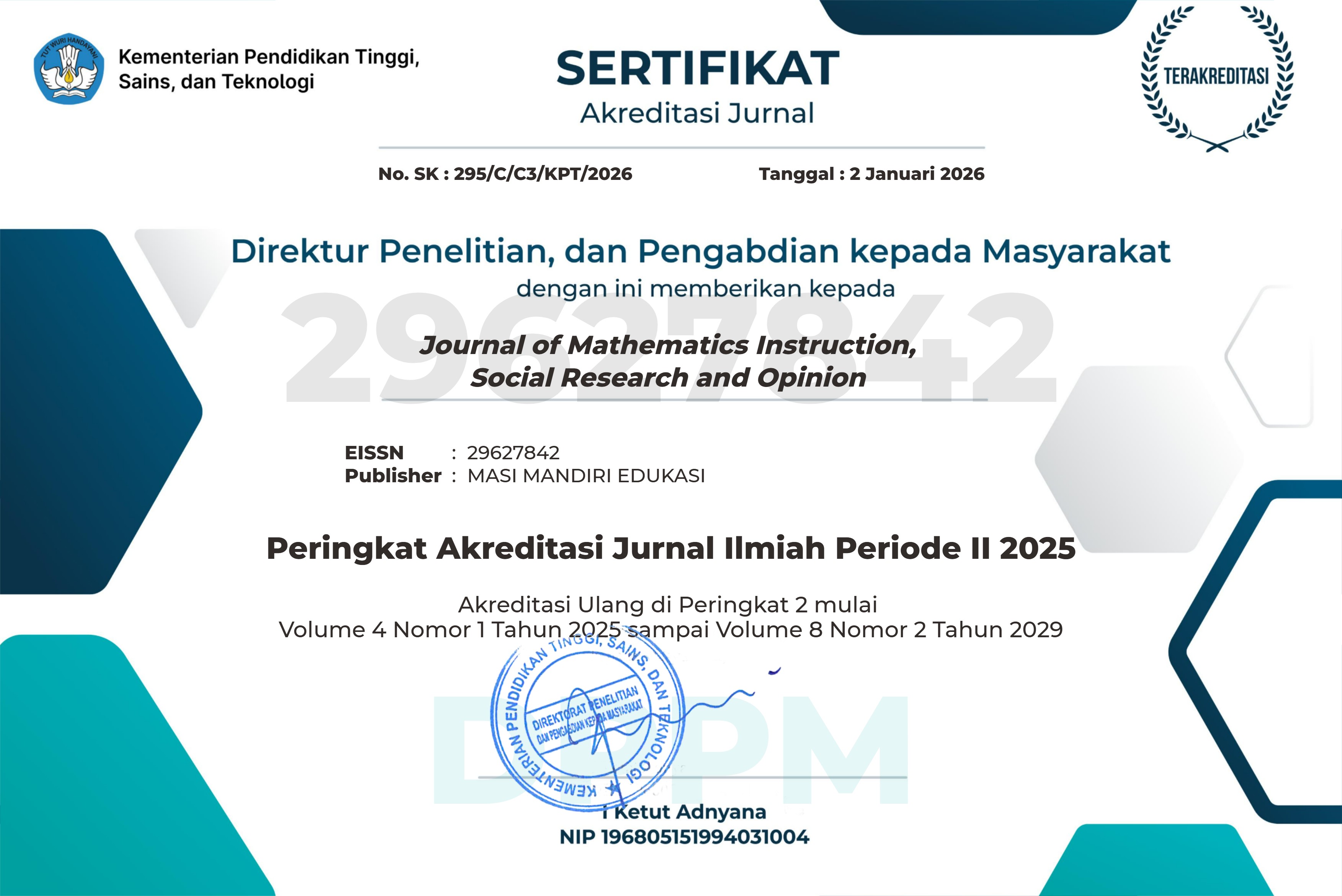
| Accreditation Certificate |
  |
| Indexing |






Contact Us

visitor
| Information |
>> For Authors
>> For Readers
>> For Librarians
| Visitor Statistics |
| Member of |


| Announcement |

| Keywords |
Mathematics Learning Difficulty Dyscalculia Teacher perceptions personality ICT Learning Computer teaching Academic Fisherfolks Economic Behavior Probit Models matrix mathematical model Concepts Guided Note Taking Golden Ratio Philosophy Integrated Learning van Hiele geometry Assessment Learning Outcomes method skills Problem Solving Experiment
| License |

MISRO is licensed under a Creative Commons Attribution-ShareAlike 4.0 International License.
| Publisher |

Address:
Jl. Gagak N0.105, Bandung,
Indonesia 40133
E-mail:
journalmisro@gmail.com
| in collaboration with |

| Recommended Tools |


| ISSN Barcode |

