
Constructing Pedagogical Identity Through Local Culture-Based English Materials among Pre-Service Mathematics Teachers
DOI:
https://doi.org/10.58421/misro.v5i1.1166Keywords:
local culture, mathematics, pedagogical identity, Pre-Service TeachersAbstract
In mathematics teacher education, English learning is often treated primarily as a linguistic requirement rather than as a pedagogically meaningful component of professional preparation. Consequently, English courses frequently contribute little to the development of pedagogical identity among pre-service mathematics teachers. This study aims to examine how local culture–based English learning materials function as a pedagogical space for the construction of pedagogical identity among pre-service mathematics teachers. This research employed a qualitative descriptive approach conducted in an English for Mathematics Learning course involving 80 sixth-semester pre-service mathematics teachers. Data were collected through open-ended questionnaires, classroom observations, and students’ written reflections embedded in culturally contextualized learning activities, and were analyzed using thematic analysis. The findings reveal that integrating local culture into English learning materials supports pedagogical identity development by encouraging culturally situated learning, reframing English as a pedagogical tool for explaining mathematical concepts, strengthening pedagogical confidence, and promoting reflective and collaborative learning practices. Cultural familiarity also reduces linguistic anxiety and enables students to position themselves more confidently as future mathematics teachers. These findings highlight the role of local culture as an epistemic and affective resource that supports participation, strengthens instructional confidence, and facilitates the development of pedagogical identity within mathematics teacher education.
Downloads
References
S. Wiyanah and S. Candraningsih, “Learning difficulties in understanding English materials of mathematics education students,” Proceedings (ASSEHR 695), pp. 189–202, 2023.
G. Lawrent, “Education sector development and teacher identity construction: a reflective experience,” Front. Educ., vol. 9, p. 1407416, Dec. 2024, doi: 10.3389/feduc.2024.1407416.
H. Pravitasari, E. S. Yanto, and I. N. K. Fatihah, “Emotional experiences and identity construction of pre-service English teachers during teaching practicum in Indonesia,” J. Engl. Educ., vol. 11, no. 1, pp. 68–87, May 2025, doi: 10.20885/jee.v11i1.40130.
D. Paris, “Culturally Sustaining Pedagogies and Our Futures,” The Educational Forum, vol. 85, no. 4, pp. 364–376, Oct. 2021, doi: 10.1080/00131725.2021.1957634.
M. Caingcoy, “Culturally Responsive Pedagogy: A Systematic Overview,” Div Journ, vol. 8, no. 4, pp. 3203–3212, Oct. 2023, doi: 10.48017/dj.v8i4.2780.
V. Siliunas, G. Wan, and E. Edejer, “Teacher Preparation for Culturally Responsive Teaching: Implications for Teacher Education,” Action in Teacher Education, vol. 46, no. 4, pp. 313–331, Oct. 2024, doi: 10.1080/01626620.2024.2358912.
L. Azhary and S. Fatimah, “The Integration of Local Cultures in English Teaching Materials in Promoting Culturally Responsive Teaching,” AIJP, vol. 16, no. 2, May 2024, doi: 10.35445/alishlah.v16i2.4998.
Ni Nyoman Tantri and Made Hery Santosa, “The Integration and Development of EFL Classroom Materials Based on Local Culture: A Systematic Literature Review,” JPBI, vol. 12, no. 1, pp. 61–70, Jul. 2024, doi: 10.23887/jpbi.v12i1.80050.
R. Ningsih, “English instructional material development for mathematics students: A needs analysis-based approach,” Journal of English Language Teaching and Linguistics, vol. 6, no. 2, pp. 145–160, 2021.
T. D. Rahmawati, T. Septia, V. H. Kristianto, and V. H. Ndori, “Pengaruh Model Pembelajaran Make a Match terhadap Pemahaman Konsep Matematika Siswa,” IJME, vol. 4, no. 2, pp. 101–109, Jul. 2025, doi: 10.58917/ijme.v4i2.225.
F. Z. Kumala, I. D. Tantri, and F. Agarica, “Development of Educational Game Media with An Ethnomathematics Approach based on Banyumas Culture and Science,” Inspiramatika, vol. 11, no. 1, pp. 152–176, Jun. 2025, doi: 10.52166/inspiramatika.v11i1.9517.
L. D. Hidayat and I. Novikasari, “Effectiveness of Realistic Mathematics Approach to Increasing Mathematical Representation Ability at SMP N 9 Purwokerto,” IJRME, vol. 1, no. 2, pp. 116–125, Nov. 2023, doi: 10.24090/ijrme.v1i2.9139.
A. Sari and Yuliana, “Pengembagang Modul Bahasa Inggris untuk Mahasiswa Program Studi Matematika di STKIP Muhammadiyah Pagaralam,” JIK, vol. 6, no. 2, pp. 143–154, Nov. 2022, doi: 10.33369/jik.v6i2.23943.
I. Novikasari, L. Awalia, and N. Elebrary, “Ethnomathematics-Based Geometry Modules to Enhance Problem-Solving Skills of Islamic Junior High School Students,” Al-Ta’lim Journal, vol. 32, no. 3, 2025.
A. M. P. Siregar, S. Sahyoni, and S. Suadi, “DEVELOPING A TEACHING BOOK ‘ENGLISH FOR MATH’ BASED ON LOCAL WISDOM,” PJEE, vol. 14, no. 2, p. 422, Jun. 2025, doi: 10.24127/pj.v14i2.12065.
P. J. Allen, I. Bergès, R. Joiner, and G. G. Noam, “Supporting every teacher: Using the Holistic Teacher Assessment (HTA) to measure social-emotional experiences of educators,” Teaching and Teacher Education, vol. 119, p. 103827, Nov. 2022, doi: 10.1016/j.tate.2022.103827.
G. Barkhuizen, Language Teacher Identity. Cambridge University Press, 2022.
I. M. Mukaromah and F. Z. Kumala, “Pengaruh model pembelajaran vak dengan menggunakan media video pembelajaran terhadap kemampuan pemahaman konsep matematis,” Prosiding Seminar Nasional PGSD UST, pp. 263–271, 2024.
M. K. Faskha and F. Z. Kumala, “Pengembangan Media Game Edukasi Materi Aljabar Untuk Meningkatkan Kemampuan Pemecahan Masalah Matematis Kelas VII SMP Ma’arif NU 1 Bumiayu,” Proceedings Series on Social Sciences & Humanities, vol. 24, pp. 199–202, 2025.
I. Novikasari, A. Hidayat, and R. Nugroho, “Integrasi Teknologi Visual dan Problem Based Learning terhadap Penguatan Kemampuan Kognitif Matematika Siswa,” Jurnal Lebesgue: Jurnal Ilmiah Pendidikan Matematika, Matematika dan Statistika, vol. 6, no. 2, pp. 843–851, 2025.
M. ’Azmi Nuha and R. M. Alfathy, “Pre-Service Teachers Perspectives on Stem - Science, Technology, Engineering, and Mathematics,” Russian Psychological Journal, vol. 21, no. 1, pp. 210–224, 2024, doi: https://doi.org/10.21702/rpj.2024.1.11.
M. Ulpah, Muflihah, and U. Hidayati, “Developing English Learning Material with Islamic Context for Pre-Service Mathematics Teachers,” EDUKASIA Jurnal Pendidikan Dan Pembelajaran, vol. 6, no. 2, pp. 915–926, 2025, doi: https://doi.org/10.62775/edukasia.v6i2.1647.
S. Pevec-Zimmer, L. P. Juang, and M. K. Schachner, “Promoting Awareness and Self-Efficacy for Culturally Responsive Teaching of Pre-Service Teachers Through the Identity Project – a Mixed Methods Study,” Identity, vol. 24, no. 4, pp. 288–306, Oct. 2024, doi: 10.1080/15283488.2024.2344086.
M. H. D. Nurdiansyah and I. Novikasari, “Sociology-based character education strategies and their role in shaping moral development in boarding-based islamic education,” JORCS, vol. 2, no. 2, Aug. 2025, doi: 10.61511/jorcs.v2i2.2025.2008.
V. Oktaviani, I. Novikasari, and A. Y. Rizky, “Media Pembelajaran Digital Berbasis Budaya Lokal untuk Meningkatkan Kemampuan Komunikasi Siswa,” Prosiding Diskusi Panel Nasional Pendidikan Matematika, 2025.
D. Marsilia and F. Z. Zana, “The Influence of Snowball Throwing Learning Model with Contextual Approach on Critical Mathematical Thinking Skills and Students’ Self Confidence Grade VIII MTs Ma’Arif NU 1 Kedungbanteng,” Proceedings Series on Social Sciences & Humanities, vol. 24, pp. 397–401, 2025.
X. Huang and C. Wang, “Pre-service teachers’ professional identity transformation: a positioning theory perspective,” Professional Development in Education, vol. 50, no. 1, pp. 174–191, Jan. 2024, doi: 10.1080/19415257.2021.1942143.
M. Arvaja, “Constructing Teacher Self in a Dialogue between Multiple I-Positions: A Case from Teacher Education,” Journal of Constructivist Psychology, vol. 37, no. 4, pp. 451–471, Oct. 2024, doi: 10.1080/10720537.2023.2276275.
F. Z. Kumala, S. Nurfadila, and T. Rahmawati, “Etnomatematika Pada Kelenteng Boen Tek Bio Banyumas: Studi Geometri, Transformasi Geometri, dan Himpunan,” Edumatnesia: Prosiding Seminar Nasional Matematika dan Pendidikan Matematika, pp. 414–430, 2024.
R. Kurniasari and F. Z. Kumala, “Pengembangan Media Pembelajaran Berbasis Articulate Storyline dengan Pendekatan Etnomatematika untuk Meningkatkan Kemampuan Pemecahan Masalah Matematis Siswa SMP,” Supermat : Jurnal Pendidikan Matematika, vol. 9, no. 2, pp. 90–106, 2025, doi: https://doi.org/10.33627/sm.v9i2.4045.
W. Pasaribu and S. Lestari, “Teaching Anxiety Among EFL Student Teachers During the Teaching Practicum,” eduline j. educ. learn. innov., vol. 3, no. 4, pp. 543–547, Nov. 2023, doi: 10.35877/454RI.eduline2145.
S. Attia and M. Algazo, “Foreign language anxiety in EFL classrooms: teachers’ perceptions, challenges, and strategies for mitigation,” Front. Educ., vol. 10, p. 1614353, Aug. 2025, doi: 10.3389/feduc.2025.1614353.
D. Fulana and F. Z. Kumala, “Enhancing 8th grade students’ mathematical understanding: A quasi-experimental study on game-based learning media,” Union J. Ilm. Pendidik. Mat., vol. 12, no. 1, pp. 134–144, Mar. 2024, doi: 10.30738/union.v12i1.15657.
H. A. Setiaji, M. A. Nuha, and W. A. Nuron, “Analisis Kemampuan Numerasi Siswa SMP dalam Menyelesaikan Soal Asesmen Kompetensi Minimum (AKM) ditinjau dari Adversity Quotient (AQ),” J.A.PMat, pp. 68–75, Nov. 2024, doi: 10.55340/japm.v10i2.1658.
J. Golzar, “Teacher identity formation through classroom practices in the post-method era: A systematic review,” Cogent Education, vol. 7, no. 1, p. 1853304, Jan. 2020, doi: 10.1080/2331186X.2020.1853304.
S. Fackler, L.-E. Malmberg, and P. Sammons, “An international perspective on teacher self-efficacy: Personal, structural and environmental factors,” Teaching and Teacher Education, vol. 99, p. 103255, Mar. 2021, doi: 10.1016/j.tate.2020.103255.
D. S. Mukaromah, F. Z. Kumala, and J. M. C. Sardido, “Enhancing Junior High School Students’ Mathematical Understanding through Augmented Reality Media Using Assemblr Edu: A Development Study,” IJRME, vol. 3, no. 1, pp. 33–50, Jun. 2025, doi: 10.24090/ijrme.v3i1.13438.
H. Al Faruq and K. Hidayati, “The Influence of Critical Thinking, Logical Thinking, and Belief on Students’ Mathematical Problem Solving Abilities,” MaPan, vol. 13, no. 2, pp. 429–447, Dec. 2025, doi: 10.24252/mapan.2025v13n2a10.
H. Hidayah and M. Ulpah, “The Effect of Inquiry Learning Model on Mathematical Ability Connection And Habit of Mind of Eighth-Grade Students at MTs Ma’arif NU 09 Kutawis Purbalingga,” Proceedings of International Student Conference on Education (ISCE), vol. 24, pp. 133–137, 2025.
L. N. Istiqumatunisa and F. Z. Kumala, “Pengaruh Pendekatan Matematika Realistik Terhadap Kemampuan Pemahaman Konsep Matematis Siswa Kelas VII SLB-B Negeri Mandiraja Pada Materi Perkalian,” Proceedings Series on Social Sciences & Humanities, vol. 24, pp. 477–483, 2025.
C. Li and L. Yang, “How scientific concept develops: Languaging in collaborative writing tasks,” System, vol. 105, p. 102744, Apr. 2022, doi: 10.1016/j.system.2022.102744.
P. Shaw, “Eckardt, F. D. (ed.) (2022): Landscapes and Landforms of Botswana. Springer, Cham, Switzerland. xxiii, 403 p., 265 figures and tables. ISBN 978-3-030-86101-8. https://doi.org/10-1007/978-3-030-86102-5,” Zeitschrift für Geomorphologie, vol. 64, no. 1, pp. 73–75, Dec. 2022, doi: 10.1127/zfg/2022/0770.
P. Rahayu and I. Novikasari, “Language Development in Children From The Perspective of The Philosophy of Science,” International Proceedings of Nusantara Raya, vol. 3, no. 1, pp. 41–45, 2024.
I. Novikasari and C. A. Santosa, “Designing for Equity: Gender-Responsive Mathematics Materials in Indonesian Teacher Education,” in Integrating Gender Equity Into Mathematics Curriculum and Teacher Education, L. Incikabi, Ed., IGI Global Scientific Publishing, 2025, pp. 243–276. doi: 10.4018/979-8-3373-7245-7.ch008.
Mutijah, Rohmad, Kholid Mawardi, Suparjo, Muhamad Slamet Yahya, and Ifada Novikasari, “Analysis of Multinomial Logistics Regression on the Students Faith Data,” ENTHUSIASTIC, pp. 36–45, Apr. 2025, doi: 10.20885/enthusiastic.vol5.iss1.art4.
A. Yudistira Aditya, H. Al Faruq, and D. Susanto, “Optimization of Mathematics Learning Interest and Achievement through Group Investigation Type Cooperative Learning Model in Online Learning,” INOMATIKA, vol. 7, no. 2, pp. 176–196, Jul. 2025, doi: 10.35438/inomatika.v7i2.499.
Downloads
Additional Files
Published
How to Cite
Issue
Section
License
Copyright (c) 2026 Journal of Mathematics Instruction, Social Research and Opinion

This work is licensed under a Creative Commons Attribution-ShareAlike 4.0 International License.
SideBar
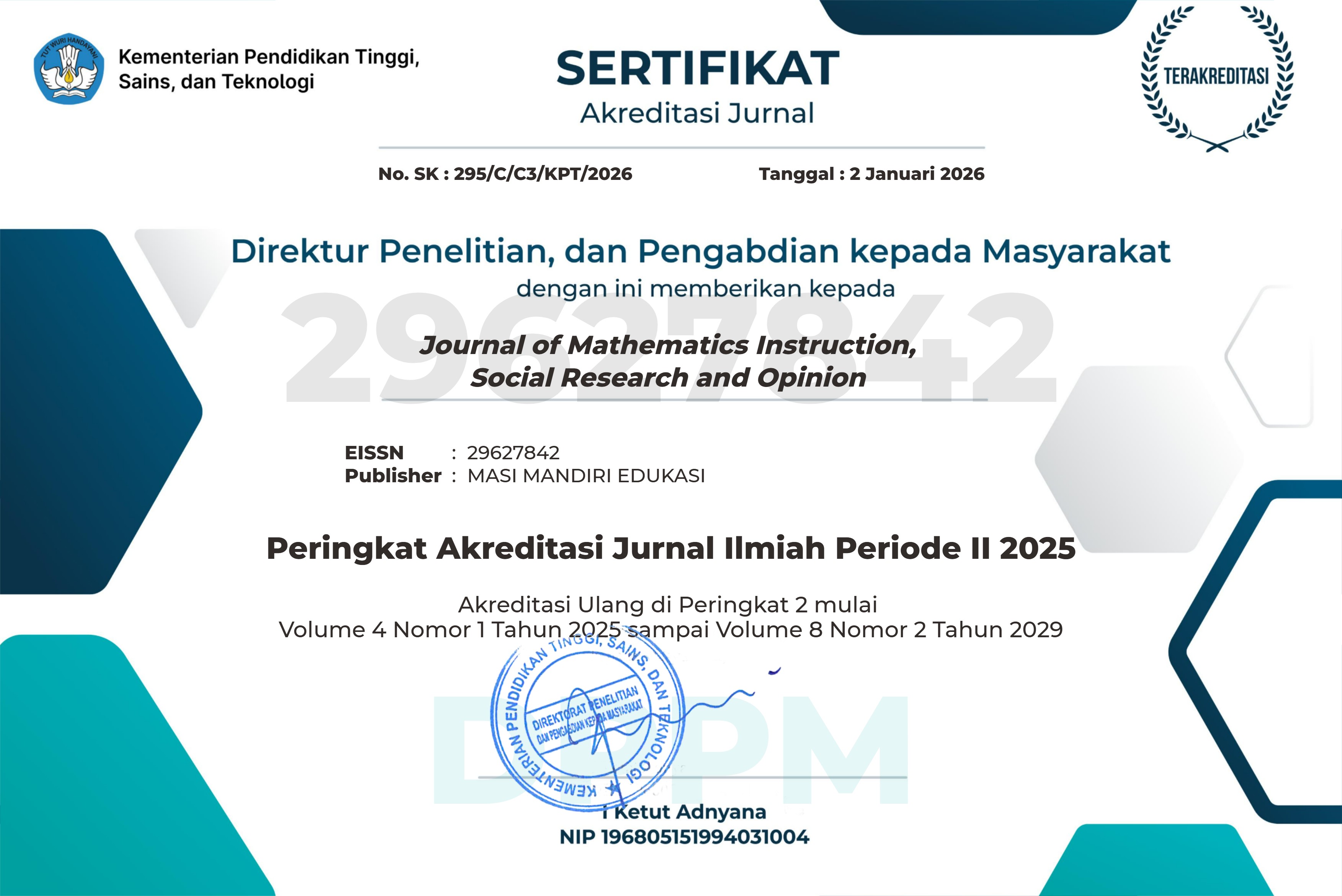
| Accreditation Certificate |
  |
| Indexing |






Contact Us

visitor
| Information |
>> For Authors
>> For Readers
>> For Librarians
| Visitor Statistics |
| Member of |

| Announcement |

| Keywords |
Mathematics Learning Difficulty Dyscalculia Teacher perceptions personality ICT Learning Computer teaching Academic Fisherfolks Economic Behavior Probit Models matrix mathematical model Concepts Guided Note Taking Golden Ratio Philosophy Integrated Learning van Hiele geometry Assessment Learning Outcomes method skills Problem Solving Experiment
| License |

MISRO is licensed under a Creative Commons Attribution-ShareAlike 4.0 International License.
| Publisher |

Address:
Jl. Gagak N0.105, Bandung,
Indonesia 40133
E-mail:
journalmisro@gmail.com
| in collaboration with |

| Recommended Tools |


| ISSN Barcode |

