
Digital Transformation of Road Safety Systems: A Mediating Model for Transportation Safety Pillars in Indonesia
DOI:
https://doi.org/10.58421/misro.v5i1.1157Keywords:
Road Safety Policy, Digital Transformation, Safety Systems, Technology Mediation, RUNK LLAJAbstract
Road transportation safety remains a major public policy challenge in Indonesia, characterized by high accident rates and substantial socio-economic impacts. The government has introduced the National General Plan for Traffic and Road Transportation Safety 2021–2040, structured around five key safety pillars. However, policy implementation continues to face challenges, including institutional fragmentation, weak cross-sectoral coordination, limited data integration, and the suboptimal use of digital technologies. Prior studies have predominantly examined road safety from fragmented perspectives, often positioning technology as a supporting factor rather than a systemic component. Consequently, empirical evidence on the mediating role of technology in strengthening road safety policy outcomes remains limited, particularly within developing country contexts. This study addresses this gap by conceptualizing technology as a mediating variable within the national road safety policy framework. A quantitative approach was adopted using the Structural Equation Modeling–Partial Least Squares (SEM-PLS) method, based on survey data from 1,000 respondents comprising policymakers, law enforcement officers, transportation stakeholders, and road users. The findings demonstrate that the five road safety pillars, safe systems, safe roads, safe vehicles, safe road users, and post-crash management have a positive and statistically significant effect on road transportation safety performance. In addition, technology was empirically validated as a significant mediating variable that enhances the effectiveness of each safety pillar. These results emphasize the strategic importance of digital transformation for achieving integrated, evidence-based road safety governance. Policy implications include strengthening integrated data systems, reinforcing lead agency functions, enhancing institutional capacity, and adopting a Digital Safe System approach.
Downloads
References
World Health Organization. (2023). Global status report on road safety 2023. WHO Press.
Badan Pusat Statistik. (2024). Statistik kecelakaan lalu lintas di Indonesia 2023. BPS RI. https://www.bps.go.id
Bliss, T., & Breen, J. (2013). Implementing the safe system approach to road safety. World Bank. https://openknowledge.worldbank.org
World Health Organization. (2017). Save LIVES: A road safety technical package. WHO Press
Larsson, P., Dekker, S., & Tingvall, C. (2010). The need for a systems theory approach to road safety. Safety Science, 48(9), 1167–1174. https://doi.org/10.1016/j.ssci.2010.03.006
Stanton, N. A., Salmon, P. M., Rafferty, L. A., Walker, G. H., Baber, C., & Jenkins, D. P. (2020). Human factors methods: A practical guide for engineering and design (2nd ed.). Ashgate.
Edward III, G. C. (1980). Implementing public policy. Congressional Quarterly Press
Winarno, B. (2016). Kebijakan publik: Teori, proses, dan studi kasus (Edisi revisi). CAPS.
Agustino, L. (2016). Dasar-dasar kebijakan publik (Edisi revisi). Alfabeta.
Rogers, E. M. (2003). Diffusion of innovations (5th ed.). Free Press
Davis, F. D. (1989). Perceived usefulness, perceived ease of use, and user acceptance of information technology. MIS Quarterly, 13(3), 319–340. https://doi.org/10.2307/249008
Ajzen, I. (1991). The theory of planned behavior. Organizational Behavior and Human Decision Processes, 50(2), 179–211. https://doi.org/10.1016/0749-5978(91)90020-T
Reason, J. (1990). Human error. Cambridge University Press.
Wickens, C. D., Hollands, J. G., Banbury, S., & Parasuraman, R. (2013). Engineering psychology and human performance (4th ed.). Pearson.
Cicchino, J. B. (2018). Effectiveness of forward collision warning and autonomous emergency braking systems in reducing front-to-rear crash rates. Accident Analysis & Prevention, 99, 142–152. https://doi.org/10.1016/j.aap.2016.11.009
Papadoulis, A., Quddus, M., & Imprialou, M. (2019). Evaluating the safety impact of connected and autonomous vehicles on motorways. Accident Analysis & Prevention, 124, 12–22. https://doi.org/10.1016/j.aap.2018.12.019
European Commission. (2013). eCall impact assessment. Directorate-General for Communications Networks, Content and Technology. https://ec.europa.eu
Hair, J. F., Hult, G. T. M., Ringle, C. M., & Sarstedt, M. (2019). A primer on partial least squares structural equation modeling (PLS-SEM). Sage.
Sarstedt, M., Ringle, C. M., & Hair, J. F. (2017). Partial least squares structural equation modeling. Handbook of Market Research. Springer.
Ferdinand, A. (2014). Metode Penelitian Manajemen: Pedoman Penelitian untuk Penulisan Skripsi, Tesis, dan Disertasi Ilmu Manajemen (Edisi 5). Semarang: Badan Penerbit Universitas Diponegoro
Ghozali, I., & Latan, H. (2015). Partial least squares: Konsep, teknik, dan aplikasi menggunakan program SmartPLS 3.0 (Edisi ke-2). Badan Penerbit Universitas Diponegoro
Sekaran, U., & Bougie, R. (2016). Research methods for business: A skill-building approach (7th ed.). Wiley
Downloads
Additional Files
Published
How to Cite
Issue
Section
License
Copyright (c) 2026 Journal of Mathematics Instruction, Social Research and Opinion

This work is licensed under a Creative Commons Attribution-ShareAlike 4.0 International License.
SideBar
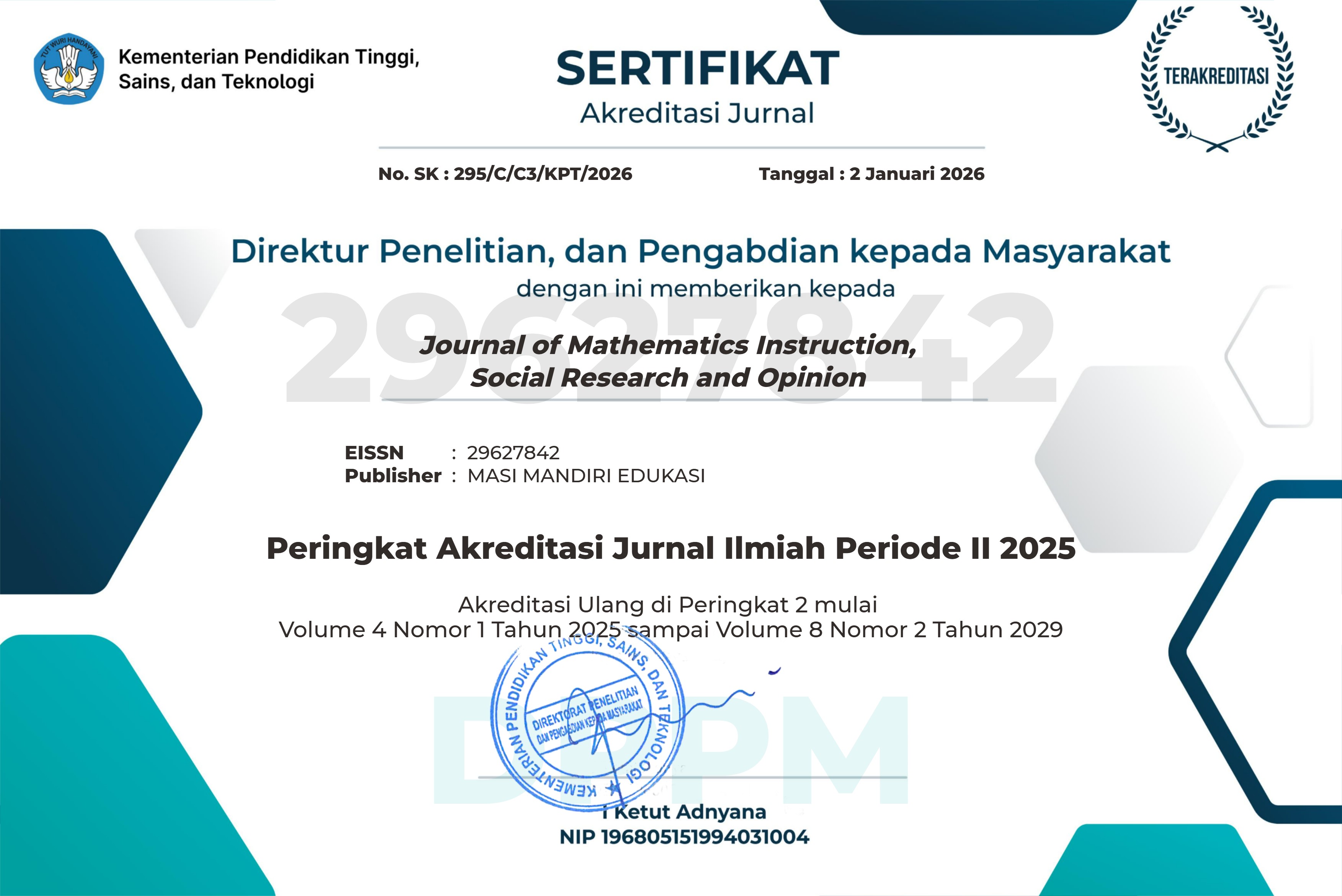
| Accreditation Certificate |
  |
| Indexing |






Contact Us

visitor
| Information |
>> For Authors
>> For Readers
>> For Librarians
| Visitor Statistics |
| Member of |


| Announcement |

| Keywords |
Mathematics Learning Difficulty Dyscalculia Teacher perceptions personality ICT Learning Computer teaching Academic Fisherfolks Economic Behavior Probit Models matrix mathematical model Concepts Guided Note Taking Golden Ratio Philosophy Integrated Learning van Hiele geometry Assessment Learning Outcomes method skills Problem Solving Experiment
| License |

MISRO is licensed under a Creative Commons Attribution-ShareAlike 4.0 International License.
| Publisher |

Address:
Jl. Gagak N0.105, Bandung,
Indonesia 40133
E-mail:
journalmisro@gmail.com
| in collaboration with |

| Recommended Tools |


| ISSN Barcode |

