
Critical Mathematical Thinking Ability Viewed from The Mathematical Disposition of Junior High School Students
DOI:
https://doi.org/10.58421/misro.v5i1.1144Keywords:
Mathematical critical thinking skills, Mathematical disposition, Number pattern, Qualitative researchAbstract
This study was conducted to examine the problem that students’ mathematical critical thinking skills remain varied and are assumed to be influenced by their mathematical disposition. Therefore, this research aims to describe students’ mathematical critical thinking skills from the perspective of their mathematical disposition. This research employed a qualitative approach with a descriptive design. The subjects were six eighth-grade students from SMP IT Al-Marjan Bengkulu, categorized into high, medium, and low levels of mathematical disposition. Data were collected through a mathematical disposition questionnaire, a mathematical critical thinking skills test, and semi-structured interviews. Data were analyzed through data reduction, data display, and conclusion drawing. The findings indicate that students with high mathematical disposition demonstrate strong performance across all critical thinking indicators, including interpretation, analysis, evaluation, inference, and explanation. Students with medium disposition show adequate ability but lack consistency in drawing conclusions and providing logical justification. Meanwhile, students with low mathematical disposition tend to rely on procedural strategies rather than developing deeper conceptual understanding. These results confirm that mathematical disposition contributes to the quality of students’ critical thinking in mathematics.
Downloads
References
R. H. Ennis, “Critical thinking across the curriculum: A vision,” Topoi, vol. 37, no. 1, pp. 165–184, 2018.
P. A. Facione, Critical Thinking: What It Is and Why It Counts, Insight Assessment, 2015.
E. Jablonka, “Critical thinking in mathematics education,” in Encyclopedia of Mathematics Education, Springer, 2020, pp. 159–163.
C. Monteleone, J. Miller, and E. Ward, “Conceptualizing critical mathematical thinking in young students,” Mathematics Education Research Journal, vol. 35, no. 2, pp. 339–359, 2023.
M. B. Miles, A. M. Huberman, and J. Saldaña, Qualitative Data Analysis: A Methods Sourcebook, 3rd ed. Thousand Oaks, CA: Sage, 2014.
P. M. Almerino Jr. et al., “Students’ affective beliefs as the component of mathematical disposition,” International Electronic Journal of Mathematics Education, vol. 14, no. 3, pp. 475–487, 2019.
R. Prajono, Y. G. Dayangku, and M. Anggo, “Analysis of junior high school students’ critical mathematical thinking skills from the perspective of self-efficacy,” Mosharafa: Journal of Mathematics Education, vol. 11, no. 1, pp. 43–54, 2022.
R. Putra and E. Suherman, “Analysis of junior high school students’ critical mathematical thinking skills on number pattern material,” Mosharafa Journal, vol. 8, no. 3, pp. 471–482, 2019.
Sugiyono, Metode Penelitian Pendidikan: Pendekatan Kuantitatif, Kualitatif, dan R&D. Bandung: Alfabeta, 2019.
D. Kurniawati and A. Ekayanti, “The importance of critical thinking in mathematics learning,” Griya Journal of Mathematics Education and Application, vol. 3, no. 2, pp. 107–114, 2020.
D. Nugraha and T. Herman, “Profile of students’ mathematical critical thinking abilities in solving contextual problems,” Journal of Mathematics Education, vol. 12, no. 1, pp. 33–45, 2018.
S. Huda, “The influence of mathematical disposition on critical thinking skills of junior high school students,” Jurnal Gantang, vol. 6, no. 2, pp. 89–98, 2021.
A. Mahmudi and B. A. Saputro, “Analysis of the influence of mathematical disposition and creative thinking ability on mathematical problem solving ability,” Mosharafa, vol. 5, no. 3, pp. 205–212, 2018.
I. Syafrudin, I. Syafitri, and D. H. Pujiastuti, “Analysis of mathematical critical thinking skills: A case study,” Suska Journal of Mathematics Education, vol. 6, no. 2, pp. 89–100, 2020.
A. H. Khusna, T. Y. E. Siswono, and P. Wiyanti, “Mathematical problem design to explore students’ critical thinking skills,” Mathematics Teaching Research Journal, vol. 16, no. 3, pp. 217–240, 2024.
J. W. Creswell, Research Design: Qualitative, Quantitative, and Mixed Methods Approaches, 4th ed. Thousand Oaks, CA: Sage, 2014.
G. Polya, How to Solve It, Princeton, NJ: Princeton University Press, 1973.
A. H. Schoenfeld, Mathematical Problem Solving. Orlando, FL: Academic Press, 1985.
D. Halpern, Thought and Knowledge: An Introduction to Critical Thinking, 5th ed. New York: Psychology Press, 2014.
R. Brookfield, Teaching for Critical Thinking. San Francisco, CA: Jossey-Bass, 2012.
National Council of Teachers of Mathematics (NCTM), Principles and Standards for School Mathematics. Reston, VA: NCTM, 2000.
E. A. Silver, “Fostering creativity through instruction rich in mathematical problem solving,” ZDM Mathematics Education, vol. 29, no. 3, pp. 75–80, 1997.
R. Skemp, The Psychology of Learning Mathematics. London: Penguin Books, 1987.
J. Hiebert et al., Making Sense: Teaching and Learning Mathematics with Understanding. Portsmouth, NH: Heinemann, 1997.
S. Siswono, “Supporting students’ mathematical thinking through problem-based learning,” Journal on Mathematics Education, vol. 9, no. 1, pp. 1–14, 2018.
Downloads
Additional Files
Published
How to Cite
Issue
Section
License
Copyright (c) 2026 Journal of Mathematics Instruction, Social Research and Opinion

This work is licensed under a Creative Commons Attribution-ShareAlike 4.0 International License.
SideBar
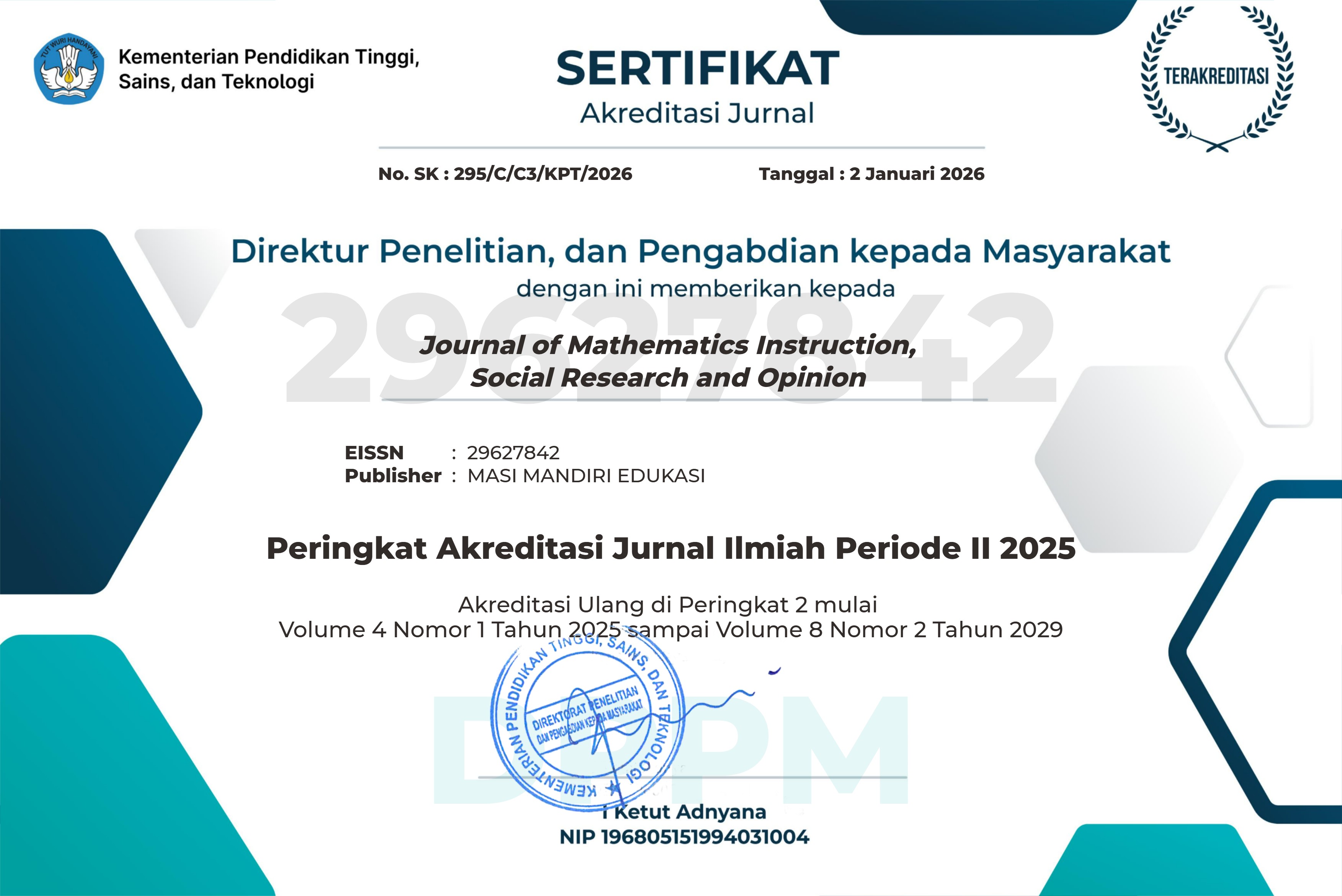
| Accreditation Certificate |
  |
| Indexing |






Contact Us

visitor
| Information |
>> For Authors
>> For Readers
>> For Librarians
| Visitor Statistics |
| Member of |


| Announcement |

| Keywords |
Mathematics Learning Difficulty Dyscalculia Teacher perceptions personality ICT Learning Computer teaching Academic Fisherfolks Economic Behavior Probit Models matrix mathematical model Concepts Guided Note Taking Golden Ratio Philosophy Integrated Learning van Hiele geometry Assessment Learning Outcomes method skills Problem Solving Experiment
| License |

MISRO is licensed under a Creative Commons Attribution-ShareAlike 4.0 International License.
| Publisher |

Address:
Jl. Gagak N0.105, Bandung,
Indonesia 40133
E-mail:
journalmisro@gmail.com
| in collaboration with |

| Recommended Tools |


| ISSN Barcode |

