
Analysis of Human Resources Readiness in Facing Organisational Digital Transformation Towards Industry 4.0: A Case Study at Instant Cement Manufacturing Company
DOI:
https://doi.org/10.58421/misro.v5i1.1107Keywords:
Change Management, Digital Transformation, Human Resources Readiness, Industry 4.0, Manufacturing CompanyAbstract
Digital transformation poses significant challenges for the Indonesian manufacturing sector in the Industry 4.0 era, demanding human resource (HR) readiness in line with technology adoption. This study analyses HR readiness at PT XYZ, an instant cement manufacturing subsidiary of Major Corporate Group, as it navigates organisational digital transformation. Using a qualitative single-case study design, the population included all PT XYZ employees involved in digital transformation, with a purposive sampling of six key informants: the HR Manager, Production Manager, IT Manager, one Supervisor, and two Production Employees. The instruments consisted of semi-structured interview guidelines, limited observation protocols, and a documentation checklist, analysed through the Miles and Huberman interactive model with thematic techniques for pattern identification. The results indicate an overall positive HR readiness, characterised by a collective understanding of transformation as a change in mindset and culture, supported by inter-divisional collaboration that overcomes psychological resistance and technical obstacles through ongoing training and mentoring. However, generational gaps persist. In conclusion, despite successful adaptation through upskilling, companies need an inclusive strategy for sustainable competitiveness
Downloads
References
J. Vrchota, M. Mařiková, P. Řehoř, L. Rolínek, and R. Toušek, “Human Resources Readiness for Industry 4.0,” J. Open Innov. Technol. Mark. Complex., vol. 6, no. 1, p. 3, Mar. 2020, doi: 10.3390/joitmc6010003.
P.-A. Dreyfus, F. Psarommatis, G. May, and D. Kiritsis, “Virtual Metrology as an Approach for Product Quality Estimation in Industry 4.0: A Systematic Review and Integrative Conceptual Framework,” Int. J. Prod. Res., 2021, doi: 10.1080/00207543.2021.1976433.
M. Raihan, M. F. I. Sinaga, M. Lintar, N. D. Putri, and T. R. Julian, “Transformation And Management Strategy Human Resources : Managing Adaptation Employees And Development Skills In The Industrial Era 4.0,” vol. 4, no. 02, 2024.
N. Abdulla, “The Human Resources Management and Artificial Intelligence,” J. Hum. Resour. Leadersh., 2024, doi: 10.47604/jhrl.2635.
S. C. Arindrajaya and S. Koos, “Legal Protection Against Cryptocurrency Investors: Overview of Indonesian Consumer Protection Law,” J. Hum. Rights Cult. Leg. Syst., 2022, doi: 10.53955/jhcls.v2i2.32.
D. O. S. Agustono, R. Nugroho, and A. Y. Alif Fianto, “Artificial Intelligence in Human Resource Management Practices,” Kne Soc. Sci., 2023, doi: 10.18502/kss.v8i9.13409.
S. Basnet, “Navigating the Ethical Landscape: Considerations in Implementing AI-ML Systems in Human Resources,” Int. J. Res. Publ. Rev., 2024, doi: 10.55248/gengpi.5.0324.0755.
P. Parimalam. and S. Dhanabagiyam, “Strategic Role of Artificial Intelligence and the Power of Ehrm for Innovative Human Resource Management,” Asian J. Manag., 2023, doi: 10.52711/2321-5763.2023.00035.
Sari Sakarina, Zet Ena, Jenita, Pandu Adi Cakranegara, and Susilo Surahman, “Digital Transformation in Human Resource Management in the Industrial Age 4.0,” Quant. Econ. Manag. Stud., vol. 3, no. 5, pp. 750–756, Aug. 2022, doi: 10.35877/454RI.qems1067.
A. Dermawan, N. Wening, Y. Vemberi, and L. I. Fitriastuti, “A Systematic Literature Review of Digital Skills and Human Resource Readiness for the Industrial Revolution Era 4.0 and 5.0,” JMKSP J. Manaj. Kepemimp. Dan Supervisi Pendidik., vol. 10, no. 1, pp. 245–259, Feb. 2025, doi: 10.31851/jmksp.v10i1.17965.
A. Maharani, W. Supriatna, and F. Yani, “Organizational Readiness and Innovation Capabilities in a Context of Manufacturing Company: Will Leadership Skills Mediates?”.
N. F. Ahmad, “Problematika Transliterasi Aksara Arab-Latin: Studi Kasus Buku Panduan Manasik Haji dan Umrah,” Nusa J. Ilmu Bhs. Dan Sastra, vol. 12, no. 1, pp. 126–126, 2017, doi: 1562294887.
D. N. Aryani et al., “How Brand Reputation Influences Customer Satisfaction: A Case Study of Starbucks, Malaysia,” Int. J. Tour. Hosp. Asia Pasific, 2021, doi: 10.32535/ijthap.v4i3.1199.
Emzir, Metodologi Penelitian Pendidikan, 1st ed. Jakarta: Rajawali Pers, 2020.
M. R. Fadli, “Memahami Desain Metode Penelitian Kualitatif,” Humanika, 2021, doi: 10.21831/hum.v21i1.38075.
Sudaryono, Metodologi Penelitian, 1st ed. Depok: Rajawali Pers, 2018.
J. W. Creswell and J. D. Creswell, Research design: qualitative, quantitative, and mixed methods approaches, Sixth edition, International student edition. Los Angeles London New Delhi Singapore Washington DC Melbourne: Sage, 2023.
N. N. Fairi, B. P. Diwangga, N. Alpia, and S. Destiyan, “Challenges and Opportunities in Implementing a Digital Curriculum in Schools: A Perspective on Teacher Readiness, Infrastructure, and Students’ Learning Behavior,” vol. 4, no. 8, 2025.
Sugiyono, Metode Penelitian Kuantitatif, Kualitatif, dan RnD, 27th ed. Bandung: Alfabeta, 2019.
M. Idrus, Metode Penelitian Ilmu-Ilmu Sosial : Pendekatan Kualitatif Dan Kuantitatif, 2nd ed. Jakarta: Erlangga, 2009.
D. A. B. Pratama, P. Retnoningrum, and M. Safrina, “Alur Kegiatan Ekspor Komoditas Kelapa pada PT Elang Sriwijaya Perkasa Palembang,” 2026.
Sugiyono, Metode penelitian kuantitatif, kualitatif, dan R&D (Edisi ke-28). Alfabeta, 2020.
A. Suryana, Metode Penelitian Kualitatif, vol. 17. 2017. [Online]. Available: http://repository.unpas.ac.id/30547/5/BAB III.pdf
M. D. Agussalim, E. G. Motherland, and N. Yantі, “The Effect of Competency Human Resources, Work Motivation, and Work Spirit on Employees Performance at the Service Cooperative &Amp; Msmes West Sumatra,” Dinasti Int. J. Digit. Bus. Manag., 2023, doi: 10.31933/dijdbm.v4i5.2026.
A. A. Armenakis and S. G. Harris, “Crafting a change message to create transformational readiness,” J. Organ. Change Manag., vol. 15, no. 2, pp. 169–183, Apr. 2002, doi: 10.1108/09534810210423080.
S. Basnet, “Navigating the Ethical Landscape: Considerations in Implementing AI-ML Systems in Human Resources,” Int. J. Res. Publ. Rev., 2024, doi: 10.55248/gengpi.5.0324.0755.
P. Parimalam. and S. Dhanabagiyam, “Strategic Role of Artificial Intelligence and the Power of Ehrm for Innovative Human Resource Management,” Asian J. Manag., 2023, doi: 10.52711/2321-5763.2023.00035.
D. J. Teece, “Business models and dynamic capabilities,” Long Range Plann., vol. 51, no. 1, pp. 40–49, Feb. 2018, doi: 10.1016/j.lrp.2017.06.007.
Downloads
Additional Files
Published
How to Cite
Issue
Section
License
Copyright (c) 2026 Journal of Mathematics Instruction, Social Research and Opinion

This work is licensed under a Creative Commons Attribution-ShareAlike 4.0 International License.
SideBar
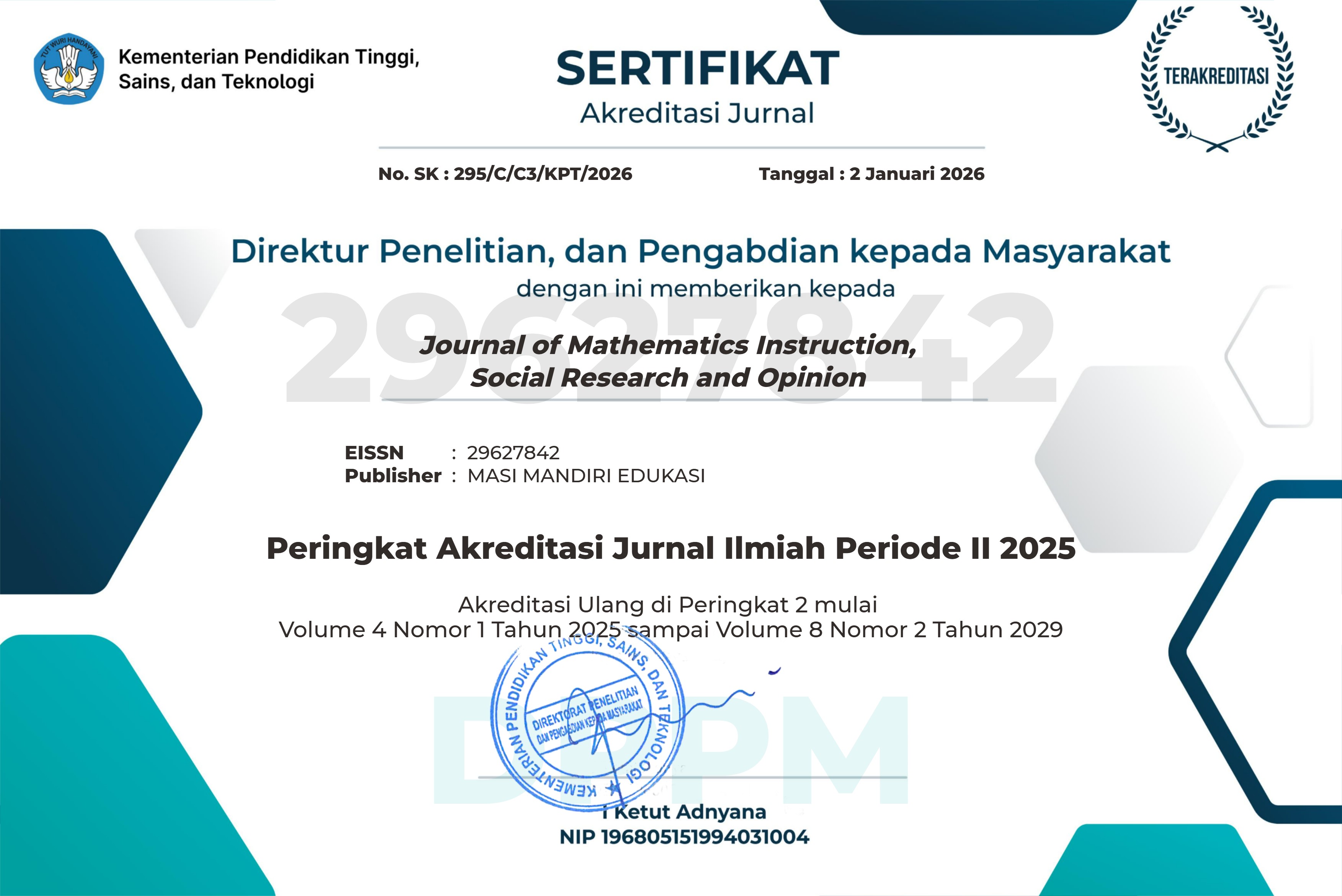
| Accreditation Certificate |
  |
| Indexing |






Contact Us

visitor
| Information |
>> For Authors
>> For Readers
>> For Librarians
| Visitor Statistics |
| Member of |


| Announcement |

| Keywords |
Mathematics Learning Difficulty Dyscalculia Teacher perceptions personality ICT Learning Computer teaching Academic Fisherfolks Economic Behavior Probit Models matrix mathematical model Concepts Guided Note Taking Golden Ratio Philosophy Integrated Learning van Hiele geometry Assessment Learning Outcomes method skills Problem Solving Experiment
| License |

MISRO is licensed under a Creative Commons Attribution-ShareAlike 4.0 International License.
| Publisher |

Address:
Jl. Gagak N0.105, Bandung,
Indonesia 40133
E-mail:
journalmisro@gmail.com
| in collaboration with |
| Recommended Tools |


| ISSN Barcode |

