
Eco-Theological Management and Its Implications for Student Character Development at Al Bahjah Islamic Boarding School
DOI:
https://doi.org/10.58421/misro.v5i1.1082Keywords:
Eco-theological management, Islamic boarding school , (pesantren), Islamic monotheism (tawhid), Islamic EducationAbstract
This study addresses the problem of strengthening student character in Islamic boarding schools through value-based educational management. Specifically, it examines how eco-theological management, grounded in tawhid (Islamic monotheism), can be implemented to support holistic character development. The objective of this study is to analyze the implementation of eco-theological management and its implications for student character development at Al Bahjah Islamic Boarding School. This research employs a qualitative case study approach. Data were collected through field observations and semi-structured in-depth interviews involving students, alumni, and parents. The data were analyzed using a descriptive-analytical technique, including data reduction, data display, and conclusion drawing, with triangulation to ensure data validity. The results show that eco-theological management, implemented through the integration of diniyah, tahfidz, and general curricula, contributes significantly to the development of students’ discipline, moral character, independence, and academic competence. Despite limitations in the general curriculum time allocation, continuous evaluation and improvement efforts help maintain educational quality. This study concludes that eco-theological management is an effective and adaptive model for strengthening student character in Islamic educational institutions.
Downloads
References
F. I. Irawan, C. Munawaroh, H. Rasyid, and H. Basri, “Pendidikan dan Pembentukan Karakter Peserta Didik Perspektif Teologi Pendidikan Islam,” vol. 01, no. 1, pp. 40–48, 2025.
M. H. Shafwan, M. M. Abdullah, and U. M. Surabaya, “Implementasi Pendidikan Tauhid dalam Membentuk Karakter Santri Pondok Pesantren Tahfidzul Qur ’ an Imam An Nawawi Batam,” vol. 7, no. 1, pp. 33–46, 2024.
M. Abdullah, Y. A. Bakar, and A. R. Assegaf, “The Relevance Between Pesantren ’ s Character Education and Ismail Raji Faruqi ’ s Thought,” vol. 5, no. 1, 2024.
S. B. Firmansyah and Z. Abidin, “Character Education Strategy in Pesantren : Integrating Morals and Spirituality,” vol. 29, no. 2, pp. 261–275, 2024.
S. Zuhri, “Integrasi Pendidikan Tauhid dan Karakter dalam Kurikulum Pendidikan Islam Kontemporer,” vol. 2, no. 2, pp. 185–195, 2025.
A. Rohman, E. Kurniawan, M. Syifauddin, S. Muhtamiroh, and A. Muthohar, “Religious Education For The Environment: Integrating Eco-Theology In The Curriculum of Islamic Religious And Character Education To Enhance Environmental Education In Indonesia,” Nadwa J. Pendidik. Islam, vol. 18, no. 2, pp. 201–226, 2024, doi: 10.21580/nw.2024.18.2.21094.
T. Hidayatulloh, A. S. Long, Irawan, and T. Saumantri, “Eco-Theology in Islamic Thought: Religious Moderation and Organizational Roles in Mining Management in Indonesia,” Progres. J. Pemikir. dan Pendidik. Islam, vol. 13, no. 03, pp. 379–392, 2024, doi: 10.22219/progresiva.v13i03.37102.
A. Muin, M. Z. Rosyid, H. Rahman, and R. Rofiqi, “Ecological Tauhid-Based Green School Management: A Case Study of Eco-Pesantren Implementation at Mambaul Ulum Islamic Junior High School, Pamekasan,” EDUKASIA J. Pendidik. dan Pembelajaran, vol. 6, no. 1, pp. 551–562, 2025, doi: 10.62775/edukasia.v6i1.1457.
V. I. Ahmad, N. Ali, and I. A. Zuhriyah, “Islamic Values in Environmental School Culture: Character Formation and Challenges,” EDUKASIA J. Pendidik. dan Pembelajaran, vol. 6, no. 1, pp. 267–280, 2025, doi: 10.62775/edukasia.v6i1.1400.
Z. Na’im et al., Managemen Pendidikan Islam. 2021.
S. Sudarsono and A. Muaddin, “Green Pesantren Leadership: Shaping a Moderate Society for Environmental Conservation,” Idarah (Jurnal Pendidik. dan Kependidikan), vol. 8, no. 1, pp. 1–12, 2024, doi: 10.47766/idarah.v8i1.1381.
Fifi Risana et al., “Strategi Program Eco-Pesantren Dalam Menghadirkan Karakter Peduli Lingkungan Terhadap Pondok Pesantren Malahayati Bandar Lampung,” Pendas J. Ilm. Pendidik. Dasar, vol. 9, no. 04, pp. 231–241, 2024, doi: 10.23969/jp.v9i04.20908.
Rokhimah, Manajemen Pendidikan Berbasis Pondok Pesantren, 1st ed. Cirebon: PT Arr Rad Pratama, 2023.
B. Suprianto, Y. Triandini, I. Abdullah, and T. M. P. Astuti, “Islamic Ecological Principles in Muslim Environmentalism Narratives for Religious Moderation in Indonesia,” Int. J. Islam. Stud. High. Educ., vol. 2, no. 3, p. 19, 2023, [Online]. Available: https://insight.ppj.unp.ac.id/index.php/insight
F. N. Rohmah, “Integration Of Ecological Principles in the Pesantren System: An Analysis Of Sustainability and Environmental Conservation Practices In Islamic Educational Institutions,” Molang J. Islam. Educ., vol. 2, no. 02, 2024, doi: 10.32806/jm.v2i02.813.
J. W. Creswell and V. L. P. Clark, “Choosing a mixed methods design,” in Designing and Conducting Mixed Methods Research, California: Sage Publications, Inc., 2011, pp. 53–106.
Sugiyono, Metodologi Penelitian Kuantitatif, Kualitatif dan R & D, 1st ed. BANDUNG: ALFABETA,CV, 2020.
I. N. Rachmawati, “Lembar Metodologi Pengumpulan Data Dalam Penelitian Kualitatif : Wawancara,” J. Keperawatan Indones., vol. 11, pp. 35–40, 2007.
Z. Abussamad, Metode Penelitian Kualitatif, Pertama. Makasar: Syakir Media Press, 2021.
Aminudin, A. M. (2023). Manajemen Pondok Pesantren. PT. Sonpedia Publishing Indonesia.Https://Books.Google.Co.Id/Books/About/Manajemen_Pondok_Pesantren.Html?Hl=Id&Id=-HHXEAAAQBAJ&Redir_Esc=Y
M. H. Rahman, I. Tianah, A. Khairi, and Y. Sintiya, “Transformasi Pesantren: Model Eko-Religius Pondok Pesantren Annuqayah,” GHANCARAN J. Pendidik. Bhs. dan Sastra Indones., pp. 408–418, 2024, doi: 10.19105/ghancaran.vi.17298.
M. Fathurahman, “Eko-Teologi Al-Quran : Internalisasi Karakter Sadar Lingkungan Bagi Generasi Alpha Indonesia,” vol. 7, 2022, doi: https://doi.org/10.21154/ibriez.v7i2.715.
M. Imdad, D. Hafidhuddin, and S. Arif, “Balancing Tradition and Modernity : The Role of Aqidah Education Management in Shaping Santri Character,” vol. 09, no. 03, pp. 766–778, 2025.
I. Fauzi and A. Syafe, Imam, “Character Education : Its Implementation at Islamic Boarding School,” vol. 2, no. 1, pp. 35–42, 2022, doi: 10.24042/jaiem.v2i1.15797.
M. T. Zaenal Arifin, “Character of Education in Pesantren Perspective: Study Of Various Methods of Educational Character at Pesantren In Indonesia Zaenal Arifin 1 , Moh. Turmudi 2 1,” vol. 30, pp. 335–348, 2019.
N. L. Aini, A. N. Majid, and U. A. Prenduan, “Edupreneurship and Pesantren Management : Forming a Multi-Skilled Muslim Character in the Era of Globalization,” vol. 5, no. 2, pp. 253–273, 2025, doi: 10.14421/hjie.2025.52-09.
H. suhendrayana M. Witrin Noorjustiatini, Achmad sanusi, Iim Wasliman, “International Journal Of Social Tariqa-Based Education Management To Improve The Character Of Students ( Case Study At Pesantren Al Jauhari Garut And Pesantren,” vol. 2, no. 4, pp. 344–362, 2019, doi: https://doi.org/10.46799/ijssr.v2i4.107.
Downloads
Additional Files
Published
How to Cite
Issue
Section
License
Copyright (c) 2026 Journal of Mathematics Instruction, Social Research and Opinion

This work is licensed under a Creative Commons Attribution-ShareAlike 4.0 International License.
SideBar
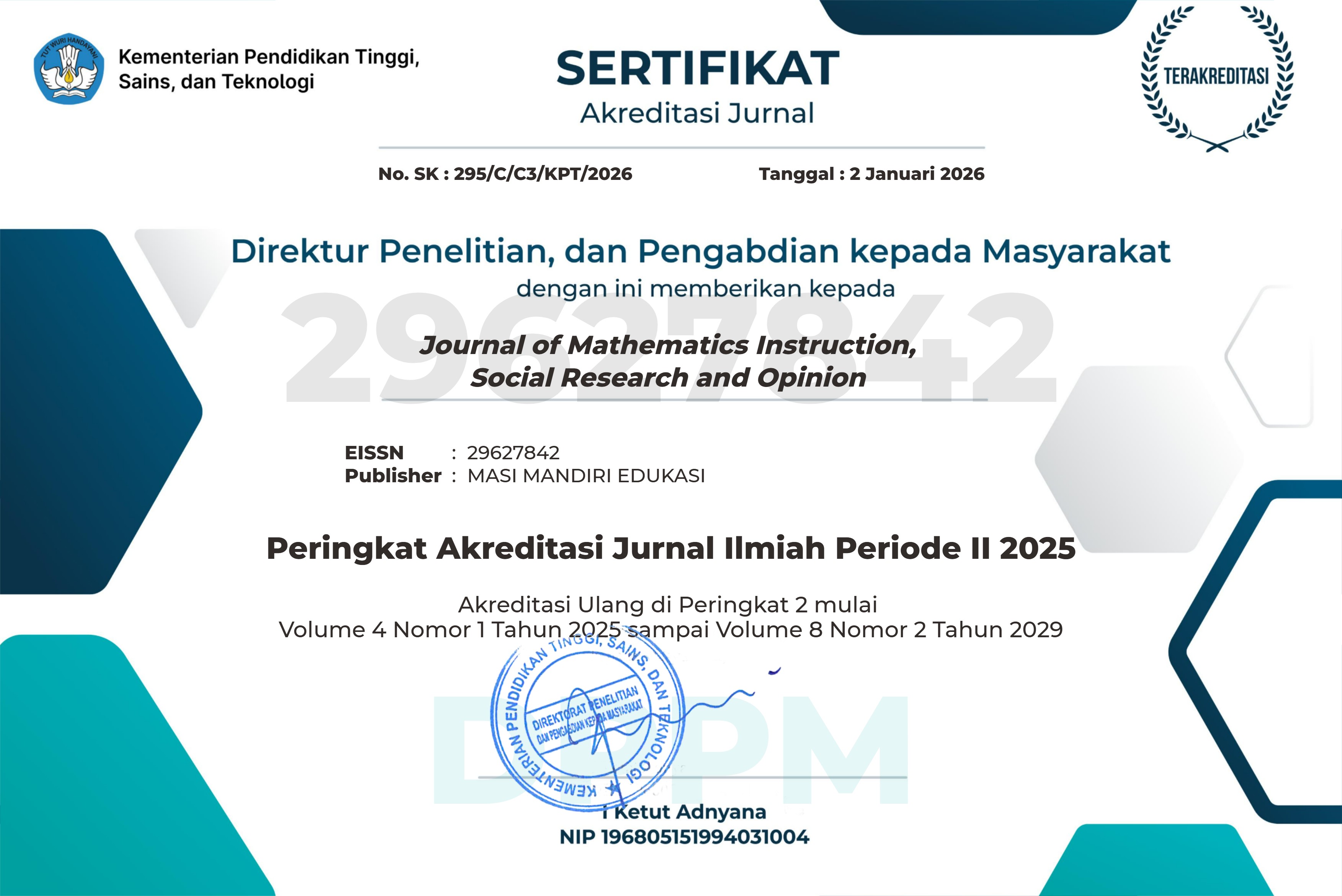
| Accreditation Certificate |
  |
| Indexing |






Contact Us

visitor
| Information |
>> For Authors
>> For Readers
>> For Librarians
| Visitor Statistics |
| Member of |


| Announcement |

| Keywords |
Mathematics Learning Difficulty Dyscalculia Teacher perceptions personality ICT Learning Computer teaching Academic Fisherfolks Economic Behavior Probit Models matrix mathematical model Concepts Guided Note Taking Golden Ratio Philosophy Integrated Learning van Hiele geometry Assessment Learning Outcomes method skills Problem Solving Experiment
| License |

MISRO is licensed under a Creative Commons Attribution-ShareAlike 4.0 International License.
| Publisher |

Address:
Jl. Gagak N0.105, Bandung,
Indonesia 40133
E-mail:
journalmisro@gmail.com
| in collaboration with |

| Recommended Tools |


| ISSN Barcode |

