
The Role of Work Engagement in The Effect of Job Demands and Job Resources on Employee Performance at The Regional Financial and Asset Management Agency of Bontang City
DOI:
https://doi.org/10.58421/misro.v5i1.1075Keywords:
BPKAD, Employee Performance, Job Demands, Job Resources, Work EngagementAbstract
Regional financial management institutions operate under high administrative pressure, strict regulatory standards, and demanding accountability requirements, which may influence employees' psychological conditions and performance outcomes. However, limited empirical research has simultaneously examined the roles of job demands and job resources in shaping employee performance through work engagement within local government institutions. This study aims to analyze the role of work engagement in mediating the relationship between job demands, job resources, and employee performance at the Regional Financial and Asset Management Agency (BPKAD) of Bontang City. This research employed a quantitative, survey-based approach. Data were collected from 45 employees selected through purposive sampling based on their involvement in financial and asset management functions. The data were analyzed using Structural Equation Modeling with the Partial Least Squares (SEM-PLS) technique to test both direct and mediating relationships among variables. The findings reveal that job demands negatively affect work engagement and employee performance, whereas job resources positively influence both. Work engagement also has a significant positive effect on employee performance and serves as a mediating variable in the relationships between job demands and performance, as well as between job resources and performance. These results confirm the central role of work engagement as a psychological mechanism that translates work conditions into performance outcomes in public sector financial institutions. The study highlights the importance of balancing job demands with adequate organizational resources to sustain employee engagement and enhance performance in regional government settings
Downloads
References
A. B. Bakker and E. Demerouti, "Job demands–resources theory: Taking stock and looking forward," Journal of Occupational Health Psychology, vol. 28, no. 3, pp. 123–135, 2023, doi: 10.1037/ocp0000356.
A. B. Bakker and E. Demerouti, Job Demands–Resources Model: A Comprehensive Overview. New York, NY, USA: Routledge, 2024.
W. B. Schaufeli and T. W. Taris, Occupational Health Psychology: Work Engagement and Job Demands. London, UK: Routledge, 2023.
W. B. Schaufeli and T. W. Taris, "Work engagement: A critical review and future directions," Annual Review of Organizational Psychology and Organizational Behavior, vol. 11, pp. 145–167, 2024, doi: 10.1146/annurev-orgpsych-012323-091456.
D. Xanthopoulou and A. B. Bakker, "The impact of job demands and resources on employee engagement and performance: A meta-analysis," Journal of Vocational Behavior, vol. 142, p. 103876, 2023, doi: 10.1016/j.jvb.2023.103876.
K. L. Akgul, S. De Winne, A. Van den Broeck, E. Baillien, L. Godderis, and T. De Feyter, "The association between job design and organisational performance: The role of workforce engagement and burnout," International Journal of Human Resource Management, pp. 1–34, 2025, doi: 10.1080/09585192.2025.2451985.
S. Darmawan and L. M. Alawiyah, "The impact of flexible work arrangements and perceived supervisor support on employee performance: The mediating role of work engagement," Klabat Journal of Management, vol. 5, no. 2, pp. 142–155, 2024, doi: 10.60090/kjm.v5i2.1168.
M. Armstrong, Performance Management: Key Strategies and Best Practices. London, UK: Kogan Page, 2023.
A. Noja, S. Tement, and B. Kubicek, "Negative cognitive-affective involvement as a mechanism linking job demands to occupational well-being," Journal of Occupational Health Psychology, vol. 28, no. 4, pp. 234–245, 2023, doi: 10.1037/ocp0000364.
N. I. Leontes and C. Hoole, "Bridging the gap: Exploring the impact of human capital management on employee performance through work engagement," Administrative Sciences, vol. 14, no. 6, pp. 129–142, 2024, doi: 10.3390/admsci14060129.
A. Helalat, H. Sharari, J. A. Alhelalat, and R. Al-Aqrabawi, "Transformational leadership and employee performance: A further insight using work engagement," Economics (Bijeljina), vol. 12, no. 1, pp. 89–102, 2024, doi: 10.2478/eoik-2025-0015.
W. A. Kahn, Employee Engagement and Work Performance: A Contemporary Perspective. New York, NY, USA: McGraw-Hill, 2023.
J. Wang and A. B. A. Rahman, "The role of employee engagement in individual work performance: A systematic review," International Journal of Academic Research in Progressive Education and Development, vol. 13, no. 4, 2024, doi: 10.6007/ijarped/v13-i4/23818.
L. Ye, Y. Li, N. Zhang, and J. Zhang, "The influence of work engagement on employee affect and creativity," Behavioral Sciences, vol. 14, no. 12, p. 1217, 2024, doi: 10.3390/bs14121217.
M. A. Naveed and M. Q. Zia, "Exploring the interplay between job resources, employee engagement, and adaptive job performance," Journal of Asia Business Studies, 2024, doi: 10.1108/jabs-09-2023-0379.
D. Faustine, “Work engagement sebagai mediator peran workplace well-being terhadap performance pada karyawan,” Jurnal Psikologi, vol. 17, no. 1, pp. 23–34, 2024, doi: 10.35134/jpsy165.v17i1.310.
W. W. Chin, "The partial least squares approach to structural equation modeling," Modern Methods for Business Research, vol. 295, no. 2, pp. 295–336, 1998.
A. S. Bryman, "Integrating quantitative and qualitative research: How is it done?," Qualitative Research, vol. 6, no. 1, pp. 97–113, 2006.
J. F. Hair, G. T. M. Hult, C. M. Ringle, and M. Sarstedt, "Partial least squares structural equation modeling (PLS-SEM): An emerging tool in business research," European Business Review, vol. 26, no. 2, pp. 106–121, 2014.
R. Likert, "A technique for the measurement of attitudes," Archives of Psychology, vol. 22, no. 140, pp. 1–55, 1932.
A. B. Bakker and E. Demerouti, "The Job Demands–Resources model: State of the art," Journal of Managerial Psychology, vol. 22, no. 3, pp. 309–328, 2007.
E. Demerouti, A. B. Bakker, F. Nachreiner, and W. B. Schaufeli, "The job demands-resources model of burnout," Journal of Applied Psychology, vol. 86, no. 3, pp. 499–512, 2001.
A. B. Bakker, J. J. Hakanen, E. Demerouti, and D. Xanthopoulou, "Job resources boost work engagement, particularly when job demands are high," Journal of Educational Psychology, vol. 99, no. 2, pp. 274–284, 2007.
M. Taris and W. B. Schaufeli, "The Job Demands–Resources model and burnout: A longitudinal test," Work & Stress, vol. 18, no. 3, pp. 223–245, 2004.
C. M. R. R. Hakanen, A. B. Bakker, and W. B. Schaufeli, "Burnout and work engagement among teachers," Journal of School Psychology, vol. 43, no. 6, pp. 495–513, 2006.
Downloads
Additional Files
Published
How to Cite
Issue
Section
License
Copyright (c) 2026 Journal of Mathematics Instruction, Social Research and Opinion

This work is licensed under a Creative Commons Attribution-ShareAlike 4.0 International License.
SideBar
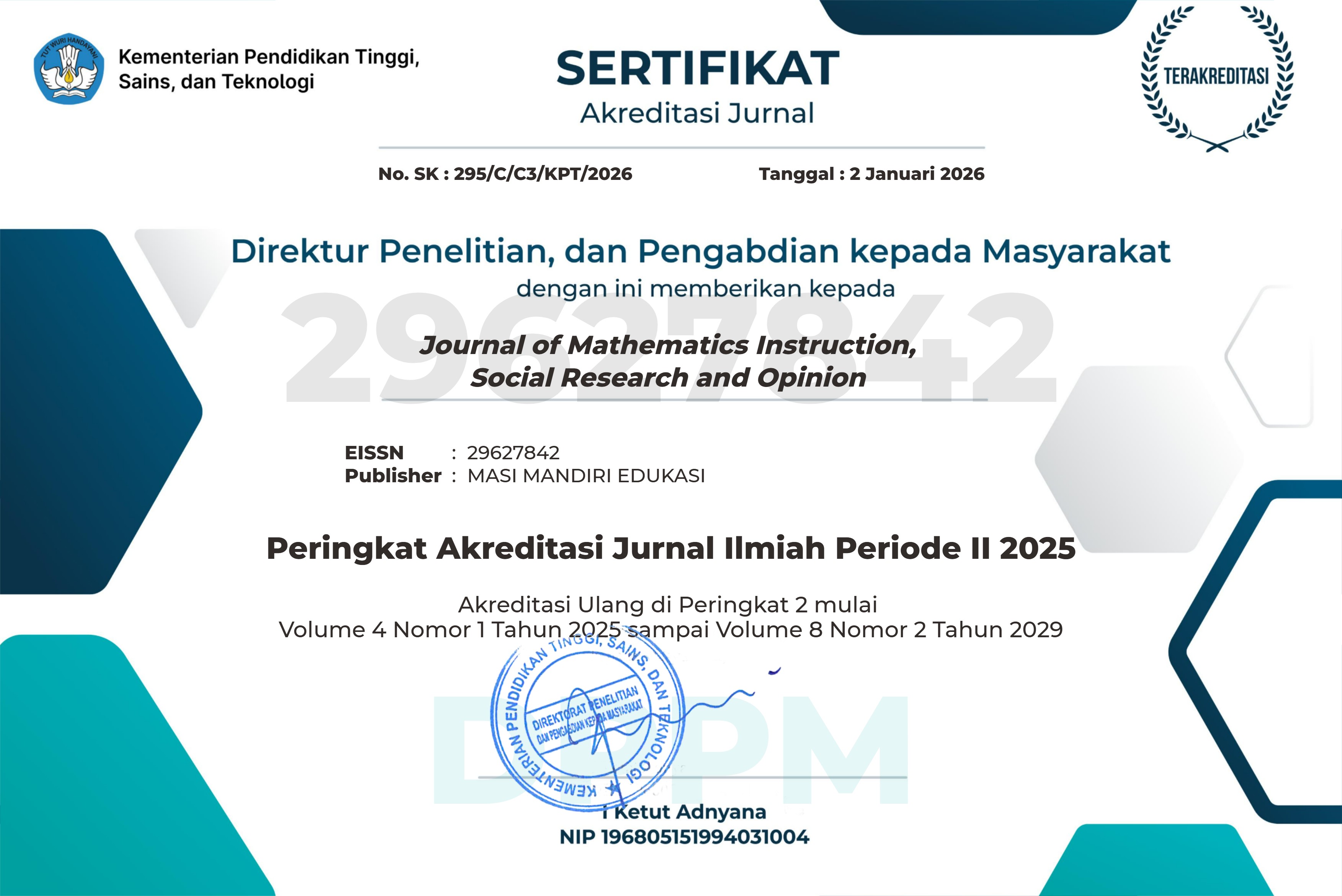
| Accreditation Certificate |
  |
| Indexing |






Contact Us

visitor
| Information |
>> For Authors
>> For Readers
>> For Librarians
| Visitor Statistics |
| Member of |


| Announcement |

| Keywords |
Mathematics Learning Difficulty Dyscalculia Teacher perceptions personality ICT Learning Computer teaching Academic Fisherfolks Economic Behavior Probit Models matrix mathematical model Concepts Guided Note Taking Golden Ratio Philosophy Integrated Learning van Hiele geometry Assessment Learning Outcomes method skills Problem Solving Experiment
| License |

MISRO is licensed under a Creative Commons Attribution-ShareAlike 4.0 International License.
| Publisher |

Address:
Jl. Gagak N0.105, Bandung,
Indonesia 40133
E-mail:
journalmisro@gmail.com
| in collaboration with |

| Recommended Tools |


| ISSN Barcode |

