
Profile of Students’ Mathematical Creative Thinking Ability in Solving Open-Ended Problems
DOI:
https://doi.org/10.58421/misro.v5i1.1022Keywords:
Mathematical Creative Thinking, Open-Ended, Data Presentation, Ability ProfileAbstract
This study aimed to describe the profile of students’ mathematical creative thinking skills in solving open-ended problems on data presentation. Mathematical creative thinking was analysed based on four creativity indicators proposed by Torrance: fluency, flexibility, originality, and elaboration. The research employed a descriptive qualitative approach and was conducted at SMP Negeri 2 Pamulihan. The research subjects consisted of 32 seventh-grade students selected through purposive sampling to represent four categories of creative thinking ability: highly creative, creative, moderately creative, and less creative. Data were collected using a mathematical creative thinking skills test, task-based interviews, and observations of students’ problem-solving processes. Data analysis was conducted through data reduction, data display, and conclusion drawing, supported by the triangulation of techniques and data sources to ensure validity. The results indicated that students’ mathematical creative thinking skills varied across categories. Students in the highly creative category achieved an overall score of 34.375% across all creativity indicators, demonstrating the ability to generate diverse ideas, apply multiple problem-solving strategies, produce original solutions, and present detailed and systematic explanations. Students in the creative category achieved the highest percentage, 37.5%, showing strong performance particularly in fluency and flexibility, although originality and elaboration were not consistently demonstrated. Students in the moderately creative category obtained a score of 9.375%, indicating limited creative thinking skills that were mostly confined to fundamental indicators, with minimal originality and elaboration. Meanwhile, students in the less creative category achieved 18.75%, characterised by reliance on a single strategy and brief, superficial explanations.
Downloads
References
H. Meissner, ‘Creativity in Mathematics Education’, in The Proceedings of the 12th International Congress on Mathematical Education, S. J. Cho, Ed., Cham: Springer International Publishing, 2015, pp. 591–592. doi: 10.1007/978-3-319-12688-3_64.
B. Sriraman, ‘The characteristics of mathematical creativity’, Math. Educ., vol. 14, no. 1, 2004, Accessed: Jan. 09, 2026. [Online]. Available: https://openjournals.libs.uga.edu/tme/article/view/1868
E. A. Silver, ‘Fostering creativity through instruction rich in mathematical problem solving and problem posing’, Zentralblatt Für Didakt. Math., vol. 29, no. 3, pp. 75–80, Jun. 1997, doi: 10.1007/s11858-997-0003-x.
T. Siregar, ‘The Influence of Learning Interest and Creativity on Mathematics Achievement Among Students in Calculus Courses’, Nov. 03, 2025, Preprints: 2025110061. doi: 10.20944/preprints202511.0061.v1.
J. P. Guilford, ‘The nature of human intelligence.’, 1967, Accessed: Jan. 09, 2026. [Online]. Available: https://psycnet.apa.org/record/1967-35015-000
E. P. Torrance, ‘Torrance tests of creative thinking’, Educ. Psychol. Meas., 1966, Accessed: Jan. 09, 2026. [Online]. Available: https://psycnet.apa.org/doiLanding?doi=10.1037/t05532-000
R. Leikin, ‘Exploring mathematical creativity using multiple solution tasks’, Creat. Math. Educ. Gift. Stud., vol. 9, pp. 129–145, 2009.
D. Dumas, Y. Kim, M. Carrera-Flores, S. Kagan, S. Acar, and P. Organisciak, ‘Understanding elementary students’ creativity as a trade-off between originality and task appropriateness: A Pareto optimisation study’, J. Educ. Psychol., 2025, doi: 10.1037/edu0000982.
T. Y. E. Siswono, ‘Pembelajaran matematika berbasis pengajuan dan pemecahan masalah’, Bdg. Remaja Rosdakarya, 2018.
D. J. Suparman, ‘Problem-Based Learning for Mathematical Critical Thinking Skills: A Meta-Analysis’, J. Hunan Univ. Nat. Sci., vol. 48, no. 2, Mar. 2021, Accessed: Jan. 09, 2026. [Online]. Available: https://www.jonuns.com/index.php/journal/article/view/521
S. Rahayuningsih, S. Sirajuddin, and M. Ikram, ‘Using open-ended problem-solving tests to identify students’ mathematical creative thinking ability’, Particip. Educ. Res., vol. 8, no. 3, pp. 285–299, 2021.
H. T. Damayanti, ‘Mathematical Creative Thinking Ability of Junior High School Students in Solving Open-Ended Problem.’, J. Res. Adv. Math. Educ., vol. 3, no. 1, pp. 36–45, 2018.
T. Solfitri, H. M. Siregar, K. Kartini, and A. Permata, ‘Facilitating Mathematical Creative Thinking Ability: Analysis of Validation, Practicality, and Effectiveness of Learning Modules’, J. Pendidik. Progresif, vol. 14, no. 1, pp. 619–634, Jun. 2024.
I. Ibrahim and S. A. Widodo, ‘Advocacy Approach With Open-Ended Problems To Mathematical Creative Thinking Ability’, Infin. J., vol. 9, no. 1, pp. 93–102, Feb. 2020, doi: 10.22460/infinity.v9i1.p93-102.
H. Meissner, ‘Creativity in Mathematics Education’, in The Proceedings of the 12th International Congress on Mathematical Education, S. J. Cho, Ed., Cham: Springer International Publishing, 2015, pp. 591–592. doi: 10.1007/978-3-319-12688-3_64.
G. Gunawan, F. Ferdianto, F. Mulyatna, and R. Untarti, ‘The Profile Of Creative Thinking Process: Prospective Mathematics Teachers’, J. EDUSCIENCE, vol. 12, no. 2, pp. 450–464, Apr. 2025, doi: 10.36987/jes.v12i2.6915.
J. W. Creswell and C. N. Poth, Qualitative Inquiry and Research Design: Choosing Among Five Approaches. SAGE Publications, 2018.
M. B. Miles, A. M. Huberman, and J. Saldaña, Qualitative Data Analysis: A Methods Sourcebook. SAGE Publications, 2013.
Sugiyono, Metode Penelitian & Pengembangan: Reaserch & Development. Alfabeta, 2021.
M. Q. Patton, Qualitative Research & Evaluation Methods: Integrating Theory and Practice. SAGE Publications, 2015.
C. Novtiar and U. Aripin, ‘Meningkatkan Kemampuan Berpikir Kritis Matematis Dan Kepercayaan Diri Siswa Smp Melalui Pendekatan Open Ended’, PRISMA, vol. 6, no. 2, pp. 119–131, Dec. 2017, doi: 10.35194/jp.v6i2.122.
D. Darmawijoyo, Z. Zulkardi, R. I. I. Putri, H. Hapizah, and S. Syutaridho, ‘How do students use mathematical reasoning to solve PISA-type mathematics problems based on making kite contexts?’, Infin. J., vol. 14, no. 4, pp. 1065–1080, Nov. 2025, doi: 10.22460/infinity.v14i4.p1065-1080.
Downloads
Additional Files
Published
How to Cite
Issue
Section
License
Copyright (c) 2026 Journal of Mathematics Instruction, Social Research and Opinion

This work is licensed under a Creative Commons Attribution-ShareAlike 4.0 International License.
SideBar
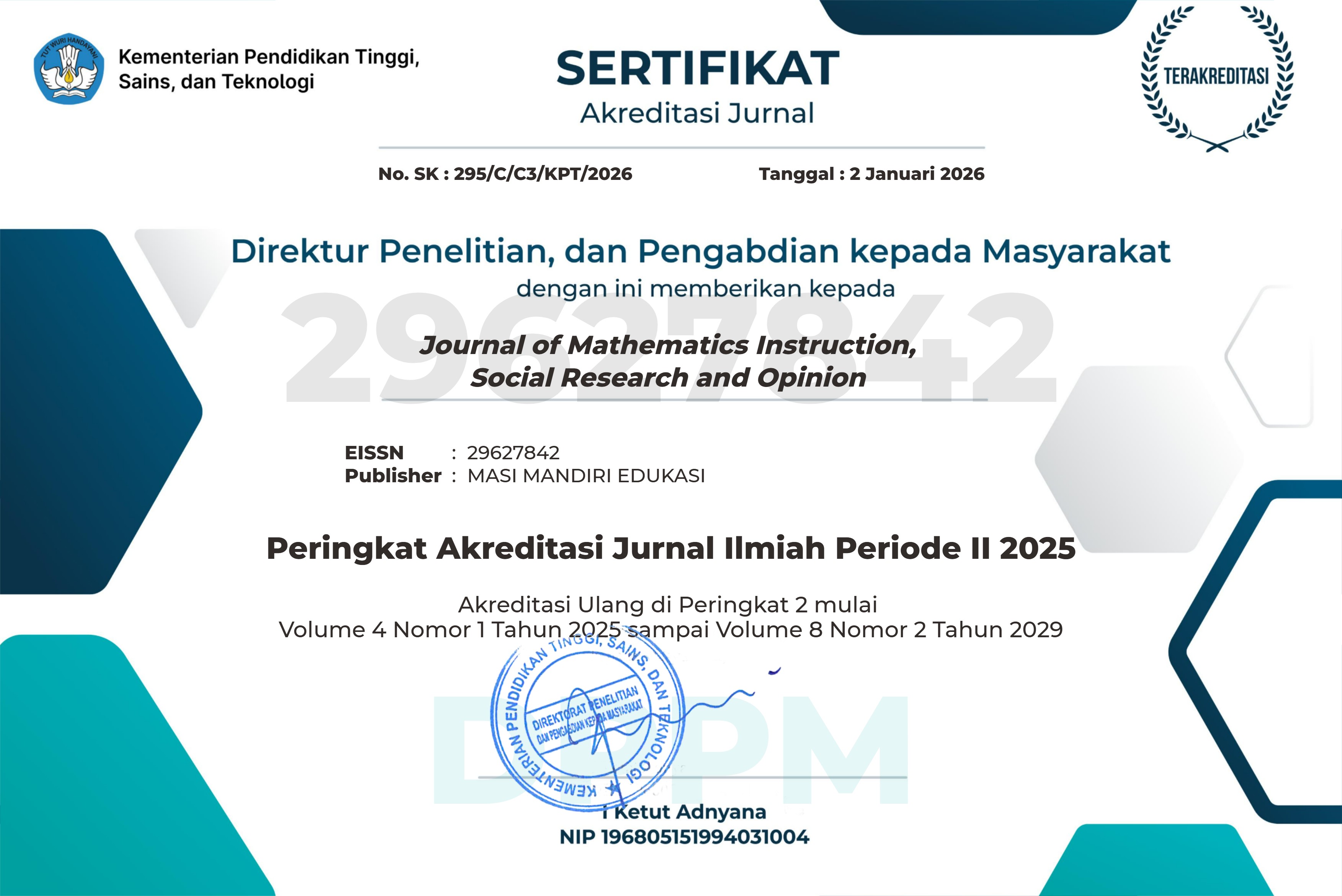
| Accreditation Certificate |
  |
| Indexing |






Contact Us

visitor
| Information |
>> For Authors
>> For Readers
>> For Librarians
| Visitor Statistics |
| Member of |

| Announcement |

| Keywords |
Mathematics Learning Difficulty Dyscalculia Teacher perceptions personality ICT Learning Computer teaching Academic Fisherfolks Economic Behavior Probit Models matrix mathematical model Concepts Guided Note Taking Golden Ratio Philosophy Integrated Learning van Hiele geometry Assessment Learning Outcomes method skills Problem Solving Experiment
| License |

MISRO is licensed under a Creative Commons Attribution-ShareAlike 4.0 International License.
| Publisher |

Address:
Jl. Gagak N0.105, Bandung,
Indonesia 40133
E-mail:
journalmisro@gmail.com
| in collaboration with |

| Recommended Tools |


| ISSN Barcode |

