
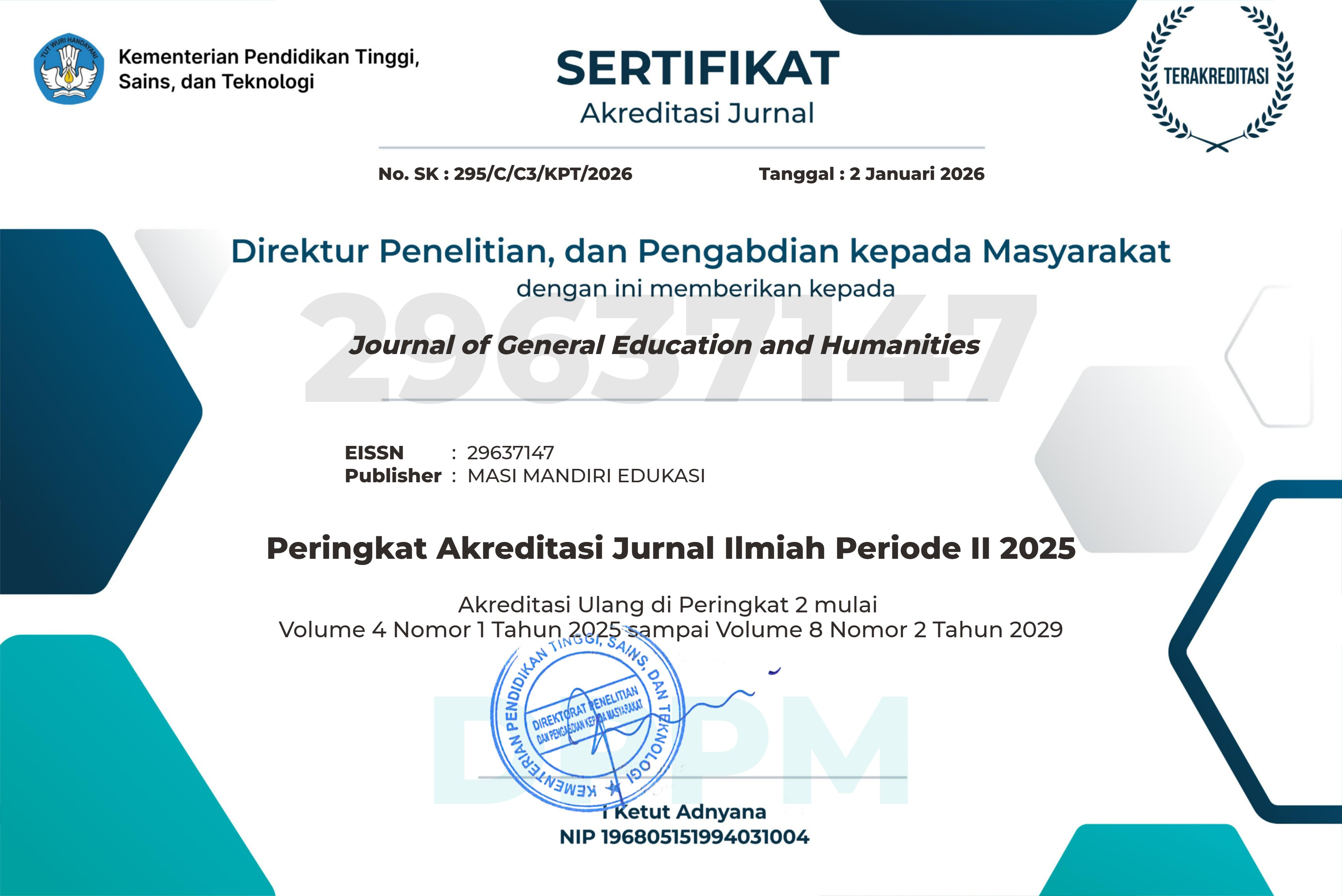
The Effectiveness of AI-Assisted Classroom Guidance Services in Improving Academic Resilience among Junior High School Students
DOI:
https://doi.org/10.58421/gehu.v5i5.2084Keywords:
Academic Resilience, Artificial Intelligence, Classical Guidance, Junior High School StudentsAbstract
Academic resilience is an important psychological capacity that enables students to adapt to academic pressure, difficulties, and failure. This study examined the effectiveness of an AI-assisted 5C-based classical guidance service in improving academic resilience among junior high school students. A quasi-experimental pretest-posttest control group design was conducted involving 62 eighth-grade students at SMP Negeri 15 Kota Cirebon, Indonesia. Participants were selected from two intact classes, with 31 students assigned to the experimental group and 31 students to the control group. The experimental group received five classical guidance sessions based on Martin and Marsh’s 5C framework: Confidence, Coordination, Control, Composure, and Commitment, supported by the RESILIA-BK AI-assisted guidance application. Academic resilience was measured using a 32-item scale based on Cassidy’s framework. Data were analyzed using descriptive statistics, independent-samples t-test, and ANCOVA with pretest scores as covariates. The experimental group increased from Mean = 95.65 to Mean = 104.74, while the control group increased from Mean = 94.97 to Mean = 98.00. ANCOVA results showed a significant difference in adjusted posttest scores between groups, F(1,59) = 36.989, p < .001, partial η² = .385. The findings indicate that AI-assisted classical guidance may serve as a complementary approach to strengthen students’ academic resilience under counselor supervision.
Downloads
References
E. M. Rahmawati, Ahman, Setiawati, Z. H. Rukman, and D. D. Rahayu, “Academic Anxiety Among College Students Reviewed From Gender, Age, and Academic Year Perspective,” G-Couns J. Bimbing. dan Konseling, vol. 9, no. 1, pp. 603–618, 2024, doi: 10.31316/gcouns.v9i1.6124.
A. J. Martin and H. W. Marsh, “Academic Resilience and its Psychological and Educational Correlates: A Construct Validity Approach,” Psychol. Sch., vol. 43, no. 3, pp. 267–282, 2006, doi: 10.1002/pits.20149.1.
F. Rahman, E. Putra, and E. Y. Ningsih, “Kecerdasan Emosi dan Resiliensi Akademik Sebagai Prediktor Prestasi Akademik Mahasiswa,” G-Couns J. Bimbing. dan Konseling, vol. 9, no. 2, pp. 820–834, 2025, doi: 10.31316/g-couns.v9i2.6859.
T. Honicke, J. Broadbent, and M. Fuller-tyszkiewicz, “The self-efficacy and academic performance reciprocal relationship : the influence of task difficulty and baseline achievement on learner trajectory achievement on learner trajectory,” High. Educ. Res. Dev., vol. 42, no. 8, pp. 1–18, 2023, doi: 10.1080/07294360.2023.2197194.
E. Panadero, “A Review of Self-regulated Learning : Six Models and Four Directions for Research,” Front. Psychol., vol. 8, no. April, pp. 1–28, 2017, doi: 10.3389/fpsyg.2017.00422.
P. N. Aini, “Hubungan Dukungan Orang Tua dengan Resiliensi Akademik pada Remaja SMP Negeri di Kecamatan Ngrambe,” Quanta J. Kaji. Bimbing. dan Konseling dalam Pendidik., vol. 6, no. 2, pp. 38–45, 2022, doi: https://doi.org/10.22460/q.v6i2p11-19.3040 A.
K. Khotimah, A. N. Budiono, and Wahyuni, “Hubungan Motivasi Belajar dengan Resiliensi Akademik Siswa,” J. Consulen. J. Bimbing. Konseling dan Psikol., vol. 5, no. 2, pp. 180–189, 2022, doi: 10.56013/jcbkp.v5i2.1613.
A. Putri, N. Darmayanti, and A. Menanti, “Pengaruh Regulasi Emosi dan Dukungan Sosial Keluarga terhadap Resiliensi Akademik Siswa,” JIVA J. Behav. Ment. Heal., vol. 4, no. 1, pp. 21–31, 2023.
D. Hermawan, N. Wijayati, Ellianawati, and D. Avrilianda, “Peran Self-Efficacy dan Dukungan Sosial pada Resiliensi Akademik Siswa SMP,” Empati – J. Bimbing. dan Konseling, vol. 12, no. 12, p. 2, 2025, doi: http://dx.doi.org/10.26877/empati.v12i2.45.
A. Ramadan, U. M. Hasibuan, and K. A. S. Mz, “Efektivitas Layanan Bimbingan Klasikal dalam Meningkatkan Kepercayaan Diri dan Semangat Belajar Siswa,” Mesada J. Innov. Res., vol. 2, no. 2, pp. 763–769, 2025.
N. H. Tanjung, N. A. Saragih, M. F. Husna, F. C. Sitinjak, and M. N. Al-washliyah, “Efektivitas Layanan Bimbingan Klasikal dalam Meningkatkan Motivasi Belajar Siswa di UPT SMP Negeri 8 Medan,” vol. 5, no. 2, pp. 434–440, 2025.
C. A. Sink and H. R. Stroh, “Raising Achievement Test Scores of Early Elementary School Students Through Comprehensive School Counseling Programs,” Prof. Sch. Couns., vol. 6, no. 5, pp. 350–364, 2003.
A. Tlili et al., “What if the devil is my guardian angel : ChatGPT as a case study of using chatbots in education,” Smart Learn. Environ., vol. 10, no. 15, pp. 1–24, 2023, doi: 10.1186/s40561-023-00237-x.
E. Kasneci et al., “ChatGPT for Good ? On Opportunities and Challenges of Large Language Models for Education,” Learn. Individ. Differ., vol. 103, pp. 1–13, 2023.
Y. Albadarin, M. Saqr, N. Pope, and M. Tukiainen, “A systematic literature review of empirical research on ChatGPT in education,” Discov. Educ., vol. 3, no. 60, pp. 1–26, 2024, doi: 10.1007/s44217-024-00138-2.
T. K. F. Chiu, Q. Xia, X. Zhou, C. Sing, and M. Cheng, “Systematic literature review on opportunities, challenges, and future research recommendations of artificial intelligence in education,” Comput. Educ. Artif. Intell., vol. 4, no. 3, pp. 1–15, 2023, doi: 10.1016/j.caeai.2022.100118.
D. T. K. Ng, J. K. L. Leung, S. K. W. Chu, and M. Q. Shen, “Conceptualizing AI literacy: An Exploratory Review Davy,” Comput. Educ. Artif. Intell., vol. 2, p. 100041, 2021, doi: 10.1016/j.caeai.2021.100041.
H. Hidayatullah and Muslihati, “Literasi AI sebagai Sarana Katalis bagi Konselor Sekolah Masa Depan: Meningkatkan Layanan Bimbingan dan Konseling,” J. ConsulenzaJurnal Bimbing. Konseling dan Psikol., vol. 8, no. 1, pp. 55–65, 2025.
N. Q. Hardiyanti and A. F. Prasetya, “Peran Artificial Intelligence (AI) bagi Guru Bimbingan dan Konseling dalam Konteks Filsafat Ilmu,” BIKOLING J. Ilmu Bimbing. dan Konseling, vol. 2, no. 2, pp. 43–48, 2025.
M. A. Setiawan, E. C. Makaria, M. Maulana, A. Suriansyah, and Aslamiah, “Etika dan Inovasi GenAI: Perspektif Mahasiswa Program Studi Bimbingan dan Konseling terhadap Peran Konselor,” J. Ilm. Glob. Educ., vol. 6, no. 2, pp. 704–711, 2025, doi: https://doi.org/10.55681/jige.v6i2.3807.
A. Faturrohmah and D. D. Sagita, “Resiliensi Akademik Siswa Sekolah Menengah Pertama dalam Mengikuti Pembelajaran Tatap Muka Terbatas (TMT) di Daerah Khusus Ibukota (DKI) Jakarta,” Bull. Couns. Psychother., vol. 4, no. 1, pp. 167–178, 2022, doi: https://doi.org/10.51214/bocp.v4i2.188.
M. R. C. Ramadhani and C. A. Pravesti, “Efektivitas Penggunaan Strategi Self-Management dalam Konseling Individual untuk Meningkatkan Resiliensi Akademik Peserta Didik,” Help. J. Penelit. dan Pembelajaran, vol. 40, no. 1, pp. 22–29, 2023.
D. D. D. Saputri and M. Nursalim, “Efektivitas Konseling Kelompok Teknik Cognitive Restructuring untuk Meningkatkan Resiliensi Akademik Peserta Didik,” J. BK UNESA, vol. 15, no. 1, pp. 149–157, 2025.
O. Zawacki-Richter, V. I. Marín, M. Bond, and F. Gouverneur, “Systematic review of research on artificial intelligence applications in higher education – where are the educators?,” Int. J. Educ. Technol. High. Educ., vol. 16, no. 39, pp. 1–27, 2019, doi: https://doi.org/10.1186/s41239-019-0171-0.
A. A. Abd-alrazaq, A. Rababeh, M. Alajlani, B. M. Bewick, and M. Househ, “Effectiveness and Safety of Using Chatbots to Improve Mental Health : Systematic Review and Meta-Analysis,” J. Med. Internet Res., vol. 22, no. 7, pp. 1–17, 2020, doi: 10.2196/16021.
J. W. Creswell, Research Design: Qualitative, Quantitative, and Mixed Methods Approaches, 4th ed. Sage Publications, 2014.
W. R. Shadish, T. D. Cook, and D. T. Campbell, “Experimental and Quasi-Experimental Designs for Generalized Causal,” vol. 36, 2002.
S. Cassidy, “The Academic Resilience Scale (ARS-30): A New Multidimensional Construct Measure,” Orig. Res., vol. 7, no. November, pp. 1–11, 2016, doi: 10.3389/fpsyg.2016.01787.
C. K. Lo, “What Is the Impact of ChatGPT on Education? A Rapid Review of the Literature,” Educ. Sci., vol. 13, no. 410, pp. 1–15, 2023, doi: https://doi.org/10.3390/educsci13040410.
Downloads
Additional Files
Published
How to Cite
Issue
Section
License
Copyright (c) 2026 Journal of General Education and Humanities

This work is licensed under a Creative Commons Attribution-ShareAlike 4.0 International License.
sidebar



Contact Us

Visitor Statistics
| Information |
>> For Authors
>> For Readers
>> For Librarians
| Visitor Statistics |
| Member of |


| Indexing |




| Keywords |
Student Creativity Experimental Method ARIAS Structuralism Literature Conceptions Phenomenography Student learning Academic Writing linguistic Motivation Reciprocal teaching Effectiveness Mathematical concept Guided Note Taking Students' understanding Education TVET misconceptions Van Hiele Motivational factors Shadow education Private tutoring CRI interviews curriculum Evaluation Translation and Transcription Communication scientific Bilingual Motivation Mathematics

GEHU is licensed under a Creative Commons Attribution-ShareAlike 4.0 International License.
| Publisher |

Address:
Jl. Gagak N0.105, Bandung,
Indonesia 40133
E-mail:
journalgehu@gmail.com
| in collaboration with |


| Recommended Tools |


| ISSN Barcode |

